
So, What Is It?
by Jessica Sequeira
To love is to translate constantly—words and gestures are never innocent, but arrive packed with meanings, in hermetic form. The simplicity that one desires comes from a kind of attention, a focus on certain elements within the vast zone of interpretation.
Author Biography
Manuel Magallanes Moure was born on November 8, 1878 in La Serena, Chile. He studied at the Escuela de Bellas Artes to become a painter, and wrote journalism for El Mercurio and Las Últimas Noticias, among other publications. He was best known to his contemporaries, however, as a poet. Along with Pedro Prado, Baldomero Lillo, Augusto D’Halmar and others, he formed part of Los Diez, one of the most famous Chilean cultural groups of the 20th century. He was a judge for the Juego Florales literary prize awarded to Gabriela Mistral in 1914, and the two began a correspondence and complicated friendship that endured for several decades. That same year, he published the stories of Qué es amor (What Is Love). For many years he lived in San Bernardo, where he also served as mayor, and he died there on January 19, 1924.
So, What Is It?
What Is Love. There is no question mark in the title of Manuel Magallanes Moure’s collection. No reply is expected. As with Lenin’s What Is to Be Done? (which does have a question mark, but nevertheless reads as a statement, since the essay tries to give a clear answer to the question), the phrase’s spareness has an unsettling quality. The defamiliarizing string of words becomes a threshold to new ideas, new sensations.
At the risk of glibness, it occurs to me that the title of Magallanes Moure’s book can be read literally. What is love, with “whatness” an undefined quality, a kind of absurdity beyond reason.
But let me try again. “Love” is always “to love,” a dialogue or conversation, something active that requires (at least) two, just like writing, reading, translating. And those two (or more) might be people, or might not.
To love is to translate constantly—words and gestures are never innocent, but arrive packed with meanings, in hermetic form. The simplicity that one desires comes from a kind of attention, a focus on certain elements within the vast zone of interpretation. Perhaps love requires an understanding that attention also requires a sacrifice of comprehension, an acknowledgement that there is much one does not know that makes the other a separate consciousness. Beyond the bounds of the individual self, beyond knowledge, there is rich mystery. To translate that richness into understanding, and into a dialogue with the known, requires the translator’s every resource and changes her in the process. (Just as she, in turn, affects the other.)
To write is to translate constantly—the object is changed into words. I could tell this as a parable. A writer saw a tram speed by, and instead of describing its speed and power, he wrote “tram.” His work became stoic and minimal, and at first he believed the world of nouns was more direct and pure. But after some time writing this way, he sensed that tram was a mere word. He tried not to impose his ideas of tramness onto it, but let it be what it wanted. He became comprehensive and receptive: a mystic. The sensory data that came to him ceased to be processed by his mind. Yet love, even of words, requires one to reach out toward the other. The noun needs deciphering to become a verb, to live. And so the writer’s book went to press with a tram thrumming from emotion, as understood by the narrator.
This is a thought exercise. I don’t know if the author of the book here had any such ideas. But he does view his objects with sentiment. To find human emotion in inanimate things is a sentimental fallacy, says the critic. If you attribute emotion to nature, as with a powerful mountain or meditative river, you’re actually referring to the emotion of the one who’s viewing them. The same goes for a throwaway remark or a way of folding the hands. Even those who try to simply describe a table (the Robbe-Grillets of the world) inevitably bring perception into it. So why not make the connection explicit? Magallanes Moure translates the things of the world not fixed as symbols, but subject to change, deterioration, ambiguity, and doubt, to alteration and new development. The speeding tram, the shadow moving over the wall, the ticking clock, the printing press in action—even the swirl of music—all are in movement, and Magallanes Moure takes them up and bestows them with his and his narrators’ emotions.
To read is to translate constantly—the word is brought back into the world, and renewed perception is given to objects. One seeks not to illuminate things, but to be illuminated by them. The reader might emerge from stories with a new readiness to participate, equipped with a new vocabulary for how to read things and situations, which she combines with other vocabularies, or discards, or takes up to invent a grammar of her own, completing the circle by becoming a writer. (Of course, none of that might happen either, with the moment of reading existing for its own sake.)
To translate is to translate constantly—I know that sounds tautological. If so, it’s because out of these three enigmatic figures (the writer, the translator, the reader), it’s the translator who lacks contact with the object itself. She doesn’t interpret the thing (as the writer does) or approach the thing with a new interpretation (the reader), but shuttles between interpretations in an atmosphere of pure words. A hell of logos. In what way can she find the mystery of the beloved object again? Where can she rediscover the world? One answer is to embrace the other roles of writer and reader, to become a lover of language and the world. To translate is also to be translated into other roles. Another answer is that through the translation itself, she can keep the referent moving, unsettling the language and message, making the words as active as the tram, clock, shadows, printing press, music.
And now I’ll repeat myself.
To love is to translate constantly.
“How can Love be explained? The intellect attempting to convey it is like an ass in the morass, and the pen that is to describe it breaks into pieces,” writes Annemarie Schimmel in Rumi’s World: The Life and Works of the Greatest Sufi Poet. Magallanes Moure doesn’t so much answer the question as change it to a different one—how is love?
In these four stories, the Chilean writer introduces subtle new forms of affection, all of which lie outside the traditional Catholic model of heterosexual marriage and ultimately are rendered impossible by the society of his time. He wrote these stories while he himself was married, to all descriptions happily and with a child. In this sense, his tales are not so much a call for the rupture of this arrangement as they are an evocation of the temptations, moments of anguish, niggling doubts, and flirtations (or beyond) that can exist within its framework, adding layers of complexity to its foundation. The characters are not brave or cruel enough to truly break with their circumstances; instead, they observe their surroundings, carefully note their inner worlds, and struggle to make compromises.
In his time, Magallanes Moure was principally known as a poet rather than a writer of stories, although his initial studies were in art. At the Escuela de Bellas Artes, one of his teachers was Pedro Lira, one of Chile’s best known artists. Although Lira is most famous for his historical painting The Foundation of Santiago, the majority of his work shows countrysides and interiors where light and shade play off one another to create suggestive spaces, with secret alcoves of quietude or repose. Lira’s scenes generally express not so much action as mood: the transition between parts of a day, or between fleeting contemplations by a solitary individual. In his work, one can appreciate the blending of muted colors, the subtle shifts of tone, the concentration of seriousness and melancholy into a single figure, the folds of garments, the play of light: in short, the creation of sensual atmospheres.
Looking at the images that Magallanes Moure created, one notes that he learned a great deal from this style. His landscapes adopt similar elements, even if they lack the dexterity, and perhaps the confidence, of his teacher. Magallanes Moure contributed illustrations to magazines, such as one that shows the French writer Jules Barbey D’Aurevilly, that explorer of hidden motivations in the aristocratic classes. The image captures his self-conscious, dandyish romanticism through an arched eyebrow, long combed hair, a groomed mustache, an elaborate lapelled coat, and a hand on the hip. Another, showing the Russian writer Maxim Gorki—a realist with an interest in portraying the effects of social pressures on individual men’s lives—depicts a furrowed brow and pained expression. It’s hard not to read these portraits of anguished intellectuals as, at least to some extent, spiritual renderings of Magallanes Moure’s state of mind. A picture of Magallanes Moure himself exists, made by his teacher Pedro Lira, in which the attributes are similar: an aristocratic suit, a combed yet stylishly disheveled mop of hair, eyes lost somewhere far away.
Magallanes Moure would also write art criticism for El Mercurio, where his work appeared under the pseudonym “M. de Ávila,” as well as journalism for publications like Las Últimas Noticias; he also edited the magazines Pluma y Lápiz and Chile Ilustrado in Santiago, and would later found the newspaper La Reforma in San Bernardo. His poems began to appear in magazines like Zig Zag and Juventud, as well as in published volumes. In the controversial anthology of the period Selva Lírica, famous for its highly opinionated, toe-treading descriptions of well-known contemporary poets within the sensitive milieu of early 20th century Chilean literature, the compilers Julio Molina Nuñez and Juan Agustin Araya show themselves to be a bit skeptical of Magallanes Moure’s early works Facetas (1902) and Matices (1904), which they claim, identifying the works with the man himself, “represent the period of his evolution from romanticism to modernism: certain ideas half-drawn from lyrical relics are submitted to a frame of young flesh and dressed up in glossy modern clothing, to give a manly appearance of placid rebellion.” In La Jornada (1910), in contrast, Magallanes Moure sings to “all that sweeps him toward the imperious need to quiver with varied sensations, experienced at the precise blue hour of psychic tension.” They continue, in their overwrought prose: “To date we have found no poet who makes of Love such a healthy, mystic, salutary, emotional philosophy as Magallanes. His verses seem to be inspired by the heat of an eastern lamp, beneath the trembling pink softness of rosy twilight.” In style they compare his poetry to that of Eduardo Marquina, Francisco Villaespesa, Juan Ramón Jiménez, and Amado Nervo.
Although these anthologists represent Magallanes Moure at his most able as an art critic, they also note his incursions into other forms, giving special attention to his plays El pecado bendito and La batalla, and the stories in this collection: “In 1914 we are presented with a delicate philosopher, an incorruptible stylist, who pours his refined artistic temperament into the pages of Qué es amor (What Is Love), a collection of beautiful stories that includes ‘Sol de estío’ (Summer Sun), which took first prize in El Mercurio’s 1913 contest.”
To my mind, the stories of Qué es amor, although delicate and stylish to be sure, mark a shift from Magallanes Moure’s previous work, and break precisely with his image of love as healthy or mystical, as attributed to him by Nuñez and Araya. The stories’ deceptive simplicity presents a far more ambiguous vignette about the small daily tortures and resignations of a mind conflicted between the regularity of bourgeois happiness, and the promises of a life fully dedicated to art in a freer, looser, more open existence. The equivalent of Magallanes Moure’s impressionistic visual artworks, these stories offer a landscape of the emotions. The bourgeois chooses the peace of regularity, but suffers as he intuits other possibilities, in glinting moments of real joy.

Moure (1910)

Manuel Magallanes Moure’s teacher
To understand the change in Magallanes Moure’s philosophy, perhaps one can take into account his vital experiences between the early poetic work of Facetas and Matices, and the later work of La jornada and Qué es amor. During the period from 1904-1905, which these anthologizers represent in their portrait as a shift in Magallanes Moure’s trajectory, he lived through various significant episodes. One of these involved his loan of a plot of land in rural San Bernardo to the founding members of an attempted Tolstoyan Colony, the writers Fernando Santiván, Augusto D’Halmar and Julio Ortiz de Zárate. The attempted commune fizzled out from a lack of logistics, internal differences, sexual tensions between the men, and urban misunderstanding of what farming work in the countryside truly involves. The members of the group, however, remained artistic brothers. And in many ways, this might be considered an early project of Los Diez, one of the most renowned Chilean cultural groups of the 20th century.
Los Diez was a fluid, shifting set of friends—including Magallanes Moure and these members of the Tolstoyan colony—who came together to mingle different art forms, and who, within the neocolonial house they chose as their headquarters, encouraged an atmosphere of high playfulness. For two years (1916-1917), the group published books as well as a literary magazine, but its activities extended before and after this in chronology and scope—from architectural plans to alter the house (today a historical monument, the “Casa de Los Diez”), to silly rituals encouraging friendship that involved alcohol, ceremonies and costumes, to the writing of manifestos and other texts. At heart, “Los Diez” was a spontaneous exchange by like-minded souls without any grand overarching philosophical ideas, but with a basic and near-holy impulse to create art, question convention, and build an atmosphere of camaraderie. More than any “thing in itself,” the group treasured the forms of beauty that could derive from fellowship in creation.
Jean Emar, writing in La Nacion in 1924 about an art exhibition featuring Magallanes Moure’s work, offered a good description of the group along the way:
The poet, like many of those who made their weapons artistic ones, enjoyed creating with verses, splotches, jottings, even easel paintings. That whole generation, which at one time was united as a faithful, compact group, “Los Diez”, was possessed of a broad, youthful, artistic eclecticism. The poets painted, the writers painted, the architects and sculptors painted. The bond that so strongly held together all for the benefit of all was crystallized in painting. This tie was artistic fraternity, and support amongst those who nourished the same aesthetic ideals.
A decade went by, but in 1914, the year Qué es amor was published, Magallanes Moure was still engaged in creative work. He had a rich inner life. He also kept up correspondences with several people, most notably Gabriela Mistral and Pedro Prado, poets with whom he had close and complex friendships. Let’s start with the second. To Prado, a fellow member of Los Diez, he wrote letters that communicate something of his desire and anguish. At the time Prado was trying to get him to edit a magazine called Chile Contemporáneo, which they decided they’d simply call Chile. While Magallanes Moure was intrigued by the potential literary project, his mind was taken up by other matters as well, and through letters one can trace a shift in his psyche. For example, on January 22, 1914, he writes:
I spent all day outside at Playa Ancha, with my wife and daughter (. . .) Everything is lovely, even the bars. And the women . . . so healthy, so happy, so simple. I imagine them clean underneath, sweet-smelling, firm. I’d like to be a friend to all of them, and not want to love any of them. I’d like to chatter away with them. But don’t be alarmed: I already know where these innocent desires might lead. “Life’s a sly devil.” Isn’t that so?
On February 8, he sends Prado a more domestic note from Cartagena, in Valparaíso. His wife is getting over an illness, and he is with her and his daughter:
Don’t pay any attention to the tired and drowsy tone of my words: it’s noon, it’s Sunday, and I’m sleepy. I went to the post office after lunch and they didn’t give me a thing. But I took advantage of the outing to buy a cigar, and I’m smoking it, not so much at ease as I’d like because it’s insisted on burning unevenly. I’m in my room, which is also that of my wife and Mireya (. . .) Oh soft white bed, so silently inviting at the time for rest, on your affectionate lap man discovers life and death, love and dream . . . and sometimes cruel fleas or vile bedbugs!
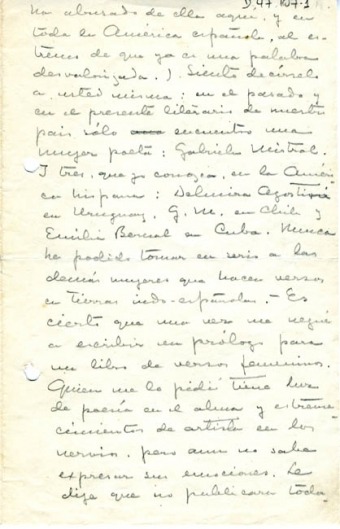
That same year, Magallanes Moure was a judge of the Juego Florales literary prize awarded to Gabriela Mistral for her Sonnets of Death, a work of Catholic imagery shot through by theosophy that introduces her idea of the resurrection of the flesh. In it, pain, languor and silence, seemingly unromantic ideas, come to bear a heavy sensual weight. Mistral famously declined to receive the prize in person because she didn’t want to stand before a crowd with a wreath of flowers on her head. That same year, the two struck up a complicated friendship that would last for decades, but centered around a period of nine years (1914-1923). Their intense, emotional letters cover a wide variety of topics from metaphysics to gossip about contemporaries’ literary production, but is most of all about longing—phrased in very earthly expressions of bodily desire. Mistral writes of yearning for Magallanes Moure’s lips, dreaming of mystical union, taking the drug ether to feel herself in a gentle dream state, and wanting to “drink down all your lymph.”
The two kindled their special relationship despite an eleven year age gap, the fact he had a wife and daughter, and differing class backgrounds. She was a rural schoolteacher and still unrecognized poet—it would have shocked those around her to be told she’d win the Nobel Prize in Literature in 1945; she took on grueling and underpaid work in the south of Chile, in the cities of Los Andes, Punta Arenas, and Temuco, with a painful experience of death behind her. (A former lover, the railworker Romelio Ureta, had committed suicide.) Although passionate, she was unsure of herself, and still wrote as Lucila Godoy, not Gabriela Mistral. Meanwhile, Magallanes Moure was a gentleman of letters who moved between Santiago, San Bernardo, and El Melocotón, surrounded by his artistic group and established in the capital city’s bourgeois literary world. Yet the fact he wrote Qué es amor, a book so full of subtle longing and frustration, the year he began his correspondence with Mistral speaks to his unstable emotional state.
The two writers had to take care to be discreet, since Mistral’s correspondence was looked on with suspicion at her local post office, where she’d requested the letters be sent, rather than to her home or school. For his part, Magallanes Moure had to conceal the correspondence from his family. Chile, then as now, was a very small world. Yet the two regularly managed to send each other books and long expressions of devotion.
For a variety of reasons, this exchange of words was never made a concrete love. Over and over, despite his repeated invitations, Mistral opted not to make the decisive trip from the south of Chile to Santiago to meet with Magallanes Moure, and transfigure their passion of the mind into a physical one. Perhaps she found more meaning in communication by writing than in any union of the flesh; in the letters, she also describes her ups and downs from exaltación (which at different moments is linked to the carnal and the spiritual) and depresión. In the end, she concludes, her aim is serenidad. Magallanes Moure, on the other hand, despite his lofty verses, was more down to earth in this respect, and one can feel his frustration at her repeated evasions of his hinting. At one point, he at last directly invites her to enjoy the straightforward pleasures of the body, but Mistral is horrified, saying she would only have him if they were surrounded by trees, in nature:
No, darling Manuel, not in a hotel. Those are sites prostituted by depraved men and easy women. I don’t want to kiss you, or take you into my arms, in a place like that. I want you under the open sky, amidst trees. The fertile earth, with its special perfume that gives vigor to things, the veins, the soul, the sun, the trees, is in all ways potent and healthy, and will help your voice to awaken love in me just the way you desire it, the kind of life that today remains sleeping. Under a roof, no; in the vile atmosphere of a hotel, I wouldn’t want you.
But then she goes on:
Listen: I’m lying down against a trunk. I’ve always liked to kiss trunks on their wounds full of pale rubber. This trunk has a dense, black tangle wrapped around its base, which belongs to who knows what vine. I’ve just kissed the trunk on its rubber-packed wound; but it’s not the tree I kiss, as at other moments, it’s you, my darling, you. This is your mouth. It’s warm because a ray of sun has fallen onto it. This whole dead vine imitates a black beard that grazes me in a caress. Here you are, you, the one that I’ve kissed.
Beardly grazes notwithstanding, the relationship between these two poets went far beyond the body. Two minds found in each other a depth of thought and conversation they did not find in others around them. Even so, time took its toll. He grew frustrated by her repeated deflections and ethical qualms, which she justified as spirituality, while she came to find his way of treating her insensitive and superficial. (“Don’t lie. It really isn’t necessary (. . .) And don’t make me into literature.”)
The rupture came when he made his frustrations explicit and took up with another writer in Santiago, Sara Hübner, who wrote under the pseudonym Magda Sudermann. Mistral was incredibly hurt, but the two didn’t entirely break contact despite this. Years later, she would recall the entire drama as an attempt to instruct Magallanes Moure toward a more spiritual way of being—at the time, however, it’s certain that neither of them experienced their angst as didacticism. The nuanced letters between them are worth reading in their entirety, in the collection edited by Chile’s Universidad Católica. Her romantic relationship with Doris Dana has come to light in recent decades (with the correspondence between those two recently translated into English by Velma García-Gorena) but Mistral was more complex than even that. As was Magallanes Moure. While the translation (or transmutation) of life to art is never straightforward, in this case I think the letters between the writers shed light on the stories here, in which allegiances are divided and motives are double- or triple-edged, but a sensitivity to the emotional contours of the smallest objects or gestures can be found at even the moments of greatest disquiet.


(See more at SURDOC)
“What is Love?”, the first story, which shares a near title with the collection, is notable for its unusual setting of a printing press, where machinery clatters and a stressful deadline must be met to publish a saltpeter report ordered by the Ministry of Finance. Saltpeter is of major importance in Chile, used in a number of industrial processes, and from 1879-1884 the country went to war with Peru and Bolivia to take over their saltpeter deposits. Against this backdrop with its eye on the bottom line, Antonio falls for his colleague Paulina, portrayed as androgynous in her manner and dress, fraternizing with men and laboring alongside them; this depiction of a working woman also stands out. Here the relationship between the mechanical and the sensual is key, not just in the description of the printing press itself, but also in the way that Antonio unfolds his soul and reads it as if it were a broadsheet of his emotions. Newspaper, soul, sex—the three are metaphorically bound. The motivations behind the attraction are just as mingled. It’s unclear whether Antonio falls for Paulina due to her own “self” (however that might be interpreted), or due to her act of reading mystics in the tradition of Catholic literature. The two work at the same desk as copyeditors, sitting across from each other, and a constant annoyance exists between them, obvious tension. This is intensified by language, through her act of reading the assignments out loud, verses of a religious work. In her mouth the words become erotic, speaking to not just the subliminal charge of a great deal of mystic poetry, but also to how language, the gestures of the body, the words used, and the tone of voice can produce attraction. The superficial dichotomy of the printing press’s hard mechanical work and the “mystery, mystery, mystery” of love holds only to a point, with the reading of literature serving as a meeting place between the two, operating its effects.
“New Year”, the second story and the longest of the collection, explores deception, hope and humiliation. The borderline between one year and the next is an existential moment of change, decision, resolve, and in this case, alteration of one’s understanding of an emotional situation. Magallanes Moure plays with light and shadow, with an extended use of chiaroscuro. Light transforms at the limit of shadow; one recalls his affiliation with the “Los Diez” group of poets and artists, as well as his training as a painter. The tale begins with Daniel leaving what is perhaps Santiago’s most symbolic building, La Moneda; here is another man with a government job. “Ardent” light hits a row of closed windows, a glimpse at how desire might be blocked. But the shadowy vestibule Daniel enters suggests hopeful possibility, an opportunity for promising silence and unwitnessed contact, not threat. We mostly follow events from Daniel’s free indirect perspective, which occasionally slips into omniscient commentary. (“How interested they were in keeping up appearances! As if their expectations of happiness rested on such hypocrisy.”) In the actions of the various characters, the story subtly explores the threshold between deceit and truth, appearance and reality, promise and lie, adventure and boredom. Ultimately, the categories of “deception” in the outside world, and security and society at home, are destabilized, with the golden light flickering between chiaroscuro’s ambiguity and absolute darkness. The last line, “a new life,” remains tantalizingly enigmatic, as does Marta’s refrain—“Will you always want to believe in it?”
“Summer Sun,” the third story, introduces another working environment: this time, a sewing room. Magallanes Moure evokes thick heat, sun, shadow, silence. What isn’t said is as important as what is, and slow gestures—the bunching of a skirt, the revelation of a leg, a yawn—take on a complicity in wordlessness. Love itself is slow here, carried out as an interminable series of social visits to a traditional middle-class Santiago home. Sewing work is done not so much to make a product—as with the newspapers—but to pass the time, and this torpor is sensual. Notably, just as in other stories, the loved woman, María, is a mother, and Samuel briefly ponders the “consequences of maternity.” This brief qualm only seems to apply to her body, however, which he concludes is still as youthful as a single woman’s, and there is little thought of the consequences of stealing a moment with another’s wife. Once again, Magallanes Moure proposes a startling vision of love in which desire triumphs over social mores and expectations. The ending might be happy, or not; the story cuts off after the instant of achieved bliss.
“The Defense,” the fourth story, takes the form of a confession—to whom, it is not quite clear. Priest? Friend? Reader? Judge? Heavenly gatekeeper? (Somewhat cryptically, the narrator says omnia transit is his interlocutor’s motto.) The story begins with a legal defense of infidelity with a neighbor’s wife, and is phrased in terms of what is “just.” Innocuous speculation about a new family on the block drifts into the stirrings of a relationship. The narrator never says he’s in love with the woman, but always defends himself by saying he just wanted to make her happy. Society is important here, as the narrator’s wife insists to him: “Life in society is necessary. Isolation leads to illness in men like you, who work all day long. One has to go out, distract oneself, talk with people who aren’t the same as those we see every day, exchange ideas . . .” But society also lays down specific regulations for friendship between a man and a woman. As in the other stories, work enters the picture—the narrator mentions “construction projects” for the Ministry of Public Works, portrayed as a relatively noble career, whereas the nouveau riche husband who makes his money on the stock market is made out to be devoid of spiritual substance. Again, as in previous stories, this is not love at first sight but a gradual love that builds over time, in an organic way, evoking nature. The narrator likens love to life itself, not “villainy,” and questions the very terms of the prosecution keen to find him guilty. The story’s fragmentary form, with its spaces, breaks, justifications and elisions, offers the perspective of the narrator alone, who is of course unreliable. (But what does it mean to be reliable?) Not only is he trying to convince the other, he is trying to convince himself. The suggestion of false consciousness, the confusion of reality and dream, and the claim of sacrifice for another’s happiness confronted against the reality of mutual fulfillment, mark this story as “modern” and bring it into dialogue with literary developments in the first decades of the 20th century in Chile and beyond.
To sum up rather brutally, Magallanes Moure’s stories include, in no particular order: deception, manual activities (printing, knitting, sewing, et cetera), hiddenness, theft, seductive words versus seductive physical attributes, Biblical quotes (e.g. from Solomon), artists’ quotes (e.g. from Ruskin), languidness / lacklusterness / longing, wilting / weather / weariness, qué diran (what’ll they say) and concern for others’ opinions, society as stifling convention, art as salvation or the excuse to gawk at peers (e.g. at operettas), love as slow and gradual development, and contrasts between banal conversations meant to pass the time and inner monologues occasionally translated into action or literature.
“Modern.” I used that word, but what does it mean? I can’t say I know, but I can point to what I believe to be the most remarkable description in the book, where Magallanes Moure describes a passing tram. In the course of its movement, not only do light and shade alternate, but the fragmented stretches of conversation become the equivalent of slats of bright and dark—a verbal chiaroscuro. Daniel and Marta speak one way in the dark and another in the light when they’re being spied on by her mother. Another moment of chiaroscuro: the shadows of the two move across the light-filled wall like a magic lantern, a vision of what could be. An illusion, maybe, but also a foregrounding for what could be possible, obscured in the present but perhaps one day permitted by the world that is signaled by the tram, with whatever new social innovations it brings.
The tense changes midway through the story, from the past (already over) to the infinitive (still possible). Marta suggests a complicated plan to meet at New Year’s with her husband there. She’ll turn around, and the two lovers will meet face to face. This dangerous ideal of a face-to-face encounter, for Magallanes Moure, suggests a true meeting with the other (just as it later will do for Emmanuel Levinas and so many other thinkers). From here we cut to Daniel’s family scenes with wife and children. She plays songs on the piano, a limpid and floating light valse free of dissonances. Simple and fresh Adela’s soul is translated into the music of Moszkowski, Grieg, Schumann. Meanwhile, Daniel enjoys the further double life and double consciousness this permits him, as he recalls lines from Flaubert, the famous ballroom scene where Emma Bovary dances with the Viscount. (Literature comes to parallel infidelity here in that both mark a betrayal of the world here and now, on behalf of a world of dream and fantasy.) The translations of Flaubert’s lines, in Eleanor Marx’s version, read: “They began slowly, then went more rapidly” and “On passing near the doors the bottom of Emma’s dress caught against his trousers. Their legs commingled; he looked down at her; she raised her eyes to his.” Interestingly, in Magallanes Moure’s story, the sentence connecting these two phrases is left out: “They turned; all around them was turning—the lamps, the furniture, the wainscoting, the floor, like a disc on a pivot.” But this disorientation returns later in the tale with a vengeance, as hidden cargo.
Magallanes Moure channels European sources of music and literature, but the effect is enigmatic. Although Emma dances with the elegant viscount, she does not end up with him. But who is the Madame Bovary? Is it Marta or Adela? Or does this musical evocation instead parallel Tolstoy’s Kreutzer Sonata? (Recall Magallanes Moure’s friends and their disastrous attempt to make a Tolstoyan colony.) Once again, the subtleties of the plot are paralleled by the subtleties of the artworks and the subtleties of the emotions. An uneasy, if tender, ambiguity reigns.
Without presenting any utopian alternative, in these stories Magallanes Moure presents the arbitrariness of convention, and explores the phenomenology of non-heterosexual married love and its effects on the body. A sociologist might abstractly sum up his interest as the complication of transgressive love a century ago in Chile, but here the stories offer the experience itself.
The comfortable becomes strange, the light slowly dims, and the rocky path fills with unfamiliar silhouettes, outlines of trees, jags of branches . . . Magallanes Moure’s stories invite the kind of speculative thinking about alternatives and mutual acceptance that the path is strange but can still be walked together that is found so often in contemporary love. More mature and less saccharine than his romantic poems, these impressionistic tales are written with a light touch but density of theme, and remain provocative. Open to interpretative ambiguity, and to many varieties of translation from their time to this one—new kinds of words, new forms of life—they offer sketches of human complexity, not answers.
Further Reading
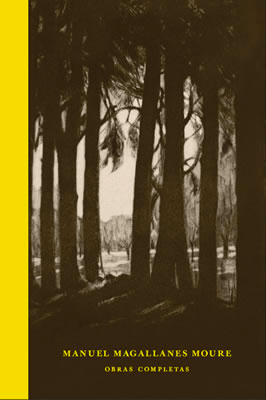
— Magallanes Moure, Manuel. Obras completas. Origo Ediciones, 2012.
— ed. Martínez Sanz, María Ester y Vargas Saavedra, Luis. Manuel, en los labios por mucho tiempo. Epistolario entre Gabriela Mistral Lucila Godoy Alcayaga y Manuel Magallanes Moure. Ediciones Universidad Católica de Chile, 2005.
— ed. Méndez, Verónica and Montero, Gonzalo. Revista Los Diez (1916 – 1917). Editorial Cuarto Propio, 2012.
— Mistral, Gabriela. Gabriela Mistral’s Letters to Doris Dana. University of New Mexico Press, 2018.
— Molina Núñez, Julio y Araya, Juan Agustín. Selva lírica: estudios sobre los poetas chilenos. Soc. Imp. y Lit. Universo, 1917.
— Prado, Pedro. Cartas a Manuel Magallanes Moure. Editorial Universitaria, 1986.

Jessica Sequeira has published the novel A Furious Oyster, the story collection Rhombus and Oval, the essay collection Other Paradises: Poetic Approaches to Thinking in a Technological Age and the hybrid work A Luminous History of the Palm. She has translated many books by Latin American authors, and in 2019 was awarded the Premio Valle-Inclán for her version of Sara Gallardo’s Land of Smoke. Currently she is a doctoral candidate at the Centre of Latin American Studies at the University of Cambridge.
Originally published on Hopscotch Translation
Tuesday, April 19, 2022

 hopscotchtranslation.com