
What Process Insights Can Be Gleaned From Translation Manuscripts?
by Mara Faye Lethem

Despite the prevailing idea that translations age faster and more poorly than originals—part of the “fetishization of the perfect translation” as Tess Lewis aptly described it—I believe retranslation and respect for translation history need not be antagonistic.
As 21st-century translators, I think we can all agree on the advantages of the computer age in terms of ease of research and delivery. However, what are the trade-offs of our embrace of technology? At times I’ve felt guilty of tossing out the baby with the bath water, when overwriting drafts in such a way that I’d effectively erased my process. In my current doctoral research, I am immensely grateful for the chance to “get to know” a deceased author through the course of reading fifty years of his correspondence, and as a result I’ve begun to be slightly more intentional about saving drafts, at least digitally. When I realized that the archive of the legendary translator David Rosenthal is held at the Biblioteca d’Humanitats at the Universitat Autònoma de Barcelona, I became intrigued with the possibility of gaining insight into his decision-making process, of shedding light on how Rosenthal resolved what David Bellos has termed, “the unfathomable puzzle of how we make ourselves understood to others and to ourselves.”
I decided to have a look at the holdings of Rosenthal’s translation of Víctor Català’s Solitud, published by Readers International Editions in 1992. My objective was to see what could potentially be of use in these archives to literary historians (as part of the ongoing story of how Catalan literature travels into English), and to translators, and to teachers of translation.
I deem David Rosenthal “legendary” because he was a true pioneer. Despite his premature death at age 46, he indelibly changed the world of English language translations from Catalan through a combination of good taste and publishing savvy. A poet, and a journalist, Rosenthal was a New Yorker who moved to Barcelona in the seventies, taught himself Spanish and Catalan, and fell in love with Catalan literature. He translated Incerta glòria (Uncertain Glory) by Joan Sales, La plaça del diamant (The Time of the Doves), El carrer de les Camèlies (Camellia Street) and La meva Cristina i altres contes (My Cristina and Other Stories) by Mercè Rodoreda, Les histories naturals (Natural History) by Joan Perucho, as well as poetry by Salvador Espriu, Joan Maragall, Maria-Mercè Marçal, and J. V. Foix. Some of his translations are long out of print, and two of these books have been retranslated by Peter Bush. However, in the case of Solitude, his translation published in 1992—the year he died—has remained in print over these three decades. It is the only English-language version ever to appear of this 1905 novel that is indisputably a quintessential part of the Catalan canon.
In the New York Times review of Solitude, David Leavitt laments that “Unfortunately, very little Catalan literature is available in English. This is a shame, since it’s a rich brew, as various as the region itself, where mountains tower over half-moon-shaped beaches and snow falls 20 minutes’ drive from the seaside. What we do have we owe chiefly to the efforts of the esteemed translator David H. Rosenthal.”[1] Despite the prevailing idea that translations age faster and more poorly than originals—part of the “fetishization of the perfect translation” as Tess Lewis aptly described it—I believe retranslation and respect for translation history need not be antagonistic. Translation into Catalan has a long appreciative past—“How can a palace be sumptuous, without guests!” said Josep Carner—which more recently has embraced the idea that no culture can make a classic their own if they only have one translation of it.
Rosenthal’s most successful translation was of the 15th-century Valencian chivalric novel Tirant Lo Blanc (by Joanot Martorell and Martí Joan de Galba). His version, “the first modern version of Tirant lo Blanc to appear in any non-Hispanic language,”[2] became a bestseller in both the US and the UK. Its reception in Catalunya was less enthusiastic, as evidenced by Jan Reinhart’s description of the work as a “controversially fluid and concise rendering of the Valencian classic” and “some 15 percent shorter than the original.”[3]
In Rosenthal’s translator’s foreword to Tirant lo Blanc he speaks some about his process. The preliminary version even offers a glimpse into his struggles:
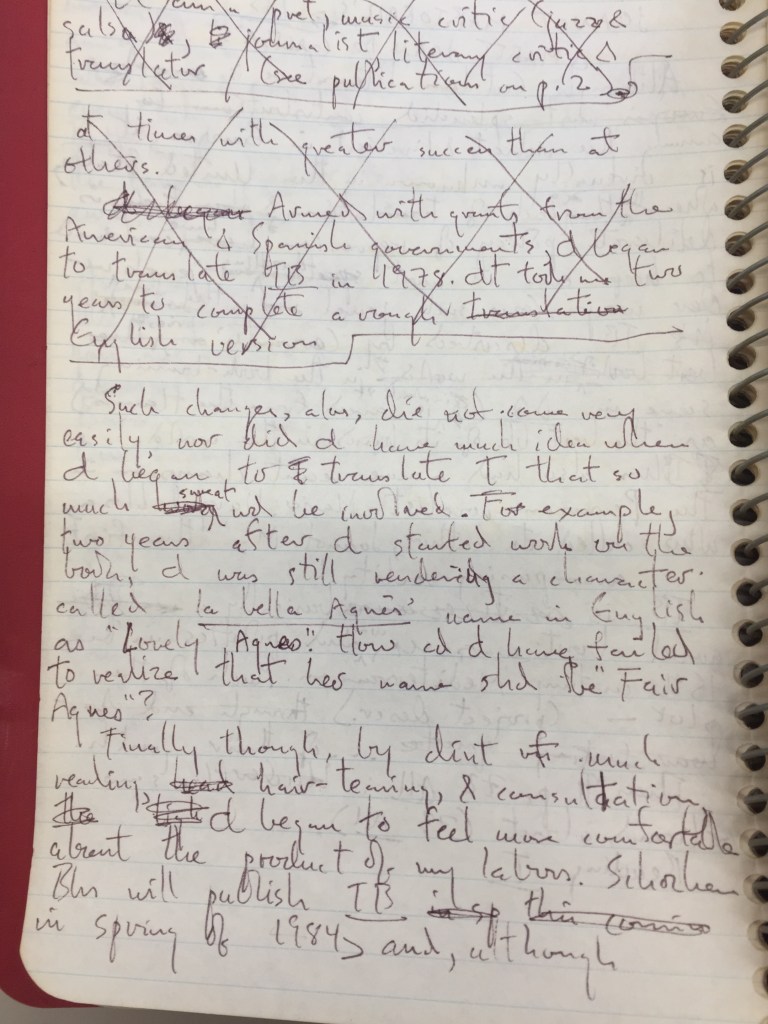
“Finally though, by dint of much reading, hair-tearing, & consultation, I’d begun to feel more comfortable about the product of my labors,” says Rosenthal himself in a draft of that foreword found in his archived notebook.[4] This confession does not appear to have made it into the published foreword.
Rosenthal does go on record stating that it is “logical to assume that Martorell never had a chance to revise what he had written. Tirant does often feel like a first draft written by someone groping his way toward a new style.” Rosenthal goes on to thus describe his translation philosophy: “I have eliminated as many redundancies as possible, both to make the book more readable and in the belief that Martorell might have done the same, had he lived to complete the project.”[5] I shall leave it up to each reader to decide if that strategy is forgivable, or indeed in need of forgiving. My intent here is not to criticize David Rosenthal’s translations, but rather to argue for the usefulness of translators’ archives in furthering the study of our field.
Rosenthal’s Preface to his translation of Solitude offers no similar insights, eschewing talk of his working procedure altogether to instead focus on the biography of Caterina Albert i Paradís (1869-1966) who published under what Rosenthal describes as “the patriotic masculine pen name” of Víctor Català, a discussion of the novel’s plot and importance, and a vindication of Catalan literature. However we see much of this same strategy of readability in the translation of Solitude as well, including for example a complete erasure of the novel’s linguistic variation.[6]
Ostensibly, the Publishers Weekly review of Rosenthal’s Solitude stated: “The seamless translation faithfully illuminates the lucid, brilliant prose of this Catalan author.”[7] What does it mean for a translation to be seamless? Obviously book reviewers have space limitations and it is still not unusual for a translator’s work to be mentioned—if at all—with a single adjective. I was interested in the fact that this adjective was “seamless.” It doesn’t even seem possible to bring a book like Solitude seamlessly into English, given its use of vernacular, as well as its very specific catalanitat [Catalan-ness].
My initial findings in the Fons David Rosenthal left me convinced as to the value of translators’ archives to researchers and professors. Rosenthal’s archives are not available for search online, not terribly extensive, and don’t seem to have many visitors. I chose to look at Solitude as an entry point into the Rosenthal archives, and began by reading through Solitud in the original and marking passages and flagging things that caught my translator’s curiosity (i.e. those moments where I thought: how did he translate that?).
Finally, given the limited scope of this paper (originally presented at the LXVI Anglo-Catalan Society’s annual conference on 5 November 2021, hosted virtually by the University of St Andrews), I decided to focus on the final chapter, chapter eighteen, La davallada, rendered by Rosenthal as The Descent.
There is a handwritten manuscript, and two typescript versions. The manuscript is written in black ink with corrections in red by Rosenthal himself, in two spiral notebooks. The first typescript has suggestions in pencil by someone else, none of which Rosenthal seems to have accepted, and corrections in red ink by Rosenthal. The second typescript is clean and very close to the final published version, with only minor changes.
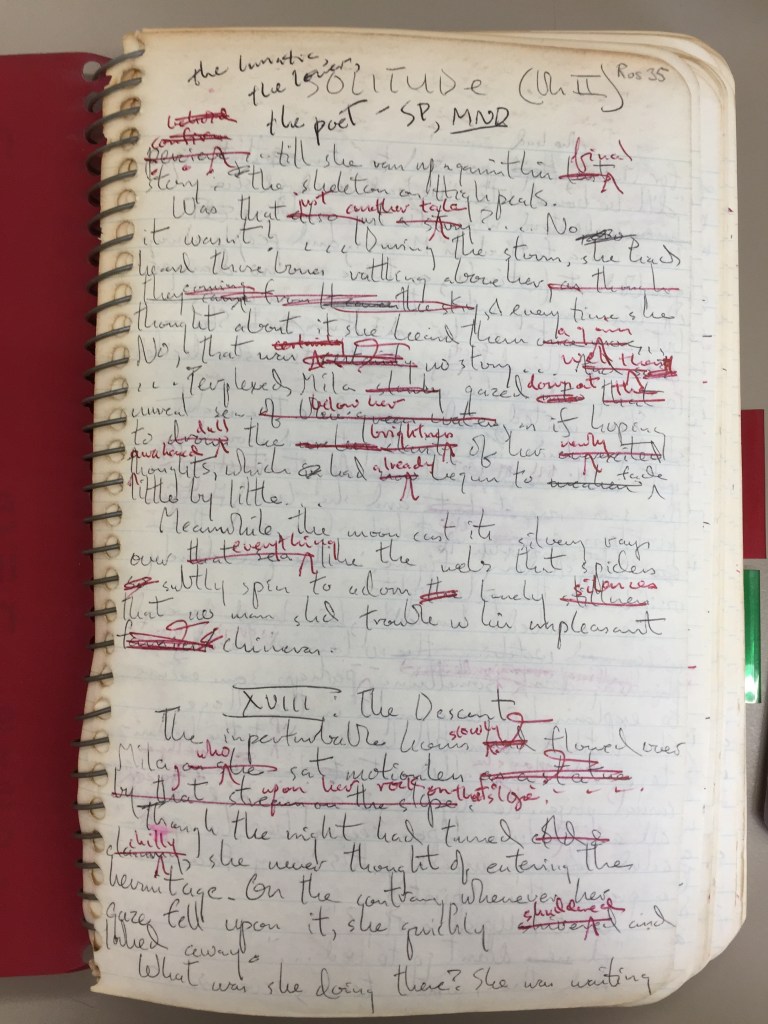
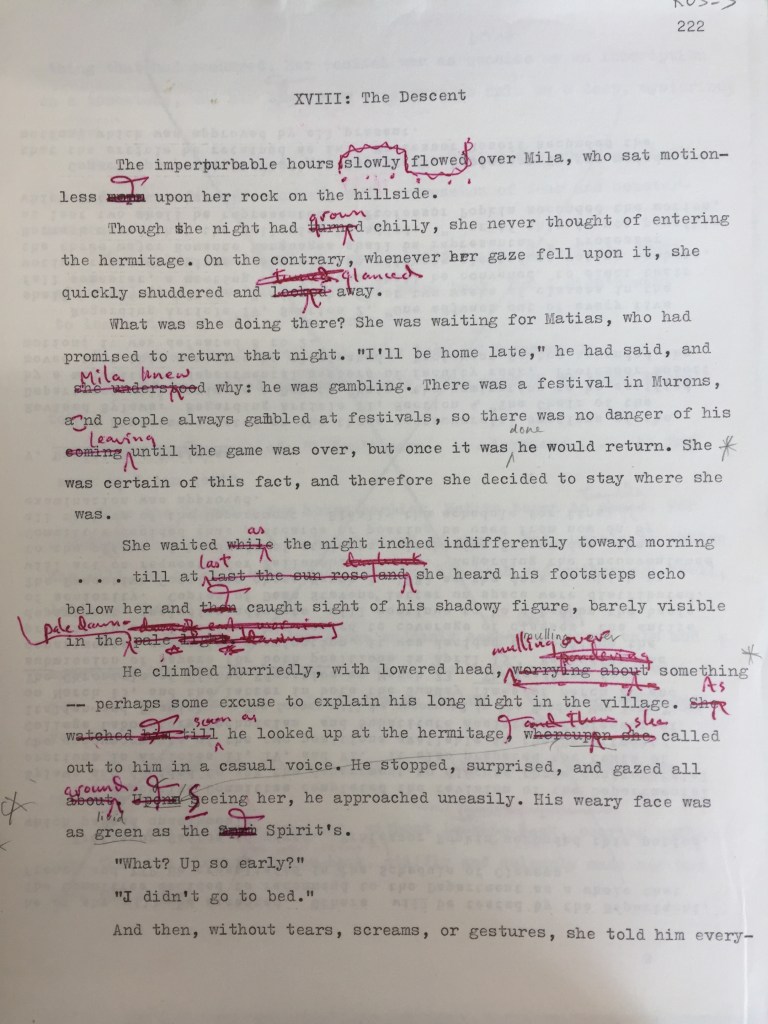
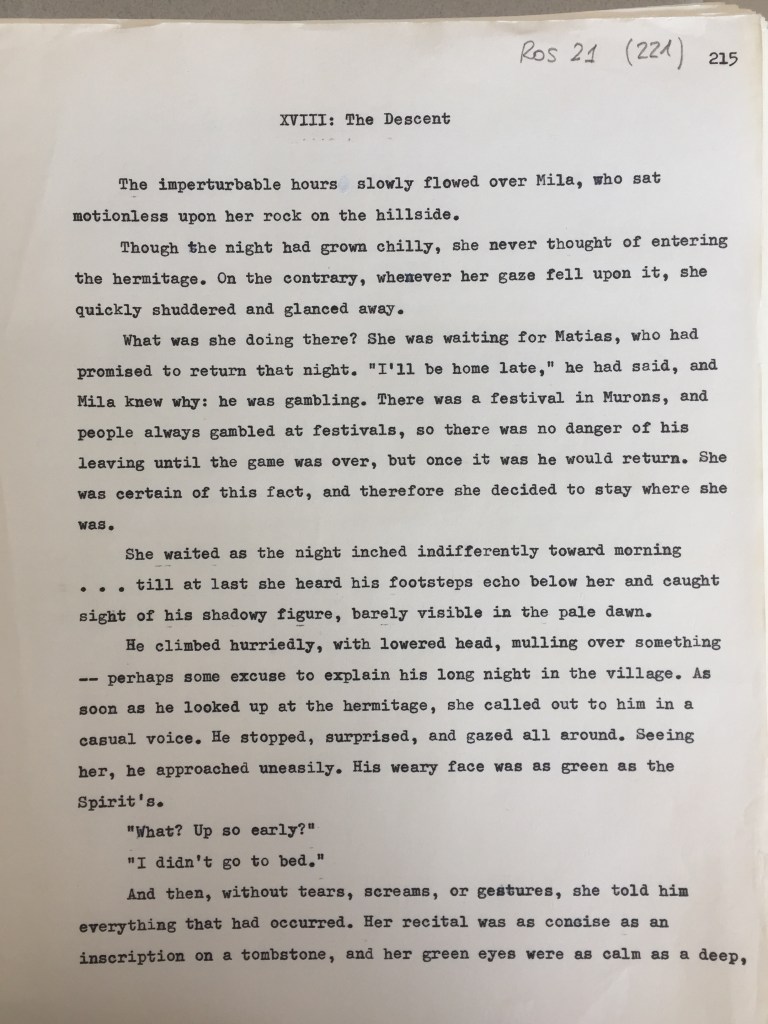
A noteworthy example of the passages I flagged as challenging to translate, due to its cultural specificity, is an extended scene of a meal of snails, which includes a character remarking “perquè sense alioli o pebre els cargols valen pas una escopinyada de penjat!”[8] [“because without alioli and pepper, snails aren’t worth a hanged man’s gob of spit!”]. In the first typescript we see Rosenthal’s “because snails without aioli and pepper aren’t worth a hanged man’s spit” become “aren’t worth a bean.”

Similarly, in the final chapter we see the sentence “Aleshores ell, com l’Ànima hores enrera, trontollà de cap a peus, mateix que sorprès per l’embat d’una tempesta inesperada.” evolve thusly:
He trembled like the Spirit had a few hours before, earlier, Matias began to tremble as though surprised by the force of an unexpected storm/gale.
Then we also find edits that are poignantly human: “rumiant-ne alguna” travels through many iterations—thinking about, fretting over, pondering, worrying about—before finally settling on “mulling over.”
Most heart-rending of all is how Rosenthal sweated over one adverb in the novel’s final line (which he has turned into an adjective), going back and forth between bitter, harsh, and cruel.
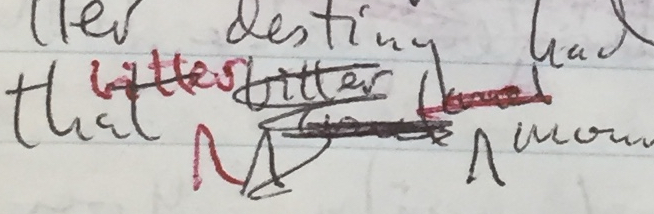
It seems to me rather evident that the earliest handwritten manuscript is not the first draft, judging by how relatively clean it is. It no longer contains any possibilities divided by slashes, or asterisks, or definitions, or anything still left in the original Catalan. It appears anything prior to this notebook draft has been lost to history.
These three drafts reveal David Rosenthal, perhaps predictably, to be highly concerned with how the English reads, and he creates an English version that bears his authorial stamp. There are moments where these edits tell a fascinating narrative of his choices.
Another salient feature of these drafts is that simplifications never bend back toward more complex solutions, which would in many cases be closer to the original. There are moments where we see choices become more simplified, but never the reverse. (The only exception to this is that the Anglicization of Ànima’s name as The Spirit is reverted back, merely without the accent. If only the correspondence with the editor was also saved!) This is something worth pondering—or thinking about, or mulling over—for its implications: would the final product be better served by an approach that was more “foreignizing” in the Venuti vein, or literal, or “thick” in the Appiah definition, or just more time sitting with the messiness of a plain old awkward early draft?
Even this rather cursory look into the Rosenthal archives reveals them to contain a wealth of insights. Indeed, I was left wishing I had more versions to compare, and I was struck by the importance of such materials for scholarship into a translator’s process. Accordingly, I will conclude with an appeal to translators: encouraging them to keep more drafts, and to university libraries: exhorting them seek out and acquire existing archives.
Beyond their enormous value to scholars, these archives could also serve as an excellent teaching tool to help translators develop and articulate their “ethics”: how they feel certain questions should be resolved (i.e. proper nouns, cultural aspects) and consider their methods, enumerating what is often intuitive. After looking at examples, students could be asked to create a series of drafts that tell the story of their decision-making, thus posing to students the fruitful question these materials inspired in me, for my own practice: Is there a way to emulate this process that allows us to slow our pace to a slightly more twentieth-century one?
NOTES:
[1] Leavitt, David. “Seduction in Catalonia,” New York Times, January 10, 1993, Section 7, Page 9
https://www.nytimes.com/1993/01/10/books/seduction-in-catalonia.html
[2] p. viii of the Translator’s Foreword.
[3] Reinhart, Jan. “David Rosenthal’s Tirant lo Blanc turns 30.” SCRIPTA, Revista internacional de literatura i cultura medieval i moderna, núm. 4 / desembre 2014 / pp. 147 – 154; ISSN: 2340-4841· doi:10.7203/SCRIPTA.4.4491
[4] This and all images reproduced here with permission from the Fons David H. Rosenthal (Universitat Autònoma de Barcelona).
[5] p. xxiii, Translator’s Foreword. Italics for emphasis, mine.
[6] For a look at how this was handled in the Spanish and German translations, see the 2018 doctoral thesis by Eva Garcia-Pinos, https://www.tdx.cat/bitstream/handle/10803/665471/tegp.pdf?sequence=1&isAllowed=y&fbclid=IwAR0jd5uFSBak6z5RKR9mlGhIscIqAhLZfVaq9GekBeFO6djLNjZ871YsnzY
[7] This oft-quoted blurb continues to be used to promote this and subsequent translations of Català’s work, although the usually reliable PW online archives reveal no trace of it. File under: a mystery for another day.
[8] p. 71. All quotes from the original novel come from the pocket edition published by Edicions 62 and “la Caixa,” Barcelona, 1979.

Mara Faye Lethem has translated books by Patricio Pron, Toni Sala, Marta Orriols, Alicia Kopf, Jordi Nopca, Javier Calvo, Iván Repila, Jaume Cabré, Albert Sánchez Piñol, Max Besora, and Irene Solà, among others. Her translations of some of Joan Perucho’s apocryphal stories recently appeared in A Public Space, and she translated “Wanjala” by Estanislao Medina Huesca for Granta’s most recent Best Young Spanish-Language Novelists issue.
Originally published on Hopscotch Translation
Tuesday, April 26, 2022

 hopscotchtranslation.com