
Translating Tawada and the Misplaced Mosquito
by Margaret Mitsutani

Although the shorter sentences should have been much easier to translate, I remember sitting in front of the computer like someone with a bad stutter, unable to get started.
To me, translation has always been something I do rather than write about, but since I’ve been translating the work of Tawada Yoko for over twenty years now, this seems like a good time to take a look back over the translations I’ve done, leading up the most recent one, Scattered All Over the Earth.
The first story of Tawada’s I translated was “The Bridegroom Was a Dog” (Inumukoiri, 1993). I read it when Tawada was awarded the Akutagawa Prize, and loved the way she used very long sentences to pull the reader into a world that, despite being grounded in reality (namely, the apartment complex where she grew up and its environs) contains elements of fantasy, such as a mysterious stranger who appears to be human but has decidedly dog-like characteristics. So when an editor at Kodansha International asked me if I’d be interested in translating it, I was more than happy to give it a try. Since the editor thought the story on its own might be a little too short for a book, he asked me to find two more to go with it, so I chose “Missing Heels” (Kakato o nakushite, 1991) and “The Gotthard Railway” (Gotthard testudo, 1996). The resulting book, entitled The Bridegroom Was a Dog (1998), unfortunately went out of print when Kodansha International was dissolved in 2011, but what I remember most vividly about this first foray into translating Tawada was the difficulty I had shifting gears between “Bridegroom” and “Missing Heels,” and the third story, “The Gotthard Railway.”
“Missing Heels,” published two years before “The Bridegroom Was a Dog,” is narrated by a mail-order bride from an unspecified Asian country who crosses an invisible border to begin her married life with a husband she never sees. As in “Bridegroom,” the sentences tend to be long. In the following example, after many nights of meeting a man she believes to be her husband in her dreams, the narrator decides to try acting like a real housewife, with dubious results:
I had been planning to go home and do some ‘cleaning’ like a good housewife that day, but the house was so big I didn’t know whether to start from inside or out, or whether to wash the windows and then scrub the floor or vice versa, and since there was no one to tell me I began in a vague sort of way with the kitchen, but the floor didn’t get any cleaner no matter how hard I scrubbed since it wasn’t really all that dirty in the first place, and while the hall wasn’t exactly sparkling no amount of mopping made it any shinier, which meant that all this drudgery was just making my shoulders ache, so I tried washing the tablecloth, which bored me stiff and left me wondering exactly what I was trying to achieve through all this housework, but then I began to think that maybe the only really dirty thing in the house was my own body, for, after all, I’d been seeing a man I didn’t know night after night, so I decided to take a bath.
Before I even started translating these first two stories, I knew it would be absolutely essential not to cut the long sentences. All through school, English composition teachers had been telling me my sentences were too long, which now made it seem that I’d been born to translate stories like this. I had a wonderful time spinning the sentences out, line after line. But when I got to the third story “The Gotthard Railway,” it almost seemed as if Tawada had taken a pair of scissors and cut those long sentences into pieces, as in the following description of the narrator’s image of Gotthard:
A beard like wires sprouting from the cheeks and chin. Lips the color of blood, quivering constantly but refusing to speak. Eyes like beads about to be smashed, full of fear and anger.
Although the shorter sentences should have been much easier to translate, I remember sitting in front of the computer like someone with a bad stutter, unable to get started. Although I eventually got over my stutter and translated the story, that sensation came back when I later read about an early Tawada story, written in German, in which a character starts stuttering while acting as an interpreter, only to discover that she has lost her tongue. This character is just one of the many unsuccessful interpreters and translators that inhabit Tawada’s early work. Another is the narrator of “Saint George and the Translator” (Arufabetto no kizuguchi, 1993, later retitled Moji ishoku; in Facing the Bridge, 2007), the next story I translated, who has traveled to the Canary Islands to translate a very short story about St. George, the dragon slayer.
A disciple of Walter Benjamin, this narrator sticks to “a literal rendering of the syntax,” breaking the text she is translating (actually a story by the German writer Anne Duden) into fragments. The princess rescued by St. George appears in a passage near the end of the translated text, the whole of which is imbedded in the narrative:
…inside, shut away, Virginal, princess, of life, from one stage, another, stage to, shrinks…
As in the legend, the story ends with the princess and the dragon going to the city, but the fragmentary style allows Tawada to inject an element of ambiguity, making it unclear who is leading whom:
…she, with both hands, both hands, to the same cord, are holding on, by that cord, she, or, the dragon, her, to the city, will take, will be taken, in the city, with one stroke, will lose its head, and, she, will be baptized…
I am sure I’m not the first translator to be drawn to Benjamin’s image of words as “fragments of a vessel” while at the same time wondering how his theory of translation could possibly be put into practice. Here Tawada actually does put it into practice, and in doing so, shows both its strengths and limitations. Although a long novel written in this style would probably not find many readers, breaking the sentences into fragments pulls them closer to poetry, with a rhythm that can best be appreciated when the text is read aloud. Although I didn’t consciously use it as a model, I think some of that staccato rhythm may have crept into my English version of Panska, a homemade language invented by Hiruko, one of the characters in Scattered All Over the Earth.
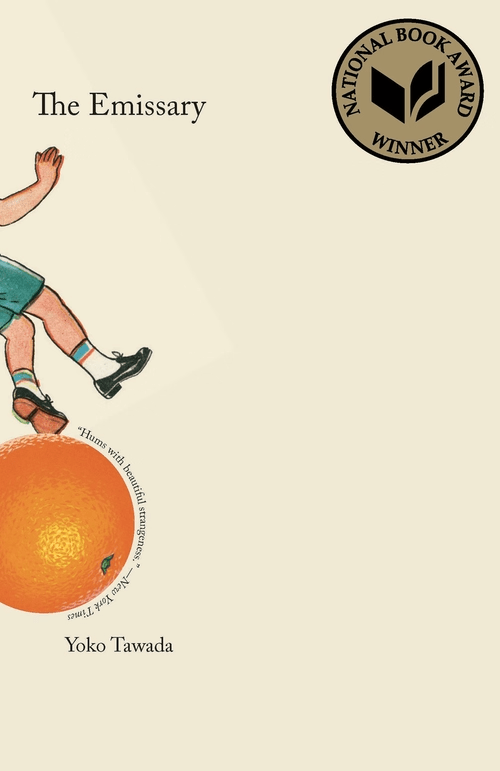
Another feature of Tawada’s writing that’s challenging for the translator is word play, which usually makes translating meaning impossible, particularly when Japanese homonyms, of which there are many, are used. In The Emissary (Kentoshi, 2014), for example, there’s a scene where Yoshiro, a novelist who is raising his great-grandson, is alarmed to see that the child’s baby teeth have all fallen out at once (in this novel the children are all weak and sickly due to the contamination of the earth, while healthy centenarians are condemned to outlive them, and watch them die). Two homonymous verbs, one meaning “fallen out” and the other “written” are used—on reaching the dentist’s office, after blurting out the first in reference to his great-grandson’s teeth, Yoshiro immediately starts worrying that, due to his wavering intonation, the dentist will think he’s talking about a piece of writing he has managed to finish. After puzzling over what to do with this for some time, I finally decided to have Yoshiro say “Fall out,” and then immediately hope it hadn’t sounded like “fallout,” which ominously evokes the nuclear contamination that damaged the children’s health—and their teeth— in the first place.


Translators have traditionally been judged on how faithful they manage to be to the original, but word play throws the whole question of fidelity out the window, forcing the translator to come up with creative solutions, to find a different way of playing with words, appropriate to the language she is working in.
Scattered All Over the Earth also has word play, but the main challenge here was capturing the voices of six different first-person narrators. Especially Hiruko, a young woman from “the land of sushi” who speaks both English (which she claims not to be very good at) and Panska, her previously mentioned homemade language, which can be understood by speakers of all the Scandinavian languages. Knut, a budding linguist who sees her on a TV program as one of a panel of people whose native countries have vanished, is so fascinated with this homemade language that he feels he simply has to meet her, and immediately calls the TV station. So, I knew the English version of Panska had to sound at least interesting enough to produce this sort of reaction in a young man whose erotic desires are directed toward language rather than sex. A Japanese friend who has translated Alice Walker and Chang Rea Lee suggested using lower case for Panska, to give it a foreign look. And because it’s safe to assume that Hiruko is Japanese, even though the country is never actually mentioned, I tried incorporating characteristics of the Japanese language, such as bringing the verb to the end of the sentence. Also, as the Japanese word used to express disagreement is literally “different,” I tried using that as well, as in the following conversation about cosplay:
“’cosplay’ from my mother tongue comes.”
“Cosplay is English, isn’t it?”
“different. english language people costume to cos not shorten. english parts in non-english way put together.”
As “cosplay” is a Japanese invention with English roots, Hiruko’s Danish colleague isn’t as far off the track as Knut is in believing that sushi is Finnish home cooking (he has apparently mixed “sushi” up with “sisu,” a Finnish concept akin to grit, or stoicism). The novel is full of such mistaken origins and identities, as in the case of Nanook, an Eskimo from Greenland who, after repeatedly being taken for a native of “the land of sushi,” fashions a second identity for himself as an authentic sushi chef and researcher of dashi, using the name Tenzo, a word that refers to the kitchen in a Zen temple. Having a special talent for learning foreign languages, he teaches himself Japanese, but while his German girlfriend Nora never doubts that he really is Tenzo, he is understandably nervous when she introduces him to Hiruko. Yet rather than being angry or disappointed, Hiruko is delighted with the hesitant way Nanook speaks her native language, allowing her to hear each word as if for the first time. She later tells Knut, “native speakers so ordinary, non-native speaker equals utopia.”
In creating voices for each of the narrators, I began by trying to imagine what they look like, and what their voices sound like. I reread their chapters until I felt I could hear them talking. Nanook is intelligent but unsophisticated—he first learns the word “identity,” along with “postcolonialism” from an American friend while studying in Denmark. Nora, on the other hand, was at the top of her high school class, and is passionate as well (the passion in her relationship with Nanook is mostly on her side). Knut is enthusiastic about anything having to do with language, and tends to have confidence in his own opinions, which are occasionally wrong. Susanoo, named after the violent, destructive younger brother of the goddess Amaterasu in Japanese mythology, has a rough, blunt way of speaking. And finally, Akash, a young Indian studying in Germany (his German is far more fluent than Knut’s), is in the process of transitioning into a woman. This, however, is not really reflected in the language he uses—he doesn’t talk like Nathan Lane’s character in The Bird Cage. He himself says that, like all Indians (this is his opinion, not mine) he loves to talk, so I tried giving him a rather chatty, somewhat British-sounding voice.
I was surprised to see that a number of reviewers use the pronoun “she” when referring to Akash, because I have never really thought of him as a woman. He uses hikkosu, a verb meaning “to move house” to refer to the transitioning process (the English word “move” unfortunately includes but is not limited to this meaning), and because he eschews hormone therapy and operations, it is proceeding very slowly. One reviewer referred to him as “non-binary,” which is better than defining him as a woman, although I would prefer to say that he’s in between genders.
If we can think of “in-between” as a new gender to which Akash belongs, perhaps Hiruko’s homemade language Panska can be said to be “in-between” in a linguistic sense. It spans three different Scandinavian languages, but is not exactly like any of them. And its inventor, Hiruko, is unmoored from her roots, a migrant who is always in between places. This “in-between” state might be one reason why she is so strongly attracted to Nanook’s self-taught Japanese. Interestingly, when she hears him speak for the first time, it occurs to her that Panska must sound to Scandinavians the way his Japanese sounds to her. To Hiruko, Panska is not merely a means of communication (a word Tawada doesn’t care for), but a way to escape from linguistic conventions—including the notion that native speakers are the most reliable users of their own languages—and make words new again.
At any rate, I will leave it up to readers of Scattered All Over the Earth to determine how successfully I have captured the voices of the six first-person narrators. For the time being, I am relieved to see that none of the reviews so far has complained that they all sound alike.
Having made a case for the important role the ear plays in translation I’d like to close with a confession, about how my ears led me astray when I translated the opening scene of “The Bridegroom Was a Dog,” which I referred to at the beginning of this essay. It’s a lazy afternoon in the apartment complex where the story takes place. In the background, “a distant drone that might have been either a dying [insect] or the hum of a machine in a school lunch factory” can be heard. Although the insect in question is clearly a cicada in the original text, and I do know the difference between the characters for cicada and mosquito, when I envisioned the scene, the sound I heard was the buzzing I often hear around my pillow on summer nights when I’ve forgotten to light the katori-senko (a sort of incense used to ward off mosquitoes). So in the original Kodansha International edition, the drone sounds like “a dying mosquito.” This has been corrected to “a dying cicada” in the Pearl Edition published by New Directions.
Translators beware: your ears are important, but not infallible.

Forthcoming from New Directions’
Storybook ND series:
Yoko Tawada’s Three Streets
Translated from the Japanese
by Margaret Mitsutani
August 16, 2022

Margaret Mitsutani was born in Pittsburgh, Pennsylvania in 1953 and has been living in Japan since the mid-1970s—first for several years in Nagoya, teaching at a women’s university, and now in Tokyo. Although she has always been interested in translation, she has never actually studied it. In addition to Tawada, she has translated the works of Hayashi Kyoko, known for her stories about hibakusha (A-bomb survivors), Oe Kenzaburo, and Kakuta Mitsuyo.
Originally published on Hopscotch Translation
Tuesday, May 31, 2022

 hopscotchtranslation.com