
Translators on Ann Leckie’s Translation State
by Alex Valente & Jeffrey Zuckerman
We’re all romantics when it comes to talking about translation with non-translators, aren’t we?
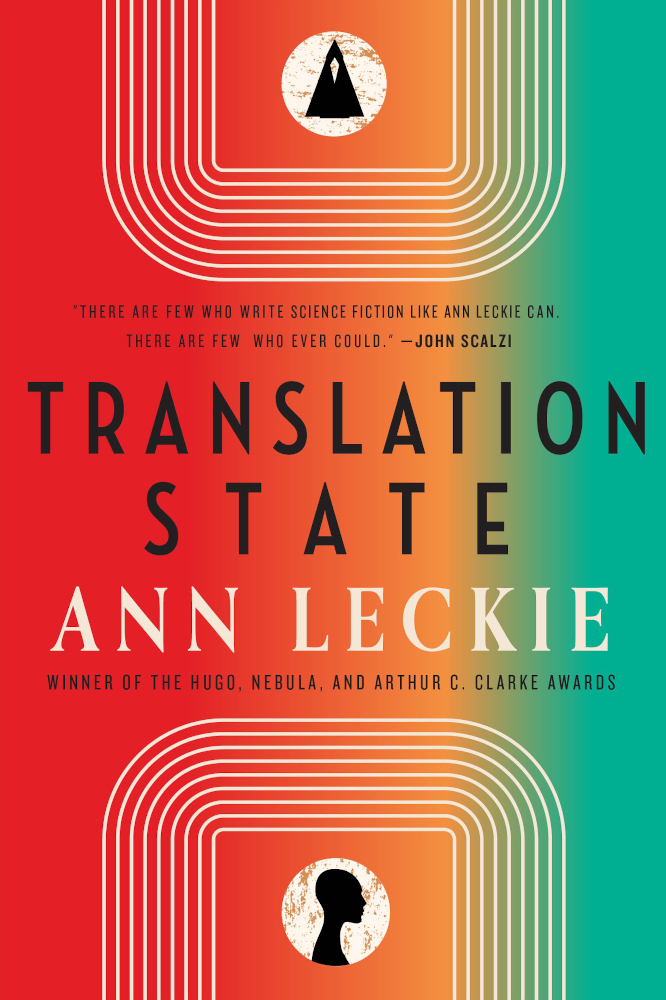
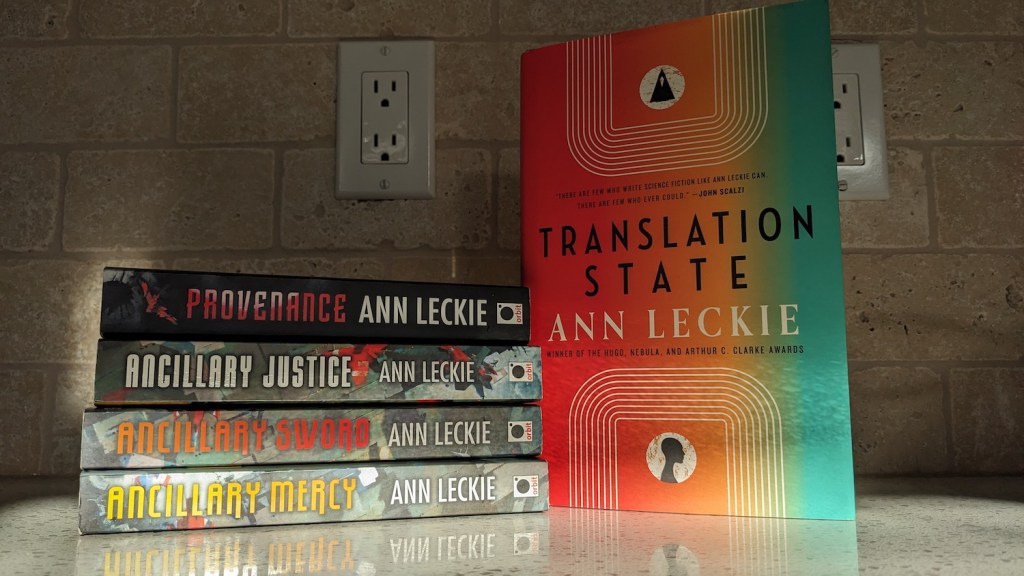
Does anyone who loves science fiction need to be told how incredible Ann Leckie is? After studying under Octavia Butler at the Clarion West Writers Workshop, she burst upon the scene in 2013 with her first novel, Ancillary Justice, which would go on to win the Hugo, the Nebula, the Arthur C. Clarke, the Locus, the BSFA, and the Golden Tentacle Awards. In the years that followed, she rounded out the trilogy of which Ancillary Justice was the first volume, racked up yet more accolades, and then put out two more novels set in the same universe, Provenance and, this June, Translation State.
The narrative universe borne of Leckie’s pen revolves, to most of its denizens’ chagrin, around the Imperial Radch: from the mysterious and dangerous Presger aliens, to the almost human (but rarely humane) Radch themselves, via the very-much-not-human Rrrrrr and the sentient AI that power the ships and stations throughout Imperial space. The latter are at the core of the Ancillary trilogy, and the enigmatic Presger are the motor behind Translation State, albeit indirectly (more on that later). Leckie is rightfully credited with updating and reviving the space opera, by dealing with issues of gender, language, sentience and speciesism, moving away from anthropocentric and ableist notions of what makes a sentient being.
As two translators on opposite coasts of North America with more than a few thoughts to trade about the ethics of translating, and the workings of various genres as well as how readers engage with those, the Italian translator Alex Valente and the French translator Jeffrey Zuckerman decided to give Translation State a read and talk about how authors can make the stuff of translation utterly gripping (and if they even get it right)…
AV: I’ll start off things, as the resident sci-fi-lingual in our system of two. Jeffrey, you translate and mainly read literary fiction. This was not your first foray into science fiction, but you did mention that it has been a while. How did it feel to dive into a definitely sci-fi story and style of writing?
JZ: So, I wouldn’t say this was so much a breath of fresh air as it was a blast of a new mix of gases that I had to hope I was able to breathe safely! I was well aware of Leckie, surprisingly not because of friends who were science fiction fans, but because I grew up in St. Louis, and friends from home kept mentioning this author from my hometown who’d been launched into the stratosphere almost immediately upon publication. So I was excited to have a fun reason to dive into her writing at last!
Reading Translation State felt, and maybe it’s a bit on-the-nose to say it, like reading a book in a language I’m pretty familiar with but not utterly fluent in. I could sense that particular things weren’t quite lining up with what I expected, and I had to consciously decide that I was going to pay closer attention than I otherwise might. Leckie is very comfortable using a wide variety of neopronouns, including some that are most widely visible in nonbinary and trans communities—sie, hir, e, eir, as well as the gamut of common English pronouns—so I had to tell myself to wait and see if they were being used in ways similar to what I’d expect in our relatively Earthling and especially trans contexts (this turned out to be a question well worth asking!).
Which is to say: I found myself reading the book like I was going to translate it. And I have a feeling that, even though I’m used to doing that (just, usually in other languages), it’s an effect Leckie intended to have, and this has probably primed a healthy portion of her readers to think about the intricacies and quirks of language the way you and I do almost every day.
Did you also find yourself reading as if it were a book you might translate, picking apart its thornier spots and more abstruse sentences as you went? Or were you able to just dive into it on its own terms?
AV: Every book I read I feel like I end up taking apart at least a sentence every few pages, be it in Italian, English, or (on rare occasions) French, looking at it closely, and mentally attempting a draft that I’m usually dissatisfied with. Maybe I am also a Presger Translator, like Qven. Given that Presger Translators, in this universe, have quite some notoriety for tearing living beings apart without many qualms, that is a horrifying thought, on some levels; delightfully so, on others. However, that’s more a mental tic than a mode of reading I had to deploy.
To backtrack a second here: it’s worth pointing out that sci-fi and fantasy writers who deal with ‘translation’ often are actually talking about ‘interpreting’—that is very much the case here. But also not. I think there is (yet another) metaphor or series of metaphors for translation at play in the text, and I’m curious to see if you thought so too.
JZ: I’ll say that, as I first read it, I was underwhelmed by the lack of actual translation or interpreting work happening. Not that I was surprised—the invisibility of the translator really does transcend all boundaries! But the fact is, this is really a novel about connecting across different cultures, and translation in and of itself isn’t how that divide is bridged. At least not on the most superficial level. There’s one scene (if you’ve got the book by you, just flip to pages 72-3 and onwards) where a character gets attacked for speaking the wrong language, but the resolution happens offstage, and I thought, hmm, okay, having interpreters available isn’t really the point in this story.
Part of the reason I was interested in reading and thinking about Translation State, even before I’d really delved into Leckie’s work, was because I knew that someone who didn’t work as a translator would have a very skewed perspective of the industry (can you call it an industry when it’s mostly freelancers? let’s just say “job”!)—and I wanted to see how someone as aware and alert as Leckie approached the subject.
But as I get some distance from the book, and think on it more, I’m actually quite surprised by how translation is leveraged by those who do not translate. It’s a theme that we’ve seen deployed in fiction before—this is something RF Kuang, to take one especially visible example, engages with heavily. Translation is usually framed, within the literary industry, as something done out of love and personal investment: heritage speakers (such as yourself, Alex [after a fashion! – AV]) have grown up working between two languages, while those who enter translation as a result of learning a second language later on (that’s me) have developed that interest and want to propagate that acquired love. But sometimes translators become so unwillingly; that’s the thrust of Kuang’s work, in which the cultivation of a cadre of native-born translators is a pernicious component of colonialism, and that’s the crux of the entire existence of Presger Translators in Leckie’s novel.
Translation State has chapters narrated by Reet—a figure who sees himself as human but very well may not be—and Qven—who is a Presger Translator and has been trained to act and perform eir humanity—and it isn’t long after they meet that they start being pressured to merge so they can serve as a translator between Presgers and humans. At which point I was reminded that this form of manipulation by authorities is in fact not nearly as alien as it may seem in the pages of science fiction…
AV: See, and all I wanted to say was that the plot boils down to a translator gone missing and the only people who actually care about that are other translators and someone who has nothing else to do, while institutions and authorities are of unsurprisingly little help—maybe not that speculative at all…
I mentioned earlier how there are metaphors of translation in the text as a whole, and that is definitely a possible reading to people in our field. You then rightly pointed out to me how Qven and Reet’s stories, Qven in particular, can be read as a commentary on how trans identities are established and reinforced or resisted, by authorities, institutions, social norms and constraints, and—crucially for this novel—family ties. And I agree: Qven is expected to use certain pronouns, certain mannerisms, and very prescriptive forms of interaction and socialisation, all because Qven was made to become a functional tool. At the same time, I don’t think that is the only possible reading of Qven’s story. In Leckie’s narrative universe, the Presger have created a species by taking apart humans and rebuilding them with parts and bits of other species, to act as their intermediaries with Radch space and other sentient species; Presger Translators, in turn, have to take apart and often consume other living creatures to understand them; this is their nature, and what is expected of them. Those expectations, however—and this is a major spoiler— turn out to be imposed and devised by senior Translators themselves. These beings have more autonomy from the Presger than is suggested anywhere else in Leckie’s work. They have clades, they have agendas, they have political goals. They also possess virtually absolute freedom of movement through time and space, by opening ‘doors’ (fun note: the whole passage from pages 264 to 266 is also the closest to accurately describing the act of translation, and the inability to find a perfect univocal equivalent meaning), not unlike the Presger themselves. That sounds like the process of translation to me, if a little romanticised on the last part.
JZ: We’re all romantics when it comes to talking about translation with non-translators, aren’t we? And then Leckie comes along with the ever-so-elegant idea that one becomes a Translator by literally getting scrambled together with a foreign entity. It takes all sorts, I suppose…
Kidding aside, most books that treat translation can gawk at the whole experience a bit. Don DeLillo, for example, wrote a play called Love-Lies-Bleeding and included a whole scene where two characters puzzle out how to render “M’illumino d’immenso” as compactly in English, and still haven’t decided by the scene’s end. So what’s amazing about Translation State, in retrospect, is that Leckie forces readers to grope in the night of a foreign language and experience the total weirdness of trying to translate something not totally familiar. I hinted at this earlier by talking about the process of internalizing multiple sets of pronouns, but Leckie goes even deeper when she gives us several chapters narrated from the point of view of a Presger Translator-to-be.
For context, Presger and Presger Translators are very mysterious and misunderstood beings in Leckie’s earlier books—their terrifying reputation for violence and inhumanity very much precedes them, and serves as the Damocles’ sword for any untoward actions from any member of the Treaty, including the seemingly all-powerful Radch (thank you for that helpful background, AV)—so when I started reading a chapter that seemed to be written from a child’s point of view, in the first person singular and with quite a few things that were off, I had to more or less imagine myself as the speaker to understand what was happening.
It’s a clever conceit, and it works so well because Leckie goes all the way: she gives us the story of Qven’s entire childhood, all the way until the point at which, having been trained in the practice of passing as human, e has to agree to merge. By that point, we’ve come awfully close to merging with Qven ourselves—and that means the merging which is such a pivotal plot point is something we’ve already begun to enact ourselves as readers.
What a devilishly clever thing to do, making all of her readers start to become Translators. We even get desensitized to the violence that Qven will carry out at the end of the book!
Anyone reading our conversation would be perfectly justified in wondering if they’d come out of reading Translation State hating themselves, so I was amazed to close the book feeling genuinely moved. Did you have that same experience, Alex? Science fiction often gets a bad rap (undeservedly so) for being cold and clinical, so I want to know how this book affected you, angsty soul that you are in this rather prosaic world.
AV: There is a very sci-fi reader answer to that criticism of the whole genre being stereotyped as chilly, which is ‘Just go read some Beckie Chambers / NK Jemisin / Ruthanna Emrys’. And then there is the specific answer to your question: While not necessarily a happy book, Leckie has provided a story about people (and I use people broadly: sentient beings, as the Treaty at the core of her books would recognise them) who are able to claim and reclaim a place in their own narrative, rather than an emissary, an inheritor, a descendant of someone else’s expectations and traditions. This is a common Leckie thread that readers will recognise from Breq’s story in the trilogy, Ingray Aughskold’s story in Provenance, and now in all three narratives that form the main plot of Translation State. It’s also a shared notion with other contemporary speculative writers: you mentioned Kuang already, but within sci-fi specifically we have Arkady Martine’s Teixcalaan books, China Miéville’s Embassytown, Nnedi Okorafor’s entire production.
Finding out that the Translators are something different from what I had come to know in previous books was a pleasantly surprising discovery, not dissimilar to Qven’s own. And unsurprisingly to myself, I loved the arrival of the AI ambassador, with her snarky, wry commentary about the entire mess we find ourselves in the final act of the book. Again, these are all stories about people: some people are furry multi-legged reptiles, some are mech-inhabiting aquatic aliens, some are not entirely just human any more, and some are entire ships or space stations using dead bodies to walk around (see pp. 272-3). I smirked appreciatively all the way through Qven’s storyline, and was very endeared by Enae’s, while feeling a rightful anger for the story happening to Reet. Crucially, though, they each get to stake that claim to the narrative. It’s a story about people, yes, but also semantics, which we translators love; and ultimately, it’s a story about who gets to claim personhood, which is frustratingly topical.
JZ: This argument for seeing the human in others is often used as a selling point for reading translations, isn’t it? Which just goes to show that the purported distinction between translated fiction and untranslated English fiction is a rather manufactured one. And idem for speculative fiction versus literary fiction: it’s the same effect, just with a few more layers of difference between the imagined world and the real one. I don’t know if I’d come away from Translation State thinking that it’s a book that all translators could benefit from reading (although it certainly wouldn’t hurt), but it’s definitely a book that does a great job of checking our assumptions without talking down to us in the least. And, you know what? I liked that. I’d definitely say this is a great book to grapple with. You’ll come out of it feeling a bit fucked-up in a nice way.
AV: If I remember who said it, I’ll make sure to credit them, but I’ve seen people mention how Leckie, much like the other authors I mentioned earlier, is concerned with ‘what truly is human’—but isn’t precious about it. Fucked-up in a nice way is exactly what the story does (except for 92-4, which is just plain fucked-up), and brings me back to a possible reading of the novel as a metaphor for translation: taking something apart, peering at its insides, prodding them around, and putting it all back together with a general idea and understanding of what it should look like. The first time will be a little wrong, but with practice and further attempts, you get something that works almost seamlessly as intended— though it might develop a life of its own (and learn to love to watch bad TV while snuggling in a blanket fort).
As we reach the end of this conversation, Jeffrey: knowing that this is probably the translatoriest— defined as we have this far, rather than literally dealing with translation—of Leckie’s books, would you go back to the trilogy and Provenance?
JZ: You know, Translation State was incredible, but I’ll be the first to say that it really wasn’t easy going for me. My friend Nick has just started on Anton Hur’s translation of Djuna’s Counterweight, and alluded to exactly the same challenge: that it’s hard for readers not in the habit of reading hard science fiction to keep all the world-building stuff straight. I really did enjoy the book, struggles and all, so I’ll probably sit down with the original trilogy once I’ve made it through my current backlog. I’m intrigued now by what else Leckie explored in her previous books set in this particular cosmos, and (maybe most important!) I wouldn’t be a very good translator if I didn’t keep my reading skills sharp. I read all sorts of creative nonfiction, I carve out time for ancient epics (I reread Beowulf every winter in a different translation), eighteenth-century doorstops, and twenty-first-century “wan little husks of ‘auto fiction’ with space between paragraphs” so it’s only right to add some hardcore science fiction into the mix. So, tl;dr: yep, because quality science fiction is part of a well-balanced reading diet! And you, Alex, you already get your fair share of iron and antimatter and Presger guts—what other science fiction books should translators be reading after they’ve closed the book on Ann Leckie?
AV: There is no shortage of sci-fi or fantasy books that deal with issues of language, some even translation (or interpreting) proper. I’ve mentioned a couple above, but to make sure: R F Kuang’s Babel, Arkady Martine’s Teixcalaan duology, even Sunyi Dean’s The Book Eaters and Seth Dickinson’s The Masquerade (after a fashion). You can go back to the classics, Ursula K. Le Guin’s The Left Hand of Darkness and Suzette Haden Elgin’s Native Tongue, or modern classics like China Miéville’s Embassytown (which I know Jeffrey has struggled with) and Ted Chiang’s Story of Your Life. One of my favourite short stories on the topic is freely available online: The Virtue of Unfaithful Translations, by Minsoo Kang. So go read that. I might even suggest dabbling in a role-playing game like Sign or Dialect, to really feel out the possibilities of language and—again, crucially—the people who use it.
Because that’s the point, right? Of these three stories in Leckie’s novel, and of translation in general. Language is what people make it, and you can’t translate without looking at, learning from, reading and talking to the people who created the text.
~ FIN ~

Alex Valente (he/him) is a bisexual bilingual Britalian on xʷməθkʷəy̓əm, Sḵwx̱wú7mesh, and səlilwətaɬ land. He is a literary translator from Italian into English, though he also dabbles with French and RPGs, and is co-editor of The Norwich Radical. His work has been published in NYT Magazine, The Massachusetts Review, The Short Story Project, and PEN Transmissions. He can be found in tiny writing on the credits page of books, when publishers remember to name the translator.
Jeffrey Zuckerman (he & il) is a translator of French, including books by the artists Jean-Michel Basquiat and the Dardenne brothers, the queer writers Jean Genet and Hervé Guibert, and the Mauritian novelists Ananda Devi, Shenaz Patel, and Carl de Souza. A graduate of Yale University, he has been a finalist for the PEN Translation Prize and the French-American Foundation Translation Prize, and a winner of the French Voices Grand Prize. In 2020 he was named a Chevalier in the Ordre des Arts et des Lettres by the French government.

Originally published on Hopscotch Translation
Tuesday, September 26, 2023

 hopscotchtranslation.com