
Between Poetry and Translation
by Guy Bennett
Looking back over several decades of literary activity, tracing the evolving relationship of writing and translating in my work…
When I think back to my first somewhat serious attempts at writing and translating, I realize with a mix of surprise and satisfaction that they coincided with my learning a second language. I was in my early twenties, had just started studying French and, on occasion, in order to share discoveries with friends, would try my hand at translating poems I was encountering in my language classes. About the same time I was writing poetry and song lyrics by highlighting words in existing texts and taking them as the raw material for these new pieces. I didn’t realize then how similar these two processes were: in both cases I was using one written work to create another. One would say much the same thing, or at least as close to it as I could manage, the other something different but inevitably related. Now, more than forty years and nearly as many book publications (both translations and “original” works) later, I see how complementary these practices have been in my development as a writer.
It was only after I completed my doctorate in the early ’90s that my first books would be published; all were translations. The earliest was a slim volume of Italian futurist visual poetry (Giuseppe Steiner’s Drawn States of Mind, 1994[1]), the next a collection of stories by a contemporary French writer (Liliane Giraudon’s Fur, 1995), and then a work of contemporary poetry, also from the French (Carnal Love by Henri Deluy, 1996). My own first collection of poetry – Last Words – was published two years later; I had been working on it at the same time as the preceding translations. Like them, each poem in that volume was derived from a source text. I used a constraint discovered in my job as a typesetter to select specific words from the latter, and these became the lexicon for the poem in question, which I then worked up into verse. As the title of the book suggests, my poems were made up of the word (or words) concluding each line (or in some cases, selected lines) of my source poems.
This basic approach was essentially identical to the one I’d used with the pseudo cut-up poems and lyrics from the preceding decade: extract words from one work and adopt them as the building blocks for another. The sole difference–in the case of Last Words, a constraint determined word selection. I would publish another five volumes of poetry over the following ten years written via the same method; some were constraint-based, others not. I would also complete and publish ten literary book and chapbook translations[2] during that period, including works by Nicole Brossard, Jean-Michel Espitallier, Mohammed Khaïr-Eddine, Mostafa Nissabouri, Valère Novarina, Jacques Roubaud, and Giovanna Sandri. I have always written and translated concurrently, the energies of each practice feeding (and feeding off of) the other.
The question has indeed occurred to me: have I worked from source texts because I enjoy translating, or have I translated because I enjoy working from source texts? There was clearly an appeal to writing from or through the writings of others, though I can’t say exactly why. Was it a way to avoid having to start from scratch and instead feel that writing was already underway before I had even jotted down a single word? Was it a feeling that I was building on the admired text of another writer and thus connecting myself and my work to it and them? Or was it perhaps a way of not having to figure out what I myself may have wanted to say about a given topic, but rather to discover it as I worked with my sources?[3] It may have been a combination of all these things, though I never articulated them to myself at the time. Finding my point of departure in another writer’s destination was simply how I wrote; I didn’t spend a lot of time wondering why.
To those who might object that “writing through”[4] a text is not the same as translating one, I would answer: I agree, if by “translating” we primarily mean preserving the semantic integrity of a work by conveying its sense in the new context as accurately as possible. Obviously, this is only one definition of translation and an inadequate one at that, especially with respect to poetry, experimental writings, and other literary forms that don’t necessarily prioritize semantic meaning over other aspects of the text (its formal, graphic, and prosodic features, for example, or whatever constraints or compositional procedures it may employ, etc.). On the other hand, if we understand translating in its most elemental sense–transforming one thing into another–then for all intents and purposes the two activities are identical in their ends, since they both lead to the creation of a new work, literary or otherwise.
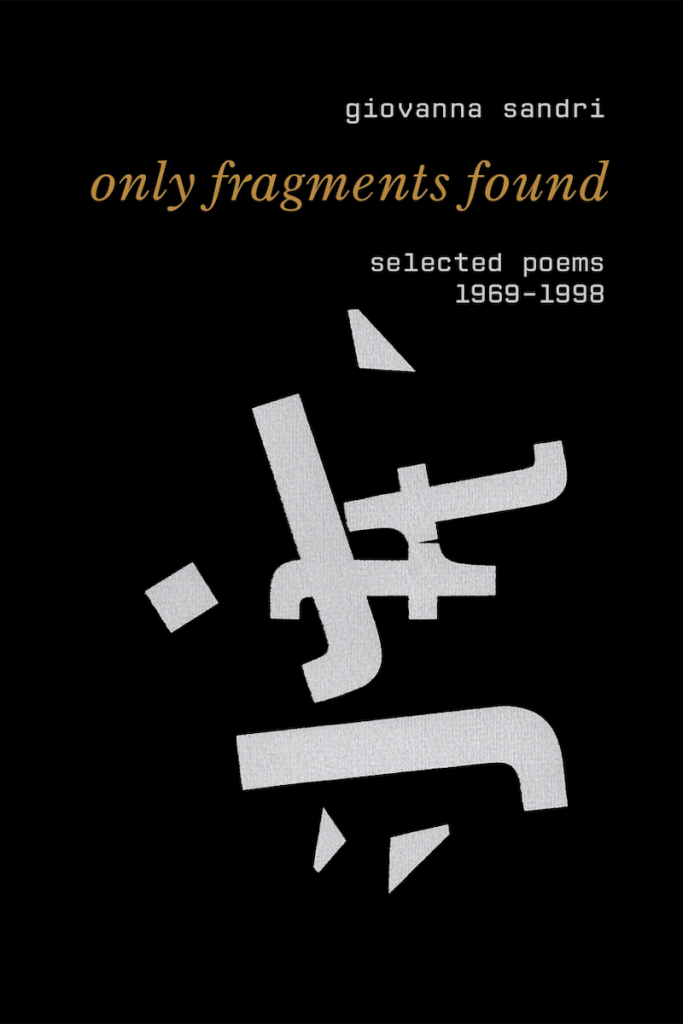
giovanna sandri, only fragments found:
selected poems 1969–1998,
trans. Guy Bennett, Faust Pauluzzi and the author (2016)
Mostafa Nissabouri, For an Ineffable Metrics of the Desert,
trans. Guy Bennett, Pierre Joris, Addie Leak
and Teresa Villa-Ignacio (2018)
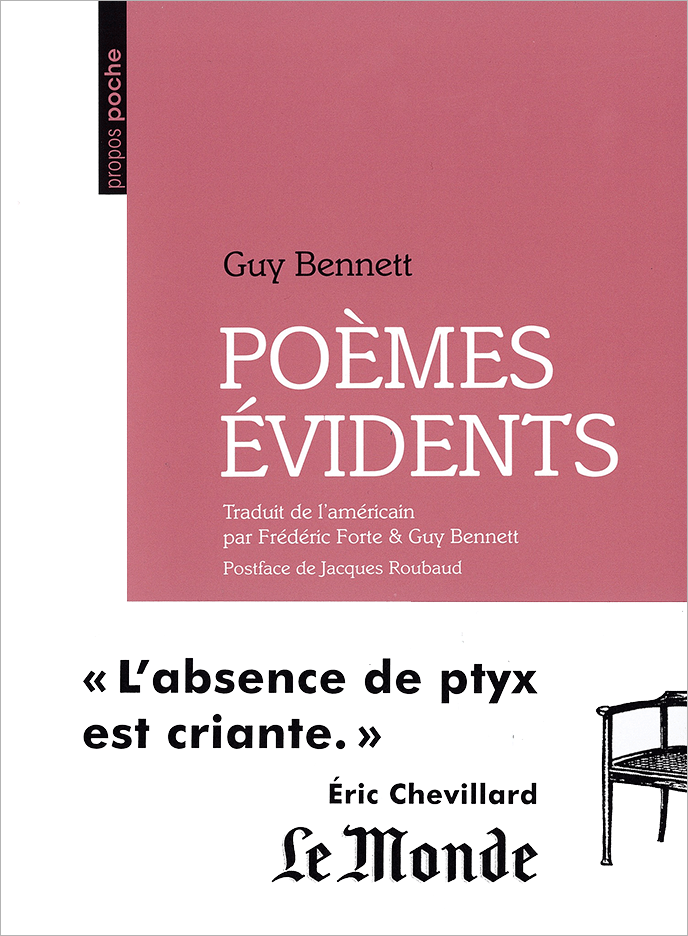
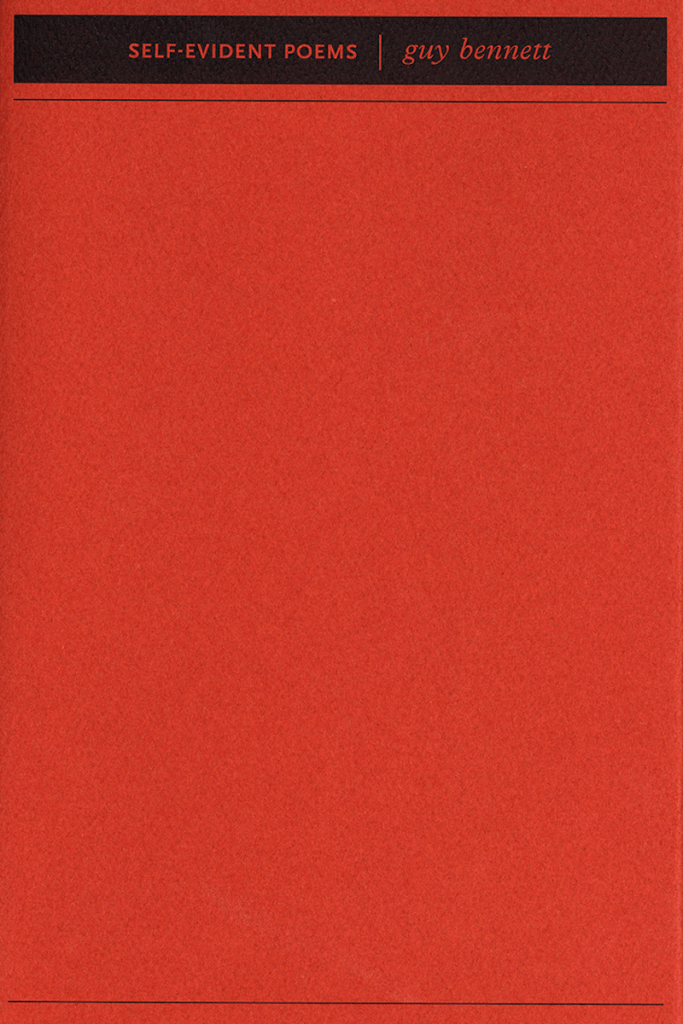
My 2011 collection Self-Evident Poems would mark a break with my previous works of poetry in that it was not derived from a source text and so was not itself the product of any translational method or strategy, though its writing was shaped by a series of constraints. Its 2015 French version, Poèmes évidents, which I co-translated with Frédéric Forte, would likewise lead to a shift in the relationship of translating to writing in my work. The book was well-received, and its publisher–Éditions de l’Attente–would bring out three other titles by me over the following six years: Ce livre (2017), Œuvres presque accomplies (2018), and Remerciements (2021); all were co-translations.[5] What differentiates them from Poèmes évidents is that in their case the original English texts have never been published; they served solely as matrices for their respective translations into French.
To draw a comparison with analogue photography, the English texts of the latter three books are like film negatives, the translations like prints made from those negatives. Prints are at once authentic instances of the latent image, though they are invariably altered during the printing process: the contrast may be heightened or attenuated, light areas darkened or dark ones lightened, grain enhanced or softened, the image cropped, etc., the goal being a more effective rendering of the pre-visualized work of which the negative is a point of departure, not of arrival.[6] At one point I realized that were these texts ever to appear in English, I would need to revise the originals in light of the published French versions, which are more fully realized and polished renderings of the latent works in question. That thought reminded me of Beckett’s claim to have written certain of his books three times: first in English, second in a French translation of the first, and third in a revised English version based on the translation. Though it’s clearly more work, I can see the advantages to such an approach, since with each translation the text is being tested and (hopefully) improved.
And so, with Ce livre, Œuvres presque accomplies and Remerciements, interlingual translation became an integral part of my writing process since, though for the most part I write in English, for the past eight years or so my primary readership has been in French. Each of the three works above duly went through multiple drafts in English before being translated into French, then that version went through multiple drafts before being fused with that of my co-translator. How that “fusing” was negotiated varied: Frédéric Forte and I worked out details–often in real time–via a Google doc, with him in Paris and me in Los Angeles, using the “Comment” feature to dialog while we (occasionally simultaneously) edited our text. As I recall Frank Smith grafted his version onto mine, then we went back and forth over the text with Françoise Valéry in what finally amounted to 11 revisions (!) of the co-translation.
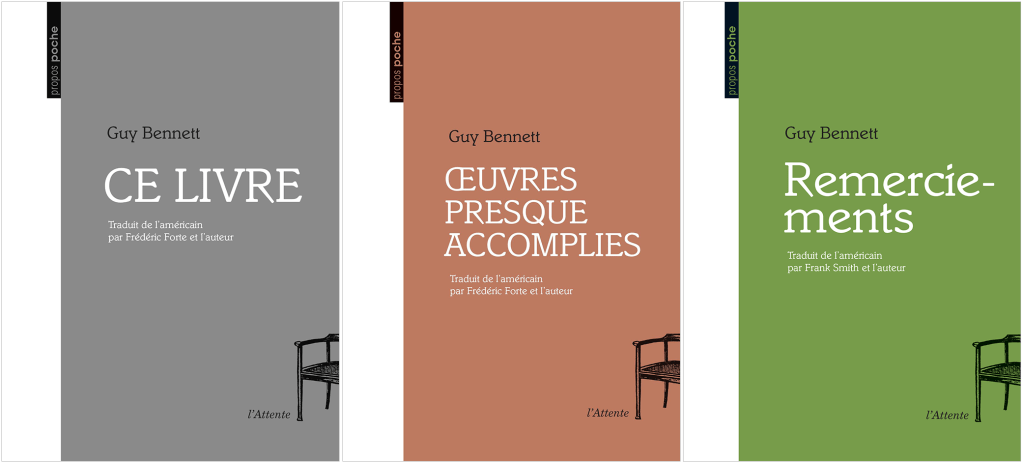
In the case of the latter book (Remerciements), I’ve often thought of comparing the published translation to the final English draft, just to see how the two actually differ. I still may do so one day, in order to gauge the role that process played in shaping and finalizing the text. In fact, I’ve wondered if the published work should even be considered a translation at all, since it only achieved its definitive state as it was being brought into its new language.
The latter question is all the more pertinent with respect to the as yet unpublished work that followed–“En exergue”–in that the conventional roles of writing and translating were inverted as the manuscript developed. As it happens, the conceptualization, initial sketches, and three partial drafts were done in English, but at one point I hit a snag and the work as initially “pre-visualized” stalled. Unsure how to proceed, I decided to revisit what I had written up to that point by translating it, and as I did so the text came into sharper focus.[7] Rather than go back and pick up the English draft where I had left it, I continued writing in French, pursuing the revised idea through to the end, then returning to the beginning and reworking the text as necessary in light of its new identity. Sometime during the rewriting process the title suggested itself; I find it significant that it doesn’t have an accurate English equivalent.[8]
“En exergue” is the first work I have written for which there is no complete English draft. To create one I would have to translate the French version, which had itself begun life as a translation. In this case, then, a translation escaped its condition as a secondary writing, transforming into the primary or “original” language writing as the text was developed and finally brought to fruition. The fact that the nascent work would only reach its definitive state after being translated implies that its ultimate identity depended on the language in which it was written, which in turn suggests that an emerging text’s ontology could be so socio-culturally bound that a change of language would result in a different work. Food for thought. Should “En exergue” one day find a publisher, it will also be the first book of mine in French whose title page would not include the phrase, Traduit de l’anglais par l’auteur.
(Slight return)
Brief comments on a few lines I encountered when reviewing notes for this essay…
“[Translation] is a process indistinguishable from poetic creation.”
– Octavio Paz[9]
This line perfectly expresses what I have always felt: that writing or translating, I was engaged in the selfsame activity, the goal of which was the creation of a new text. Though it may seem vainglorious, I considered even my translations my own “original” work for indeed they were, though the author of the text in question obviously had something to do with it. For this reason, it has always bothered me when someone would introduce a quote from one of my translations with, “As the author writes….” No, the author did not write what I wrote, I did. That translators are commonly disappeared in this way reveals a basic misunderstanding, I believe, about the fact and function of translation. It is not to say “the same thing” as the author said in another language, which is what I imagined when I began translating, but to give to understand the import of a text as understood by a particular reader–the translator. Every translation is the translator’s reading of the work in question put into words. Their own words.
Writing in light of translation–what might that mean, if only for my case?
- Writing with an eye toward, later, translating what I am writing?
- Thinking of translating–as a creative, language-based activity distinct from non-translational writing–while writing?
- Using translation skills while writing?
- Unconsciously “writing as a translator” while writing?
- Some combination of the above?
- All of the above?
In retrospect 1–4 seem rather synonymous to me… That said, the thought of engaging in the “primary” activity through the prism of the “secondary” activity does fascinate–there’s something Borgesian about this writerly equivalent of putting the cart before the horse: “I’ll write it in anticipation of / as if I were translating it.” (Echoes nicely with Borges’ claim in the essay “On William Beckford’s Vathek,” that Beckford’s French original was unfaithful to Samuel Henley’s English translation of it….) I wonder if such an approach might actually be the case of any translator who also writes their own (non-translational) work.
Can we ever abandon our ways of relating to writing / to writings?
Intéressante discussion avec Frank hier sur notre conversation de ce soir.[10] Elle portera–comme prévu–sur mon travail et comprendra discussion + lectures. Le « cœur » : mon rapport aux deux langues en ce qui concerne ma production littéraire. Je sens que cela va produire du matériel pour l’essai que j’écrirai pour Hopscotch. (D’ailleurs, je pense adopter le titre de l’événement–Entre poésie et traduction–pour l’essai.)
This event, or more precisely my discussion with Frank Smith a few hours prior, did in fact plant the seed for this essay. If in the end I adopted its title for this piece, it’s because it captures the position I have long felt I occupy as an author: somewhere between being a writer of poetry and a translator of it. This sentiment stems from the fact that I see little difference between the two activities, as Paz suggested in the line quoted above and as I have sought to reveal in this essay. It is as if I stand in two distinct places vis-à-vis the poem being written: on the inside, where I try to harness the energy generated by the forces of its creation; and on the outside, where I am able to maintain a certain critical distance from it, examining its expressive fabric from the point of view of someone who will later have to test its strength in a translation.
Hier soir au dîner après l’événement, Pierre [Fankhauser] a dit quelque chose qui, du coup, m’a fait imaginer un texte signé par le seul traducteur, il n’aurait pas d’auteur. De quel type de texte s’agirait-il ? Comment le concevoir ?
The event in question is the just noted conversation with Frank Smith. I don’t recall Pierre’s comment but remain fascinated by the idea–an authorless text signed by its translator? Would the translator not then be the author? (Isn’t that what I’m saying in my comments above, i.e. that translators are obviously authors of their translations?) Would the translation then not be the “original work”? Might En exergue, a text overtaken, transformed and ultimately supplanted by its own translation, be such a work? Might Remerciements or even Last Words?
What happens when the goal of translation is not another version of the original, but an entirely different work? Is it still a question of translation? And if not, then of what? [Later note: Would this be a work of the type “a text signed by the translator alone”?]
I suspect that the answer to these questions depends on one’s definition of translation. In the case of works like Charles Reznikoff’s Testimony, Tom Phillips’ A Humument, Alice Randall’s The Wind Done Gone, etc., might it be more a question of appropriation than translation? Would the difference between the two operations be the degree of transformation of the source text represented by the work derived from it: the closer the latter hews to the meaning and writerly integrity of its source = translation; the further it strays from those qualities and the greater the degree of transformation = appropriation? If we imagine a line stretching from strict interlingual translation to full-blown creative transformation, where might the preceding works fall? Perhaps more importantly, would the end points of that line represent the two extremes of a same trajectory?
In essence, I’m talking about taking an existing thing and making something new with it.
That new thing may seek to resemble the existing thing or it may not.
Either way, the existing thing is transformed in the process.
The process I would call translation.
This note contains my answers to all of the preceding questions and reveals my views on translation more generally speaking. Whatever the type of translation we are talking about, for me it is a fully creative act that I undertake with the same degree of excitement, curiosity, stimulation and creative energy that I do when I write my own, non-translational works. In a couple of cases, the two activities have blurred to such a degree that I am not sure whether the resulting texts should be considered translations at all or whether they are actually something else. What might that something else be–an “original work of translation”?
– Bogotá, January–March, 2023
Notes
[1] I smile at the thought that my first published translation was a book of wordless poems. True, there were titles and an introductory manifesto to translate (I also provided an introduction for the work), but the poems themselves were line drawings devoid of language.
[2] I specify “literary” because I was also doing occasional technical, legal and scholarly translations for the Getty Conservation Institute, as well as subtitling for a local post-production house producing DVDs for export to francophone countries.
[3] It has always seemed to me that, chosen purposefully, source texts are like two-way mirrors–whatever their explicit matter and the socio-cultural context in which they were produced, they reveal the preoccupations of the writer who elects to work with them and may well engage the moment of their rewriting in a meaningful way (indeed, they may be chosen specifically to reveal something about that moment).
[4] John Cage coined this phrase, using it to designate a method of deriving one text from another by selectively extracting words from a source writing which are then organized to form the new work. “Mureau” (in Cage, M: Writings ’67–’72, Wesleyan University Press, 1973, pp. 35–56) and “Writing for the Second Time through Finnegans Wake” (in Empty Words: Writings ’73–’78, Wesleyan University Press, 1979, pp. 133–176) are two of many such examples.
The latter text would ultimately become the “libretto” for Cage’s 1979 Roaratorio: An Irish Circus on Finnegans Wake, whose score is not coincidentally subtitled “Means for translating a book into a performance without actors, a performance which is both literary and musical or one or the other.” (liner notes to Roaratorio, mode records, 1992, CD, pp. 59–61.)
[5] Ce livre and Œuvres presque accomplies were translated with Frédéric Forte, Remerciements with Frank Smith. In each case, the translation was polished during production with Françoise Valéry who, with Franck Pruja, directs the Bordeaux-based publishing house.
[6] Ansel Adams defined pre-visualization as “the ability to anticipate a finished image before making the exposure, so that the procedures employed will contribute to achieving the desired result.” (Adams, The Camera, Little, Brown and Company, 1980, p. 1). The kinship with writing is obvious in those cases when one conceptualizes a piece, determines its structure, plots out its details, etc., in advance of actually sitting down and writing it. Several of my works have been written in this way.
[7] Initially titled “Overtones,” the text consisted of glosses on a sequence of paired statements by artists, filmmakers, writers, etc., that I had collected over the years. My desire was to elaborate on the aesthetic, literary and philosophical “overtones” released by the juxtaposition of statements in question, an approach suggested by photographer Ralph Gibson’s book of the same name. (Gibson created diptychs of photographs he had taken and published over the years and invited writers to comment briefly on their pairings.)
After its passage into French the work was conceptually recast as an exploration of the role and function of the epigraph. As with Remerciements, in which what is typically a paratext–the acknowledgments section of a book–becomes the primary text, “En exergue” alternates the glossed statements mentioned above, now presented as footnoted epigraphs, with still other quotations on epigraphs, quotes and the like, and the function and implication of such borrowings in both speech and writing.
[8] Exergue comes from the Greek ἐργο [“work”] and ἐξ [“out of”], thus the expression en exergue indicates the placement, typically of a phrase or quotation, just before the beginning of a work. Though exergue does not mean “epigraph” per se, over time the two terms have become roughly synonymous.
[9] The line appears in Paz’ introduction to Renga, a Western take on the collaborative Japanese linking poetic form that the latter co-authored with Jacques Roubaud, Eduardo Sanguinetti, and Charles Tomlinson. It was published in French by Gallimard in 1971. Penguin produced an English edition in 1979.
[10] The conversation in question, “Entre poésie et traduction,” took place on Thursday, June 2, 2022, as part of the series Jeudi en résidence at the Fondation Jan Michalski, where I was a writer in residence at the time.
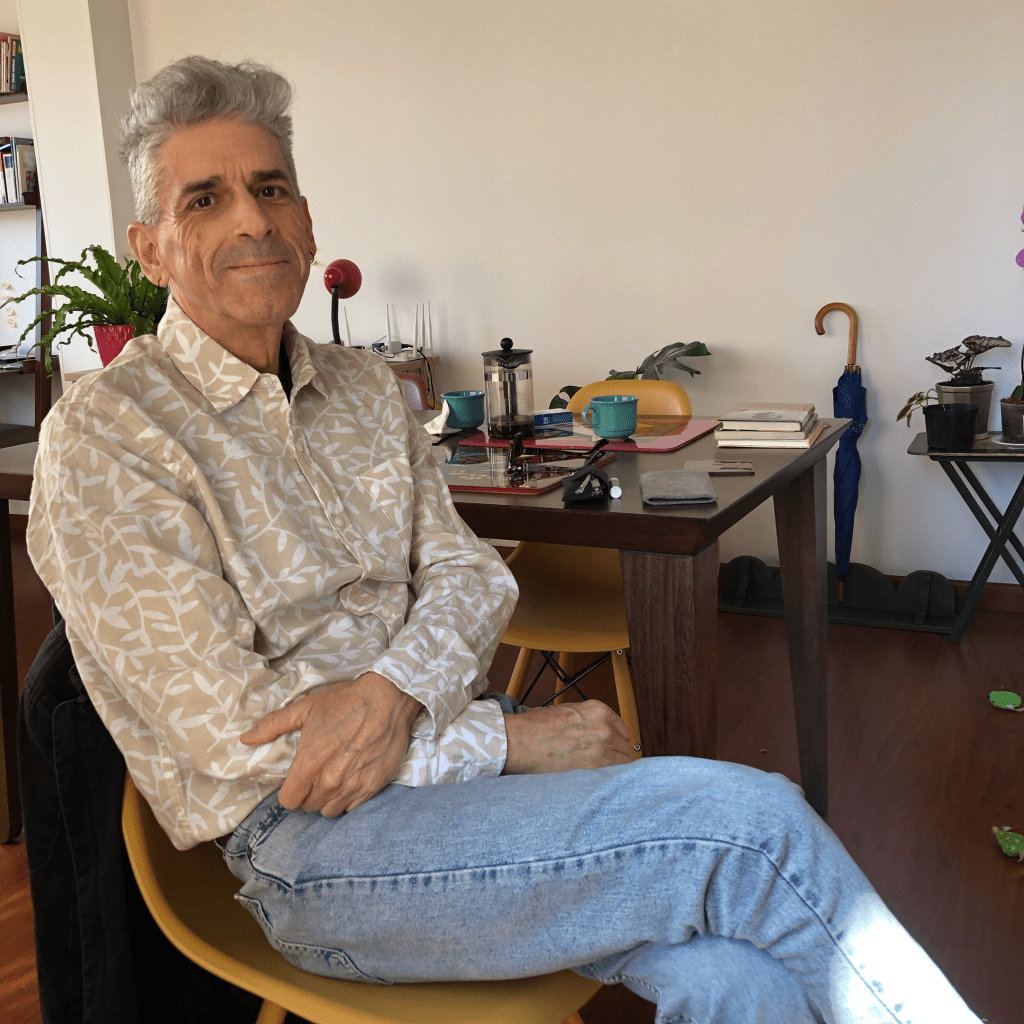
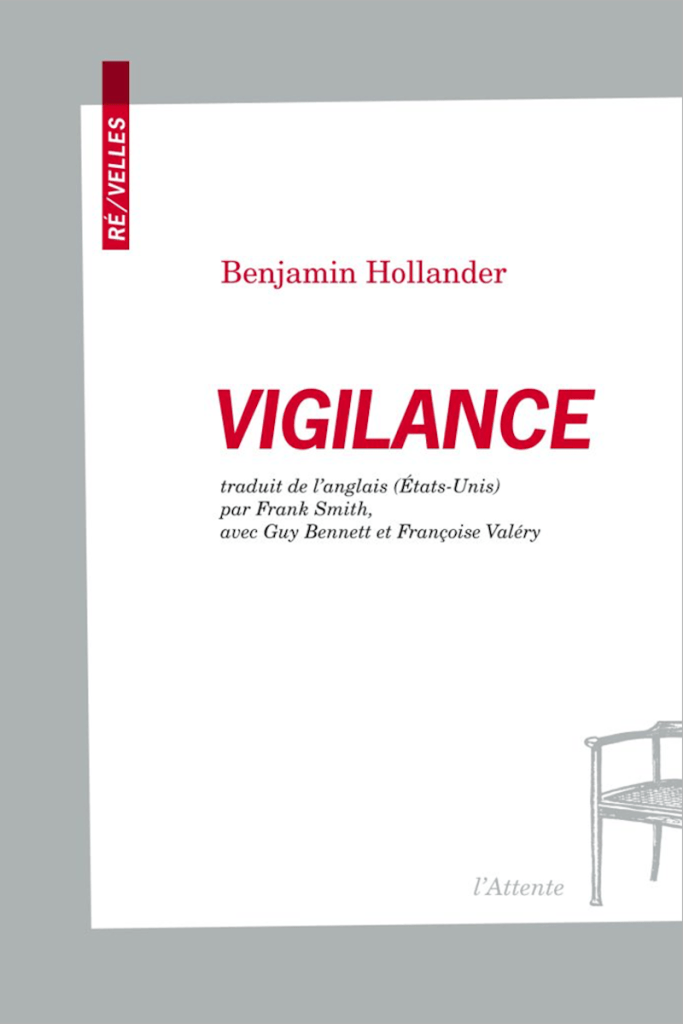
Guy Bennett’s publications include works of both poetry and non poetry, in the English (and occasionally French) original as well as in translation. Recent titles include Poetry from Instructions, a collaborative work of (non-combinatory) generative poetry, and Vigilance, a co-translation of Benjamin Hollander’s eponymous “noir poem.” Guy lives in Los Angeles and teaches at Otis College of Art and Design. www.guybennett.com [Photo: Laura Ortiz Gómez]
Originally published on Hopscotch Translation
Tuesday, May 9, 2023

 hopscotchtranslation.com