
On Translating Franca Mancinelli
by John Taylor
Once a translation is finished and a few years have gone by, it is not always easy to recover all the thinking that governed the choice of one English word instead of another one. But let me try.
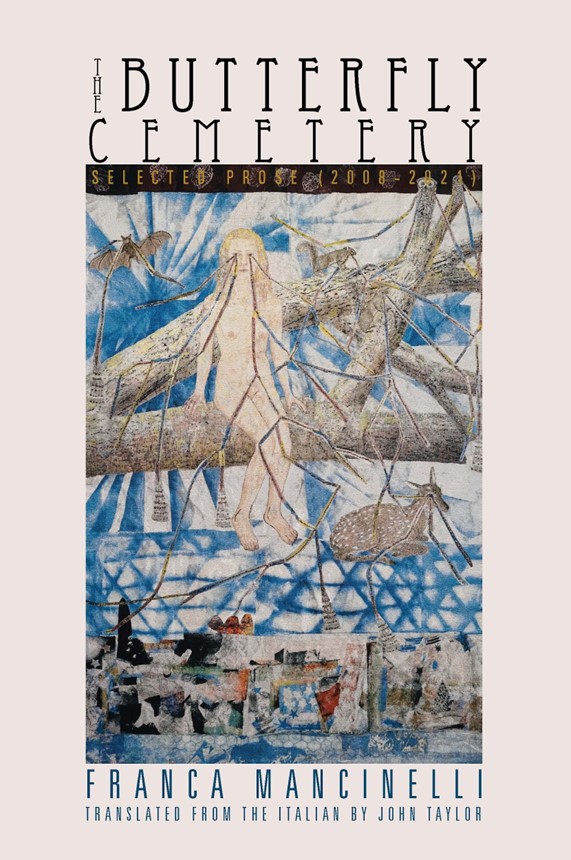
The following remarks were initially formulated as responses to questions about translation asked by students in an Italian literature and language class in the Romance Studies Department of the University of North Carolina at Chapel Hill. This fruitful exchange took place during a Zoom reading and discussion titled Franca Mancinelli: Translating from the Invisible, which was organized by their teacher, Matteo Meloni, on 10 April 2023. Both Franca Mancinelli and our publisher, Paul B. Roth of The Bitter Oleander Press, participated.
Franca Mancinelli and I met by chance in late 2017 at a literary conference in Ljubljana, Slovenia, to which we had both been invited. During our conversations there, we quickly understood that our respective literary approaches shared common stylistic concerns and similar themes. We even discovered that we had closely read some of the same essential poets, notably Rainer Maria Rilke, Cesare Pavese, and T.S. Eliot, and that in Eliot we had both been fascinated by the same lines in his Four Quartets: “In my beginning is my end. […] In my end is my beginning.” Upon leaving the conference, when I read the manuscript of her book Libretto di transito, which had not yet been published, I immediately wanted to translate it. It struck me as a deep and essential book, and I put aside other projects to begin work on it. The English translation, The Little Book of Passage, was in fact published by The Bitter Oleander Press in 2018 only a few months after the Italian edition was issued.
Although some translators prefer to work without any intervention whatsoever from the poet whom they are translating, except perhaps for asking two or three specific questions about a rare word or an unclear passage, I always seek, whenever possible, a dialogue with the poets and writers whom I translate. It strikes me as essential to listen carefully to their explanations, even if I must make the final decisions in the end. Understanding the other poet more precisely also improves one’s chances of translating better; it helps one to acquire a deeper knowledge of the foreign poet’s vocabulary, notably of why certain key-words are so crucial—in Franca’s case, words like “fault lines,” “ruins,” “openness,” “home,” “trees,” “birth,” “listening,” “blood,” “body,” “seeds,” “roots,” not to mention the polysemic Italian word “custodia” (whose meanings range from “caretaking” and “custodianship” to “safekeeping” and “watching over,” etc.). Franca and I have enjoyed this kind of dialogue from the very onset. We discuss everything from commas to etymologies, from word order to enjambments, from syllabics to alliteration. This dialogue fills the margins of the translation manuscripts that fly back and forth between us “like flocks of birds”—another favorite image of hers—sometimes as many as fourteen or fifteen times until all the final adjustments have been made and, hopefully, the best solutions have been found.

The question of translating a metaphor when there is no exact equivalence raises the issue of the “dose” of “foreignness” or “xenity”—I’m thinking of the Greek root xenos, “foreign”—that it might be important, in a subtle way, to introduce into a translation. Some translators, and indeed some editors, think that a foreign text should be completely “Englished,” in other words, that idiomatic English equivalents should be found for every single unusual or untranslatable foreign expression or metaphor. This is a necessary rule of thumb, but my personal viewpoint is more nuanced in certain situations.
For example, Franca sometimes uses the adjective “originario.” It’s a key word for her because it represents her effort to get back to the origins of phenomena, to their source, their emergence, their “birth” (another key term for her). Bilingual dictionaries instruct me to render this Italian adjective, depending on the context, as “original,” “primitive,” “primal,” and so on. But although these English adjectives give the general sense, it occurred to me one day, as I was writing my translator’s introduction to At an Hour’s Sleep from Here, that it might be better to use the word “originary” because it would bring my English closer to her—indeed original—way of thinking. Although the word “originary” is considered archaic, it remains in the dictionaries—so why not rehabilitate it? It is more precise than “original,” which has a few other meanings not really present in Franca’s use of her Italian word. And yet, when this Italian adjective cropped up five times in The Butterfly Cemetery, I ultimately chose to translate it with “original” or “primal,” depending on the context. Such are the enthusiasms and doubts of a translator, ever hesitating between boldness and idiomatic usage.
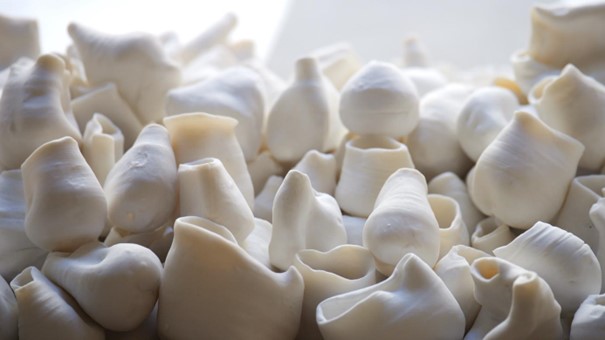
Let me give an example related to the problem of metaphors. A beautiful metaphor appears in one of Franca’s recent poems. In a poem about the potter Antonella Sabatini’s terracotta artwork, which Franca admires and with which she senses affinities, she writes, with respect to Sabatini, “alla luce dai ogni forma,” therefore punning with the expression “dare alla luce,” a literal “giving to the light” that also indicates “being born.” In English, “you give to the light” doesn’t really indicate birth, at least not idiomatically, so in my translation I used a perhaps less obvious verb, “to deliver,” as in delivering a baby, to try to catch the double meaning and preserve some of the Italian expression: “to the light you deliver every shape.” By the way, you can listen to Franca discussing her poetry and reading some of her poems, as she is sitting in the potter’s studio, in a video made by Stefano Massari and Carlotta Cicci in March 2023 as part of their Zona/ Disforme project devoted to contemporary Italian poets: https://www.youtube.com/watch?v=fQlLHrE_PjA
Thank you for this precise question about why I chose to use the word “ruins,” instead of “collapse,” in the second line of the poem “ho smesso di regerre I muri / “I’ve stopped holding up walls.” Here is the entire poem in both languages:
I’ve stopped holding up walls,
give myself over to the ruins
I’m starting up again, reduced
I return to what I am:
a lizard that halves itself
with death.
ho smesso di reggere i muri
donandomi ai crolli
ricomincio, abbreviata
torno a quello che sono:
una lucertola che si divide
a metà con la morte.
Once a translation is finished and a few years have gone by, it is not always easy to recover all the thinking that governed the choice of one English word instead of another one. But let me try.
For the translator, the choice of a word involves not only the bilingual dictionary—the two or three words that present themselves as suitable equivalents for the foreign word—but also the context around the word, the line or lines preceding or following it, even other poems in the same series or book, and also sometimes the foreign poet’s sensibility and his or her main themes, philosophical concerns, key words.
In this particular case, the initial image is quite concrete: “the walls”. In the next line, the Italian word—“crolli”—is in the plural. I preferred to avoid “collapses” or, for instance, the paraphrastic form “what has collapsed,” for stylistic, grammatical, and phonetic reasons: they filled the mouth too much, as it were, and in this plural spelling, “collapses” arguably occurs much more often as a verb in the third-person singular tense than as a noun—so perhaps some graphic confusion, for the reader, could momentarily arise. Secondly, if I used “collapse” in the singular case, which sometimes happens in a translation (especially between two languages in which singular and plural forms, or definite and indefinite articles, do not always function in the same way), then the word “collapse” remains a process, not a result (as is the case with “ruins”). Moreover, this process of “collapse” in the singular case made me think of “physical collapse,” “mental collapse”. This theme is present in this poem, of course, for one of Franca’s major themes is that of transforming misfortune or inner distress—something negative—into a “new possibility of vision,” as she puts it in her essay “A Book of Poetry: A Living Structure,” from The Butterfly Cemetery: “[. . .] a book of poetry is a lighting point, a possibility of vision: a brightness that reaches zones which, just beforehand, were inaccessible. [. ..] I write when something from the darkness beckons to be watched.” But it seemed to me that this solution—“collapse” in the singular—which would have these immediate physical and psychological connotations, would perhaps provide a too facile image; in fact, it might restrict the reader to a psychological interpretation of the poem. This is when “ruins” emerged as an alternative: the word is concrete; it is used elsewhere in Franca’s poetry; it goes well with “walls”; there is a graceful rhythmic alliteration between the “r” of “over” and the “r” of “ruins” (“give myself over to the ruins”); and, in addition, although the word “ruins” is concrete and factual, it is paradoxically more “open,” for it can also be construed as a metaphor, therefore perhaps opening up the poem to other kinds of interpretations. In any event, this play between factuality and semantic openness is one of my constant challenges when I translate Franca’s poetry.

When one translates poetry, the order of the words—the syntax—is nearly always essential because it represents the sequence of perceptions, thoughts, and emotions experienced by the poet. This sequence represents how we experience the world. As a starting point for each new translation, I always try to respect the order of the words. However, this intention can run up against impossibilities, from the idiomatic point of view, namely because English syntax is much less free than Italian syntax—and, in general, less free than the syntax of many other languages—because of our lack of grammatical markers. We don’t have masculine and feminine markers, except for possessive pronouns, and although we have an elaborate verb system, with many tenses, within that system we have only one marker for the third-person singular; and our adjectives have no markers attaching them to nouns; and so on. Many simple English lexemes, in their nearly unique spelling, can function as verbs, nouns, adjectives, and even adverbs, depending on the syntactic context. Therefore, we need to align our words in a way that will make it clear how adjectives are attached to nouns, how subjects and adverbs are attached to verbs, what the direct object of a verb is, etc.
Modern English syntax thus tends to be a linear progression, whereas in many other languages, and notably Italian, grammatical markers can enable a poet to attach a word back to another word that has appeared a few words beforehand. This affects, for example, such problems as enjambments, or, inversely, the necessity of “blocking” an enjambment. Moreover, sometimes, syntactically, what seems perfectly natural and logical to an Italian will seem, if translated literally, “flowery” or “archaic” to an English reader. Italian stems from the extraordinary concision of Latin, with its profusion of grammatical markers, whereas English is a Germanic language which, over the centuries, has lost nearly all its Old English grammatical markers and yet which has retained the natural tendency of Germanic languages to place the important semantic elements towards the end of the phrase—a tendency also affecting the mirroring of the foreign word order when one translates. All these factors come into account in the “juggling” that a translator must sometimes do if he or she nonetheless wishes to reflect, in the same order, the most essential elements of the original Italian syntax. In the opening sentence of one of the texts of The Little Book of Passage, I decided to invert the original syntax, indeed probably because I sensed that the most important semantic part of the sentence should come at the end in English:
As if I always had another number, another size, every morning I force myself to put on clothes, shoes.
Indosso e calzo ogni mattina forzando, come avessi sempre un altro numero, un’altra taglia.
As to rhythm, as to the sounds in a poem, there are of course major differences between Italian, with its beautiful “open-mouthed” vowels that necessarily crop up repeatedly in a poem and naturally create assonance—the juxtaposition of vocalic sounds—and English, whose meter is based on strong stresses and whose typical English sound often derives from alliteration, the repetition of consonant sounds. It is thus often through alliteration that I try to create a rhythmic English sound for an Italian poem whose musical presence might, instead, essentially derive from assonance. As I leaf through Mother Dough, Franca’s second book included in At an Hour’s Sleep from Here, I come across this example. My translation is initially based on a triple alliteration with “w,” then on a double alliteration with “d.” Moreover, the second line shows a shift from the active to the passive voice in English to preserve the Italian word order. It can also be noted that Franca also appeals to some alliteration in Italian, between the second and third lines (“raccolto,” “sacchi,” “scuri”) within a melody essentially created by the play of “a” and “o” sounds:
what I am is a window
my weight has been gathered
in dark sacks by the dawn.
[. . .]
quello che sono è una finestra
il peso che avevo l’ha raccolto
in sacchi scuri l’alba.
[. . .]

My first four published books were in prose, but I have always written poetry, going back to my adolescence. And those early prose texts were already quite concise, often more poetic prose narratives than short stories; in fact, I tended to call them “apperceptions,” not “stories.” When Franca and I met in 2017, I had already published some poetry books as well as books comprising both poetry and prose; and three of my books, two of which comprised much poetry, had also been translated into Italian.
Our first meeting thus took place under the sign of poetry. In fact, since Franca was putting the last touches on The Little Book of Passage at the time, we discovered that we were both interested in the not-always-distinct boundaries between prose and poetry. The texts in her book are probably best defined as “prose poems,” but several of them succinctly recount an “event” in a way that also makes them especially concise “poetic prose narratives.” She also uses both prose poetry and verse poetry, as well as hybrid forms, in her most recent book, Tutti gli ochi che ho aperto, which is forthcoming in my translation, from Black Square Editions, as All the Eyes that I Have Opened.
To answer your question, I don’t think that it is an absolute necessity for a translator translating poetry to be a poet, but it is necessary for the translator of poetry to be deeply attentive to the rudiments of language—sound, syntax, grammar, punctuation, etymology, synonyms, diction—and to be an active reader of poetry, much poetry, written in his or her mother tongue as well as in foreign languages via translations. It’s probably also true that it can be an advantage for a poet to translate a foreign poet with whom he or she has thematic and stylistic affinities, as in my work with Franca. But I have translated a few other poets whose writings are quite different from mine, notably the two other Italian poets whom I have translated, Lorenzo Calogero and Alfredo de Palchi. Interestingly, the task of translating these two poets, especially Calogero, helped me to better define aspects of my own work, such as the theme of the “other” and how it can be expressed by means of the narrative “I” or the narrative “you.” One of Calogero’s own key words, lievità, “lightness,” continues to fascinate me.

With respect to the liberties that I allow myself when I translate, especially as regards diction, rhythm or style, my primary concern is nearly always the meaning of a poem, all its semantic subtleties, all its semantic resonance. By “semantic resonance,” I mean the ways with which Franca encapsulates in single words and lines various possible meanings and connotations. That is, the meanings and connotations of a word, an image, can form a kind of bouquet in which the flowers are perhaps related to one other but also remain different among themselves; the whole bouquet can be perceived as such, as a whole, and, if one reads attentively, so can the distinct flowers. A telling example of this occurs with her use of “falda,” “water table,” in The Little Book of Passage. At the very end of the text, the word takes on a personal meaning alongside the specific geological one:
In the evening, a cigarette between his fingers, watching the sky darken like moistened soil, my father waters his garden. When he’s standing down there in the farthest corner, hidden by the tomato plants, I can hear the water pouring from the well, streaming down between the dirt clods to the roots awaiting it. Here, where the flow has trickled out, sprout plants with poisonous fruit, stiff stalks of grass with tiny flowers. I haven’t succeeded in hoeing them away, in repairing the water table.
La sera, con una sigaretta tra le dita, guardando il cielo scurirsi come terra bagnata, mio padre annaffia. Quando è laggiù, nascosto dalle piante dei pomodori, nell’angolo più lontano del giardino, posso sentire dal pozzo l’acqua versarsi e scendere tra i granuli, fino alle radici dove è attesa. Qui, dove il flusso si perde, crescono erbe dure dal piccolo fiore, piante dal frutto velenoso. Ma non riesco a zapparle via, non riesco a riparare la falda.
Franca is a master at creating such bouquets of sense. Her goal is to keep her poetry as semantically “open” as possible, and in our work together, we constantly discuss how to do this as well as possible in English, a relatively “matter-of-fact” language with respect not only to Italian but also to the other Romance languages. This task often involves choosing between an English word with a Germanic root and a synonym with a French-Latin derivation, that is, between a noun or a verb which might pin down a fact (and Franca’s poetry always stems from a factual origin) and a more abstract word which, despite its relative vagueness, might nonetheless offer a greater semantic aperture.
The choice is not always easy. For example, in her poem (from Mother Dough) beginning “buckets scattered about the room, / empty notebooks,” she continues: “Torneranno / a frantumare come infiltrazioni [. . .].” I rendered this as “They’ll come back / like leaks that shatter [. . .].” That is, I ultimately preferred “leaks” to “infiltrations,” not only because of the alliteration between “like” and “leaks” but also because it seemed, in this particular case, that the word “leaks”—of Old English origin—offered a more vivid image and, if stretched a bit, could also express some of the semantic resonance of the original, whereas “infiltrations” would remain comparatively vague and introduce connotations not necessarily present in the original. Here is the entire poem in translation:
buckets scattered about the room,
empty notebooks. They’ll come back
like leaks that shatter,
but cry anyway and learn
from the overflowing eaves
fonts of holy water
at the door where everyone
heals his hands.
secchi sparsi nella stanza,
quaderni vuoti. Torneranno
a frantumare come infiltrazioni
ma piangi pure e impara
dalle grondaie colme
acquasantiere
sulla porta dove ognuno
si medica le mani.
Diction and rhythm can participate in this resonance, of course: the use of a rarer word or, instead, a popular expression—although Franca nearly always draws on simple common words. Or there can be an echo of a classical meter that creates a kind of “rhythmic recollection,” be it of Dante or—in English—of Shakespeare or some other poet whose “tone” is well-known to readers. Moreover, especially in her first book, Mala Kruna (which is included in At an Hour’s Sleep from Here), Franca sometimes instinctively counts the number of syllables in her lines of verse. And if she has, say, seven or eight syllables in her line and my first translation draft has, say, thirteen, then this might encourage me to seek a metrically more concise solution.
To be very technical, think of how Italian possessive pronouns have two syllables (“mio,” “tuo,” “suo,” “nostro,” “vostro,” “loro”) whereas English possessive pronouns have only one syllable: “my,” “your,” “his,” “her,” “its,” “our,” “your,” “their.” Such minute calculations can come into play, in the translator’s ear, especially in situations where, idiomatically, Italian does not need a possessive pronoun whereas English usage demands one. In any event, possessive pronouns function completely differently in the two languages. Our English possessive pronouns are based on the “subject-possessor,” whereas Italian possessive pronouns depend on the gender of the object. This fundamental difference can induce some tricky translator’s decisions, especially in Franca’s poetry because, in her aspiration to keep her meaning as open as possible and not necessarily associate it with a gendered human “subject,” she might well also be envisioning a subject that is non-human. Remember that, in English, the possessive pronoun associated with a non-human is “its,” a grammatical fact compounding the problem. The necessity of grammatically distinguishing humans and non-humans, which is required in English but not in Italian, notably arose in the last poem of Mother Dough. At the very end of the poem, Franca uses the word “salvata” in the feminine case. Does it refer to her as the poet who is “saved” or to the air (“aria,” also in the feminine case)? She leaves the question open. After much cogitation and discussion with her, I opted for the “air”:
every endless night I would sleep
on a blank page. In the morning
a shadow of my weight, some creases
and suddenly it turned: to continue
is this beginning of a new line,
a mouth that passes warmth on
to the air as if it could awake
still be saved.
dormivo su una pagina ogni notte
bianca. Il mattino
un’ombra del mio peso, alcune pieghe
e subito voltava: proseguire
è questo a capo del principio,
bocca che passa calore
all’aria come potesse svegliarsi
essere ancora salvata.
Ideally, I try to take no liberties with meaning, keeping my English interpretation as close as possible to Franca’s intentions. This is why our dialogue is so important. I much prefer a close equivalence of meaning to a seemingly “more musical” result in which some meaning would be lost. I cringe at the notion of a “free interpretation” in translation. I have listened closely to another poet whom I translate, the late Philippe Jaccottet, who considered that the search for stylistic smoothness or musicality could sometimes distance a poet from the search for truth. To which can be added Samuel Beckett’s quip that he had decided to write in French, his second language, because it was too easy to be “poetic” in English. I would argue that Franca’s drive towards succinctness in her verse, a kind of “bone-dry” concision (as she has stated), and her acceptance of “fragmentation” (as opposed to desiring, at all costs, a certain “wholeness” in a text), belong to this same kind of truth-seeking or meaning-seeking poetics.
My standpoint on meaning also has much to do with the kinds of poets whom I translate. Like Franca, the French poets whom I translate—Philippe Jaccottet, Pierre-Albert Jourdan, José-Flore Tappy, Pierre Chappuis, Pierre Voélin, to mention only a few—are intimately and intensely concerned with the meaning of existence, with the significance of the other and otherness, with a human being’s relationship to the cosmos, and similar psychological, philosophical, and even spiritual issues. Like Franca, these poets are themselves highly conscious and stylistically meticulous producers, through their poetry, of deep new meanings, questions, and vantage points.
Three books by Franca Mancinelli are available from The Bitter Oleander Press: The Little Book of Passage, At an Hour’s Sleep from Here: Poems 2007-2019, The Butterfly Cemetery: Selected Prose 2008-2021. Forthcoming from Black Square Editions is All the Eyes that I Have Opened, the original Italian edition of which won two national prizes in Italy: The Europa in Versi Prize and the San Vito al Tagliamento Prize. Taylor and Mancinelli also carry on a dialogue about literary, philosophical, and spiritual issues: the first part was published in the special feature, on her writing, in the Autumn 2019 issue of The Bitter Oleander; a second part appeared online in Hopscotch Translation (July 2021); and a third part, which was originally broadcast on Trafika Europe Radio, was published in Eurolitkrant (April 2022).
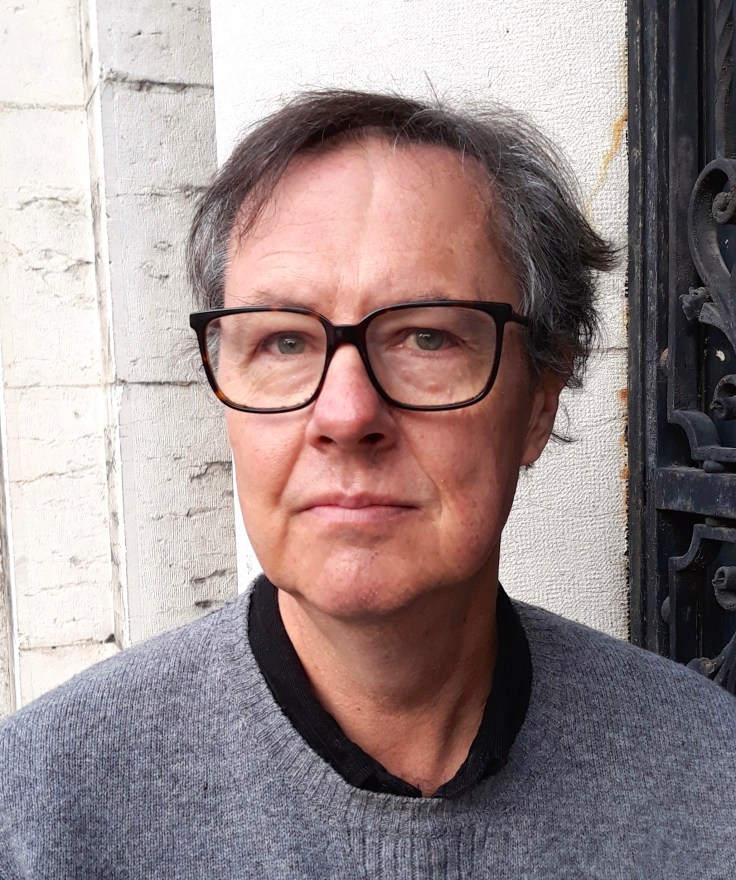
John Taylor is an American writer and translator who lives in France. His most recent books are Remembrance of Water & Twenty-Five Trees (The Bitter Oleander Press) and a “double volume” co-authored with Pierre Chappuis, A Notebook of Clouds & A Notebook of Ridges (The Fortnightly Review Press). [Photo: Françoise Daviet-Taylor]
Originally published on Hopscotch Translation
Tuesday, May 23, 2023

 hopscotchtranslation.com