
Now More Roads Lead to France: Review of Adlestrop & autres poèmes d’un temps de guerre by Edward Thomas, translated into French by Sarah Montin
by Samuel E. Martin
The landscapes and languages of England and France fold over one another in these pages…
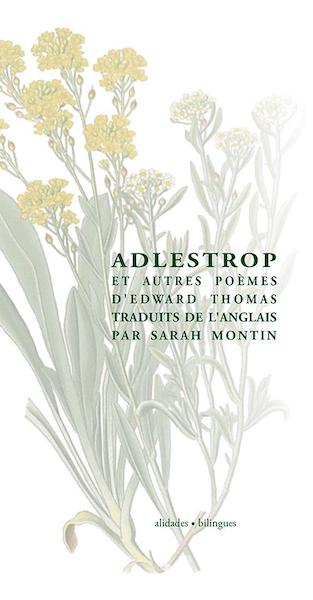
Adlestrop & autres poèmes d’un temps de guerre, by Edward Thomas, translated into French by Sarah Montin. Alidades, 2023, 56 pp., €6.50. ISBN 978-2-919376-95-7
In a recent issue of The Dark Horse, Stewart Sanderson, echoing his fellow Scottish poet Douglas Dunn, takes square aim at Robert Frost’s adage according to which ‘poetry is what gets lost in translation’. ‘Pace Frost’, writes Sanderson, ‘poetry is what survives the journey between languages. More than that, all poems are in some sense attempts to translate, to carry something across, from world to word, from writer to reader’. I’d like to imagine that on this point Edward Thomas would have agreed wholeheartedly with Sanderson and Dunn, even had it meant quibbling with his friend Frost, in so many other respects a kindred poetic spirit. The very same issue of The Dark Horse, in fact, contains a rendering in Scots by Robert Crawford of Edward Thomas’s own poem ‘Words’ (‘Chuise me, ye Scottish wurds’), as if to underscore the mobility of the latter’s own verse across borders and idioms. It is consequently heartening to see that a selection of Thomas’s poems has newly been translated into French by Sarah Montin. Over the years, anthologies and literary journals in France have published occasional versions of Thomas by other translators – among them Vladimir Fisera, who read some of his translations for the Edward Thomas Literary Festival in October 2020 – but Montin’s bilingual edition, while still quite slim, represents the first standalone volume of Thomas’s work in French.
As well as already having translated Ivor Gurney and Isaac Rosenberg for two other selections published by Alidades, Sarah Montin has previously authored an extensive academic monograph on British poets of the First World War. Edward Thomas remains a marginal figure in that book, and in the preface to her new translations, Montin points out that Thomas doesn’t quite fit the War Poets’ ‘typical profile’. Nevertheless, there can be no mistaking the lens through which she views Thomas’s work; her title, Adlestrop & autres poèmes d’un temps de guerre (‘Adlestrop & Other Wartime Poems’), sets a clear agenda. Indeed, the choice of texts appears to have been dictated as much by historical circumstances as by poetic criteria. Of the twenty-one poems gathered here, over half make either veiled or explicit mention of the war, occasionally taking it as the primary theme. ‘This is no case of petty right or wrong / That politicians or philosophers / Can judge’, writes Thomas in one familiar instance; by translating ‘judge’ with the verb ‘trancher’, a homonym of ‘tranchée’, Montin brings the trenches even more distinctly into the foreground. The landscapes and languages of England and France fold over one another in these pages, and Thomas’s declaration ‘Now all roads lead to France’ (in the poem ‘Roads’ / ‘Routes’, deliberately placed at the end of the book) acquires a further literal dimension.
Of course, Now All Roads Lead to France also became the title of Matthew Hollis’s much-loved 2011 retelling of Edward Thomas’s final years and his bond with Robert Frost. Sarah Montin’s preface to her volume clings to Hollis’s version of events, notably the story of Thomas’s bloodless death, which Jean Moorcroft Wilson’s more recent biography reminds us was a fiction concocted to spare the poet’s widow Helen. That said, Hollis is by no means the only one to have repeated the story. A surer sign, I think, of Montin’s reliance on Hollis’s account is her assertion that Frost’s poem ‘The Road Not Taken’, with its playful critique of indecision, helped spur Edward Thomas to enlist in the Artists Rifles. She goes on to begin her selection of translated poems with ‘Lights Out’ (‘Extinction des feux’), which ends up sounding more than ever like a direct response to Frost:
I have come to the borders of sleep,
The unfathomable deep
Forest where all must lose
Their way, however straight,
Or winding, soon or late;
They cannot choose.
As a translator, Sarah Montin cannot not make choices – every word is a road taken at the expense of all others – and her deft handling of this opening stanza hints at the approach she will pursue throughout the volume. Despite French having a narrower range of phonemes than English, Montin resists the temptation to meddle with Thomas’s line breaks solely for the sake of rhyme, preferring instead to mirror as closely as possible the shape of the phrase across the stanza. She achieves a forest-like cluster of assonance and alliteration – her own rebuke, you might almost say, to Frost and his claim about poetry’s supposed untranslatability:
J’arrive aux lisières du sommeil,
L’abîme, l’insondable
Forêt où chacun doit perdre
Son chemin, si droit
Ou sinueux soit-il, tôt ou tard ;
On ne peut choisir.
Frost’s presence extends into other corners of this volume, particularly ‘The Sun Used to Shine’ (‘Le soleil brillait jadis’), in which Thomas fondly recalls their ‘talks-walking’ that had been so formative for his own poetic voice. And on that note, the translation of ‘It Was Upon a July Evening’ (‘C’était une soirée de juillet’) turns up a pleasing, albeit far-fetched, possibility. Edna Longley, in her annotated edition of the Collected Poems, calls attention to the oxymoron at the end of the final line (‘What of the lattermath to this hoar Spring?’), and reads it as a meta-commentary on Thomas’s late blooming as a poet. Sarah Montin’s French version of the line (‘Ce qu’il en sera des regains de ce printemps de givre ?’), as I suddenly noticed when looking at it, could be back-translated into English as follows: ‘What of the regrowth from this Spring of frost?’ Coincidence, no doubt – or maybe, just maybe, a sly pun that had lain dormant…
Given the centrality of ‘Adlestrop’ to this book and to Thomas’s broader reputation, I can only regret a few signs of laxness in this latest incarnation of the poem. For one thing, it’s somewhat mystifying that no one should have spotted a stray syllable in the middle of the second line (an infelicitous ‘puisque qu’un’ rather than ‘puisqu’un’) before the typo was reproduced on the book’s back cover and the publisher’s website. The final quatrain, meanwhile, distorts Thomas’s sense. When translating ‘a blackbird sang / Close by, and round him, mistier, / Farther and farther, all the birds’, Montin inexplicably takes the phrase ‘and round him’ to refer to the first blackbird’s song rather than to the chorus; this results in a bizarre spatiotemporal stutter, the equivalent of ‘a blackbird sang / Close by and all around, then in the mist / Farther and farther away, all the birds’. As for ‘De l’Oxfordshire et du Gloucestershire’, there is a clear risk in leaving the pronunciation unglossed (ungloucest?) for French readers: the consonants are shunted against one another like so many cars on the railway line. Yet Montin’s ‘Adlestrop’ has its victories, too. I especially admire the balance that she manages to maintain in the third stanza. The line ‘No whit less still and lonely fair’ has tested previous translators from Michel Remy to Pierre Leyris, who have struggled not to stretch it out of proportion; Montin’s ‘Pas moins immobiles ni beaux esseulés’ is a compact and euphonious solution to the conundrum.
At their best, Montin’s translations find a fitting space within the parameters of French verse for Thomas’s pensive musicality. Take the quatrain entitled ‘In Memoriam (Easter, 1915)’:
The flowers left thick at nightfall in the wood
This Eastertide call into mind the men,
Now far from home, who, with their sweethearts, should
Have gathered them and will do never again.
In Montin’s hands, this becomes:
Les fleurs qui regorgent quand la nuit tombe au bois
En cette saison pascale évoquent les hommes
Loin de chez eux, qui, avec leur amie, auraient dû
Les cueillir et ne le feront jamais plus.
The first half consists of a pair of classic 12-syllable lines, delicately weighted. Line 3 then adds an extra syllable, with the past conditional of ‘auraient dû’ like a yearning prolonged ever so slightly, while line 4 pulls up a syllable short, a gentle metrical mime of loss, even as it offers the consolation of a rhyme. It is a lovely poem in both languages; one could scarcely wish for purer evidence of the gains of translating Edward Thomas. I hope that in the French literary landscape the lattermath of Sarah Montin’s efforts will be a fruitful one.

Samuel Martin teaches French at the University of Pennsylvania. He has translated works by several contemporary writers including Jean-Christophe Bailly and Georges Didi-Huberman; his translation of Didi-Huberman’s Bark was a co-winner of the French-American Foundation Translation Prize and was longlisted for the PEN Translation Prize.
This review appears in the Edward Thomas Fellowship Newsletter, Spring 2024, Issue 91. Republished on Hopscotch Translation with permission on Tuesday, February 27, 2024.

 hopscotchtranslation.com