
Writer, Translator, Sorceress: Jenny McPhee’s Divinatory Translation of Elsa Morante’s Lies and Sorcery
by Elena Schafer
Through the act of translating, the translator resurrects the text, fanning flames from the dormant ashes.
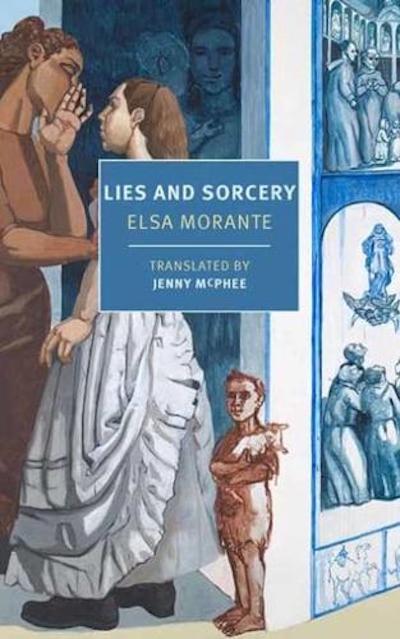
Lies and Sorcery, by Elsa Morante, translated from the Italian by Jenny McPhee. New York Review Books, October 2023, $24.95. ISBN 9781681376844
Elsa Morante’s Lies and Sorcery, in a new translation by Jenny McPhee, recovers some 200 lost pages originally cut in the first English translation of the novel. While this is no small transformation, measuring the evolution of a translated text simply in terms of pages recovered falls short. Improvement itself might not be a useful way to think of the process of revisiting, retranslating, and republishing. Such a task is never so simple as to befit the categorization of better, the same, or worse.
In trying to understand what it is about translation that defies “improvement,” I found myself coming back to the vision of a haunt. The dredging up of an old story may very well be its own form of haunting. Among the endless metaphors for translation, the one I find most fitting in this case is the representation of the original text as a phantom. This phantom, in haunting its living counterpart (that is, the translator), creeps up from behind. It pulses against the newly live body of the text and with a shadow not quite visible to the living ranks (that is, the readers in the target language), it clings to the text with an eerie glow. Eerie because it is familiar and inseparable. Of course, a ghost is never a stranger.
By revisiting the first American translation of Morante’s book by Adrienne Foulke, McPhee has peeled back another layer of the text, and in doing so, she has contributed to the re-livening of its spirit. The 1951 translation of Menzogna e sortilegio into House of Liars, though perhaps a punchier title, is less linguistically faithful to the original Italian. The insistence on the more straightforward transliteration, Lies and Sorcery, reflects much of the ethos behind McPhee’s translation style. In a novel so concerned with setting the record straight, with extracting the truth out of the past, it is a commendable act from the translator to make this first act of insistence towards a perhaps more truthful account.
So, with nearly 70 years between the two iterations, a discussion of the differences between McPhee’s 2023 translation and Foulke’s 1951 English translation can and should transcend the pitfalls of a simple mistake/correction paradigm. Although the 1951 translation seems by all accounts to have been a travesty (cuts so drastic and severe that Morante herself called it a “mutilation”), I find it interesting that the present state of the novel is now haunted by its past. Through the act of translating, the translator resurrects the text, fanning flames from the dormant ashes, until it can once again assume command of its own survival, regardless or in spite of its lineage.
What’s important about a new translation, and what makes this case enticing, is that it has the same effect as a conversation with a ghost. It challenges the notion of temporal advancement. It is both a regression, back into the haunted house of its past, and an emergence, a restructuring, a renovation.
The new edition from NYRB includes an introduction from McPhee herself, in which she calls the story “a searing dissection of the vanity of aspirational existence in a stratified society… a depiction of humanity’s eternal stagnation” (viii). True, then, that the ghosts linger on. But, as in the case of the book’s narrator, Elisa, McPhee gets comfortable with the ghosts of this story. Otherwise, how would one uncover what is really underneath?
This is where the business of the narrator, writer, and translator converge. Of course, introducing the idea of truth into a translation invites doubt. The translator is necessarily unfaithful, they stretch and twist and break. What matters is the success of the spell, as in, how well the text makes good with its ghost. In her introduction, McPhee dubs Elisa a “witch with a pen.” Narrator and translator alike are implicated in this act of spell work, though perhaps the effect is less binding than it is conjuring. As McPhee says: “If there is a glimmer of hope, it lies in the act of writing.”
Lies and Sorcery was Elsa Morante’s first novel, edited by a then-young editor at the Italian publishing house Einaudi, Natalia Ginzburg. Morante began writing Lies and Sorcery while in hiding from the German occupation of Rome in a town outside Naples. The novel very much reflects the frightened and suspended immobility of its author. The characters emerge from Morante’s own familial history. Citing Don Quixote as an exemplary model for the sort of baroque, bourgeois epic from which Lies and Sorcery gets its style, Morante’s narrator manages to alchemize the spirits of her past into narrative form. The phantoms, once bound in text, loosen their grip. Still, Elisa makes for a Miss Havisham-like figure, weaving together the tales of her familial origin in isolation in her room, surrounded by the phantoms of her dead relatives.
Most of the novel describes the events leading up to Elisa’s orphaning at age 10. We know that, in the years since, Elisa had been living in the care of an “immoral woman” who, by the time the story begins, has also just passed away. Alone and in the sole company of ghosts, she begins her tale with the story of her grandmother’s girlhood and marriage, followed by her mother’s own ill-fated affairs; eventually, the historical narrative catches up with living memory. By the final act of the novel, Elisa corroborates the years of her mother’s life with the fraught recollections of her own childhood memories.
The long epic makes for a peculiar reading experience, as mysteries slowly become unraveled and the reader makes guesses which Elisa confirms or denies. She opens her tale with a dedication to her mother, Anna, “or rather, To the Fairytale,” and it is with this bitter concession that the great trick of the novel commences. Elisa’s writing is such that she strains for distance, striving for something like objectivity, a quality which readers of Elena Ferrante will recognize. One could almost forget that these characters are not historical figures or invented mythologies but the members of Elisa’s own family. But although this narrative distance is a futile effort, it is no less worth undertaking. Even Elisa must admit that, in her noble attempts to set right the matter of her family’s peculiar fate, she is tragically and necessarily compromised. “I have tried often in these pages to be severe with her,” Elisa writes of her mother, “but every time I believed I was condemning her, I soon realized I was writing her a love poem” (705).
Recognition of the falsehoods in her family’s history is an essential element of the narration. In the novel’s dedication to her mother, Elise declares that fiction is the “lunatic garment” with which she “cloaks” herself. Her infectious narrative voice transports her reader through time and space, generation after generation, visits to ghosts and tombs and lone trains into the impenetrable night. And like a train pulling into a solitary station, lit only by the stars, we must follow her guidance, the only source of hope for the lost and weary reader. It is impossible to talk about Elisa’s voice without recognizing McPhee. Certain words remain in Italian, others seem to have been plucked miraculously, brilliantly, from the faraway corners of the kaleidoscope of the English language. Given that Morante was herself a translator, it is no surprise that Lies and Sorcery makes for such a feast of language, and, thanks to McPhee, this reincarnation brings Morante’s writing to life.
At times, as if in a haunted house, I wanted to jump out the story and escape, looking for an exit sign. The 800-odd pages can be claustrophobic, long, and winding, and if it was only a morbid curiosity for resolution which led me to the end, I might have been able simply to finish and put the book away. But the story felt impossible to put down, impossible to leave behind.
The book ends with an apt, if peculiar, “Ballad for Alvaro the Cat.” Alvaro is a reprise of a character whom Elisa only briefly mentions at the very beginning of the novel. He is her “mysterious companion,” described simply as nonhuman. What appears at first a menacing, formless presence turns out by the end to be a beloved pet cat. It is with this ballad that Elisa seems to cast out the hauntings of her past, and she finishes her story with an amicable reclamation of the unknown, having set right the unsettled fissions of her past, to the extent such a task is possible. To return, briefly, to the original title, I’d like to note that another English translation for the Italian word sortilegio is divination. Divination, like sorcery; an application of order to the unknown by supernatural means.

Elena Schafer received her B.A. in English and Spanish from Michigan State University and worked in academic publishing in New York City for two years before returning to the Midwest to complete an M.A. in the Humanities at the University of Chicago. While completing her M.A., she wrote about the role of authorship and translation in Elena Ferrante’s Neapolitan Quartet. She is currently a Writing Advisor at the University of Chicago and is interested in Spanish-English and Italian-English translation.
Originally published on Hopscotch Translation
Tuesday, January 14, 2025

 hopscotchtranslation.com