
The Office, The Daily Show, and Waiting for Godot: Three Reflections for a Translation Practice
by Amanda L. Andrei
What if there were a move towards translation that invoked the pleasurable, the nostalgic, the pop culture laugh-out-loud nature of Comedy Central?
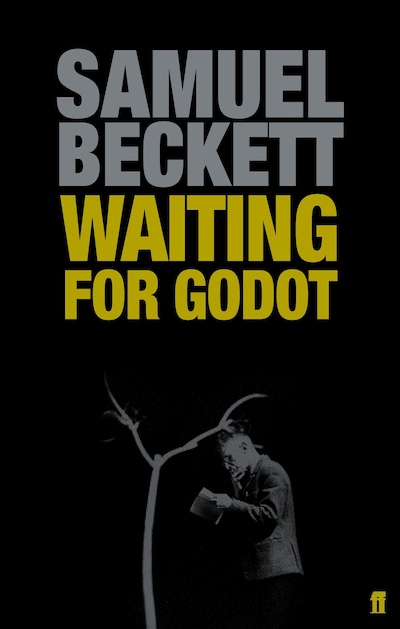
“It’s funny because it raises so many questions,” I overheard an audience member say about Waiting for Godot during intermission. “It’s funny,” they emphasized to their partner. “Right?”
They meant “funny” in a humorous way and not so much a strange way, but both meanings are apt for the recent Geffen Playhouse production of Samuel Beckett’s tragicomedy about two eccentric men anticipating the arrival of an enigmatic man named Godot. In fact, the multiplicity of meanings packed into this specific production and the feelings that arose—confusion, mirth, headiness, absurdity, boredom, strangeness—spoke to me most strongly as a literary translator, accustomed to such feelings when in the midst of translating. Produced in association with Gare St Lazare Ireland, the show became an opportunity to reflect on my translation practice and glean three insights (or provocations) for translators to consider in their own processes.
The echo of past roles and their influences on an experience
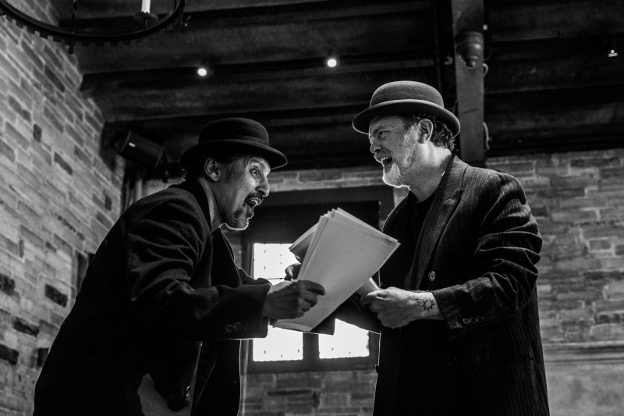
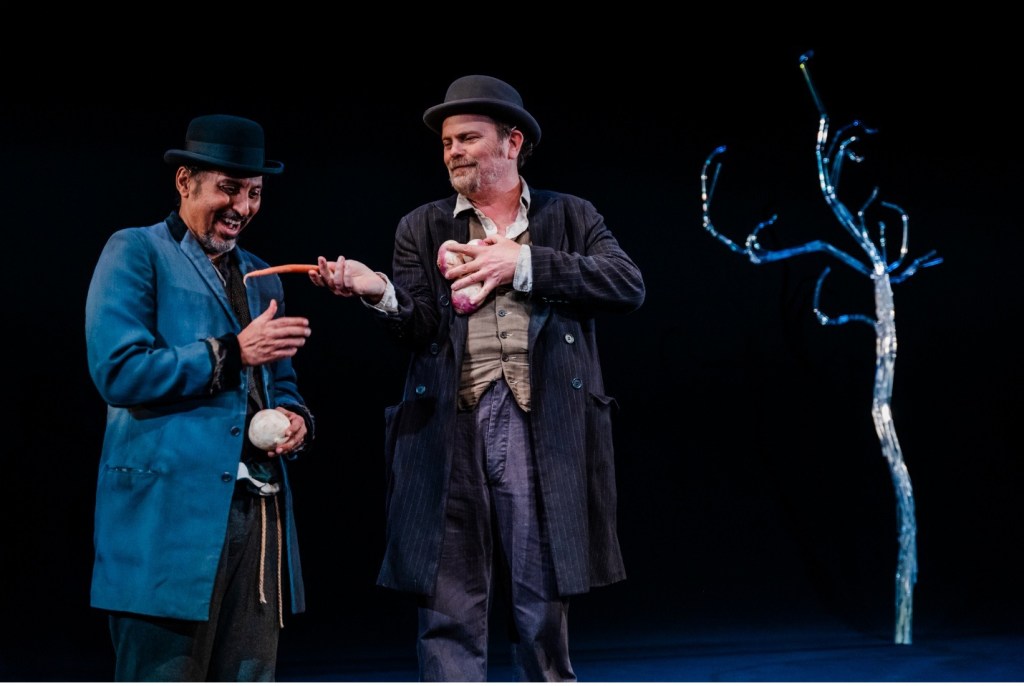
I admit: I was intrigued by this production because of its stars. Rainn Wilson, known as the eccentric paper salesman and beet farmer Dwight Schrute on The Office, and Aasif Mandvi, known as one of the correspondents on The Daily Show, take on the roles of Vladimir and Estragon, the two “tramps” in this purgatorial landscape. Vladimir and Estragon quibble, joke about hanging themselves, and pull and eat vegetables from their overcoats. In coming to this Western canonical play, I felt the gravitas of Beckett’s reputation descend—here, a great piece of theatre upon which to philosophize grandiose universal truths! But in seeing Wilson and Mandvi, my expectations also mingled with hopes that another contemporary Western canon—televised comedy—would bring with it the pleasurable and nostalgic feelings of time spent watching Comedy Central with friends. It’s not so much that I was expecting to see the character of Dwight Schrute as the character of Vladimir—but rather wondering how the echoes of past roles would come to life before us. How would someone like Rainn Wilson or Aasif Mandvi, shedding the persona of a previous character well-known by millions, step into the visages of these older, contemporary classical characters?
Director Judy Hegarty Lovett anticipated this concern. In the playbill interview, she noted, “I think what has happened is that, not unlike Joyce, Beckett has been kept in an academic box. Somehow and somewhere along the way it was believed to be a play for intellectuals, and that’s a great pity, because it’s a play written for everybody.”
How often have similar questions or notions been raised about literary translation? Before I began literary translation as a creative practice, I had the impression that it was an activity conducted by academics as a byproduct of their in-depth studies, or as a practice that demanded high degrees of fluency. These concepts became superimposed onto ideas of intelligence, intellectualism, and utility. What if there were a move towards translation that invoked the pleasurable, the nostalgic, the pop culture laugh-out-loud nature of Comedy Central?
Here’s a hint from this Geffen show: an unexpected feeling of pride.
Amidst Beckett’s absurd situations and dialogue, I found myself proud and inspired to see Wilson and Mandvi, not merely as actors or characters, but as theatremakers who were stretching themselves beyond the confines of their popular character personas. I feel similarly for translators, especially those for whom literary translation is part of their creative process. How wonderful to see a translator stretch and grow into new roles, whether that might mean changing the type of work they translate or experimenting with new strategies that speak to new audiences.
Stuplimity and the consequences of overthinking
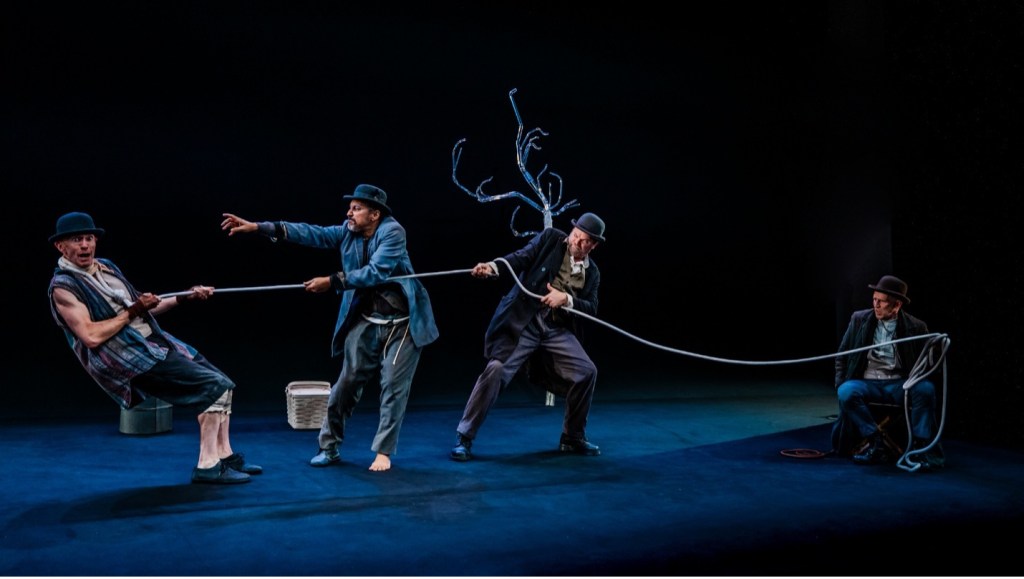
And yet, despite knowing that this play operates on its own dream logic, I found my brain racing to attribute meaning to all the absurdity. Estragon repeatedly falls asleep, and when Vladimir orders him not to share his dreams with him, Estragon’s ambiguous gesture and statement, “This one is enough for you?” hold multiple meanings of the performance (or the script of the play, or the scene itself) being a reenacted dream. I found myself exhausted as other bizarre characters burst in: Pozzo, a bellicose man tugging a rope slung around the neck of Lucky, an abject man docile towards his master, and a small unnamed boy who appears to be a messenger for the elusive Godot. Everything felt pointless yet also of great importance. In short, I was experiencing “stuplimity,” a tension of the stupid and sublime.
Stuplimity is an experience “in which astonishment is paradoxically united with boredom,” notes critic Sienna Ngai, with features including irritation or agitation mixed with fatigue and desensitization, most often found in the arena of lowbrow humor, peppered with gags, crude references, and seemingly inane wordplay. Beckett’s work is a constant source for the stuplime, with characters that appear to go nowhere and language that feels thick and inane, yet somehow resonant. Why would anyone ever want to experience the stuplime?
Ngai suggests that stuplimity potentially creates a secondary space in its wake, one that is “strangely neutral, unqualified, ‘open.’” It’s through the tension of boredom and astonishment that the audience might create a clearing or a state of awareness upon which to reflect (or, she suggests, to resist). I find that this clearing, however, is open but not empty. Because of the bare stage with only the mysterious feeble tree (designed by Kaye Voyce), harshly lit with contrasting shadows and white (designed by Simon Bennison), the clearing is more like a Rorschach test. The performance acts like an aleatoric mirror and audience members learn more about themselves than about the stage images they have witnessed.
This affective state reminds me yet again of my translation work: how I have meditated on a word or a punctuation mark to the point of disillusionment only to return to my original choice for translation, like Estragon and Vladimir deciding whether to leave in Godot’s absence, or continue waiting. How the congestion of language, exemplified in a nonsensical monologue by Lucky (expertly portrayed by Adam Stein), reveals its arbitrariness, and, at times, how translation can feel so absurd. Here, this production takes those internal translator feelings and presents them collectively, thereby allowing me to see that my feelings of absurdity are not merely mine, but part of a greater phenomenon of language that can be broken, reversed, and overwhelmed. And experiencing stuplimity in a theatre, where the requirements for attention and patience are greater than in books or television, offers an opportunity to truly sit in the discomfort of words and the act of waiting.
Untranslatability as an opening for transcendence
Waiting for Godot is a play that calls for silences, pauses, and stillness. I find that American theatre audiences, particularly in L.A., can often be uncomfortable with these moments and strive to quicken the pace or to inject a silent moment with laughter or sound. While this production maintained silence between the characters, it was overlaid with an ambient drone that gave a touch of the uncanny to the piece, bordering on the supernatural. In some ways, the low tone added some grounding for the audience, though I found myself wishing for more awkward silence, the jagged edges of quiet amidst the rush of words and violence onstage.
The awkward silence can serve as a somatic parallel to the concept of untranslatability. An awkward silence makes people itchy, makes us smile or look away, makes us try to make meaning from an experience full of discomfort. I feel similarly with something that feels “untranslatable,” something that feels it would require excessive words in the target language or would be cut out from a text because it would be too uncomfortable or unruly for a reader or spectator. I feel the translator’s burden to make tradeoffs. And Waiting for Godot is less about tradeoffs and an economy of equivalence, and more about probing the world through extremes and bizarre logic.
“This is awful!” Vladimir declares in the silence, receiving a hearty laugh from the playhouse. It was a sign that actors, characters, and audience were in the same boat, that the people onstage knew how ludicrous this was to those offstage. He and Estragon continue:
ESTRAGON: Sing something.
VLADIMIR: No no! [He reflects.] We could start all over again perhaps.
ESTRAGON: That should be easy.
VLADIMIR: It’s the start that’s difficult.
ESTRAGON: You can start from anything.
VLADIMIR: Yes, but you have to decide.
ESTRAGON: True.
[Silence.]
VLADIMIR: Help me!
ESTRAGON: I’m trying.
[Silence.]
In between moments that are attempts to be creative and generative through words and desire, it’s these silences that held the greatest potential for feelings of transcendence, one that comes through durational discomfort as opposed to a one-time thunderstruck revelation. And it’s not a transcendence that lingers. The bare tree and rubbish on the ground, coupled with the sonic atmosphere, are sensory reminders of the tense, long-term situation of these two tramps.
In our own processes, how do we experience durational discomfort, and how do we deal with untranslatability? Is it something that makes us itchy, something that we feel we need to solve or appease? Do we rush to remedy awkward silences, or do we trust that the right audience would be ready to receive them?
Interestingly, Samuel Beckett was a self-translator, writing a version of Waiting for Godot first in French, with a Paris premiere in 1953. Two years later, the English version debuted in London. The Irish playwright was well aware of the differences between his two texts, as well as the critical discourse around his play, making him a fascinating figure as both a dramatist, translator, and multilingual person.
Roughly seventy years later, with this play performed in Los Angeles by prominent comedians (and soon to receive a Broadway revival with Keanu Reeves and Alex Winter of Bill and Ted’s Excellent Adventure fame), I hope the productions challenge American audiences in ways that leave them unsettled and open to reflection and resistance. There is no doubt that Waiting for Godot raises questions and has the capacity for both humor and philosophy, but I find in our current social moment, we must also examine our relationships with confusion, boredom, and stupor, especially when these states come in a deluge and leave us exhausted. These conditions clear the way for a secondary space as fragile as the leaves on a dying tree. How we translate that space is up to each of us.
References
Beckett, Samuel. The Selected Works of Samuel Beckett, Volume 3. Grove Press, 2010, pp. 53-54.
Ngai, Sianne. Ugly Feelings. Harvard University Press, 2007, p. 271.
O’Connor, Olivia. “His Writing Sustains.” Program for Samuel Beckett’s Waiting for Godot at the Geffen Playhouse, Los Angeles, Playbill, 2024, pp. 22-5.
Uchman, Jadwiga. “Crossing the Borders of Language and Culture: Samuel Beckett’s Waiting for Godot.” Text Matters, 2(2), 2012.

Amanda L. Andrei is a playwright, literary translator, and theater critic based in Los Angeles. She writes epic, irreverent plays that center the concealed, wounded places of history from the perspectives of diasporic Filipina women, and she translates from Romanian to English with Codin Andrei, her father. Recent translations include Tatiana Niculescu’s Brancusi v. United States and Oana Hodade’s Scenes from the Life of the Family Stuck. MA: Georgetown, MFA: University of Southern California. www.amandalandrei.com
Originally published on Hopscotch Translation
Tuesday, February 25, 2025

 hopscotchtranslation.com