
Post-War, Lesbian, Heretic: A Review of Selma Asotić’s Say Fire, Translated and Reworked by the Author
by Denis Ferhatović
Asotić represents a courageous poetic voice singing lesbian desire in Bosnian, switching between its torments and enchantments.
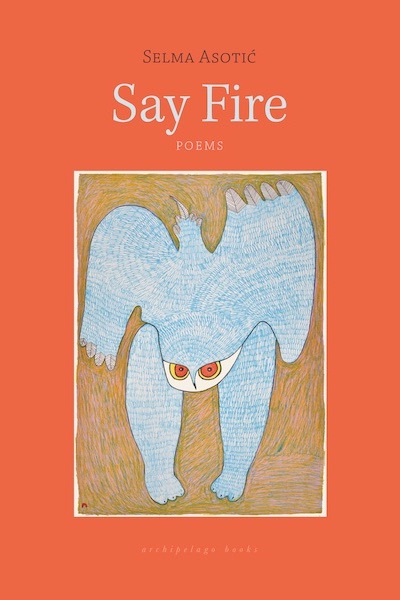
Say Fire: Poems by Selma Asotić, translated and reworked from the Bosnian by the author. Archipelago Press, 2025, 52 pp, $16. ISBN 9781962770439
Unfortunately, it is not our delectable cuisine – the sweet spot between the Mediterranean/Ottoman and the Central European/Austro-Hungarian cooking – or musical achievement in multiple genres (folk, pop, rock, turbo folk, rap, and trap) that comes to mind when Western Europeans and North Americans hear the word “Bosnia.” If anything at all comes to mind, it is the war that began in 1992 and ended in 1995, with the two particularly gruesome events being the siege of Sarajevo and the genocide in Srebrenica. Selma Asotić’s poetry collection Say Fire does not shy away from confronting the ravages of the military conflict and its aftermath, three decades later. Born in 1992, the poet strikingly anthropomorphizes war, showing its constant, embodied presence, in one of her most memorable poems, “Lessons from a war.” There, she depicts the war following the lyrical speaker in her wanderings abroad, as the personified war develops a cough and needs to be taken to the bathroom to vomit. “Lessons from a war” ends with an affirmation of belonging to war, “because there’s nothing / left to do, and there’s no one else here, / except you and your war” (35). Yet, the rest of the poem makes it clear that war is not a condition peculiar to Bosnia or the wider region of the Balkans, but rather a global phenomenon that can easily spread, and that the international community, including the United States, is implicated. Asotić mentions “CNN’s chyron,” “an UNPROFOR peacekeeper,” and Orientalist statements in the US media such as a New Yorker writer’s tweet “compassion is not the first thing that comes to mind / when one thinks of the balkans” (34-35).
While the lines I cite above stay close to the Bosnian version mentioned in the colophon, Reci vatra (published in Belgrade in 2022), the poem immediately following “Lessons from a war,” entitled “they descend upon us,” contains references that confront the American reader more directly. Here Asotić satirizes foreign scholars of genocide who dehumanize us by using our suffering as a chance to build a career. “Dolaze po nas” speaks of “zapadni doktoranti” [Western Ph.D. students] and “Noa iz Osloa” [Noa from Oslo], whereas the English text has “the American PhDs” and “Nick from Connecticut.” (The excruciatingly literal translations are the reviewer’s.) To Noa, the lyrical speaker says: “tvoja mama na telefonu sa drugaricom tako mi je drago što je imao jedno takvo iskustvo.” [your mom on the phone with her (female) friend I am so glad that he had one such experience] (40), but to Nick: “your mother on the phone to Aunt Linda I’m so glad he gets to have this experience.” (36). Noa’s name “pristaje svaki font” [fits every font], and Nick’s name is “Garamond-friendly,” which reminded me of my own exhilaration when Garamond first allowed South Slavic diacritics a few years ago. I should note that Asotić is currently pursuing a Ph.D. at the University of Massachusetts, Amherst, but in comparative literature. (During one poetry reading, she stated, with her signature dead-pan expression, that now she has an even worse opinion of academics [Mattingly and Asotić, around the 14:40 mark]) The English version approaches the outsiders on a more confrontational and personal level.
But I do not want to suggest that Say Fire concerns itself entirely with war and its aftermath, however central these topics might be to the work. For the remainder of this review, I will briefly discuss two crucial, interrelated threads: queerness and heresy. Asotić represents a courageous poetic voice singing lesbian desire in Bosnian, switching between its torments and enchantments. She belongs to a relatively recent boom of Sapphic writing in BCMS (Bosnian/Croatian/Montenegrin/Serbian) that includes Lana Bastašić (b. 1986), Lejla Kalamujić (b. 1980), Antonela Marušić a.k.a. Nora Verde (b. 1974), Radmila Petrović (b. 1996), and others (see the bibliography for a selection of their works available in English). Both Say Fire and Reci vatra center lesbian experiences with such titles as “First time in the only lesbian bar in my town” and “Coming out,” that is, “prvi put u jedinom lezbijskom baru u mom gradu” and “coming out.” Amidst haunting images of apocalyptic surrealism, Asotić depicts a yearning for connection. “Monologue for a second date” / “monolog za drugi dejt,” which consists of a Kharmsian list of ways to die imagined by the anxious speaker, concludes tenderly: “I squeeze my eyeballs shut / and think of you. I think of you / in as many ways as the rain falls” (33) or “Tad stisnem očne jabučice / i držim se čvrsto. Tad mislim o tebi. Mislim o tebi / na onoliko načina na koliko ih pada kiša” [That is when I squeeze my eyeballs shut and hold on tight. That is when I think of you. I think of you in as many ways as the rain falls] (37). “My Father and I, seven fathoms later” / “otac i ja, sedam hvati kasnije” remembers a summer vacation in childhood when the speaker felt an early pang of erotic longing for a young fruit seller with a trace of perspiration on her clavicle.
Within these poems, the Bosnian often indicates the female gender of the speaker and/or the other person through grammatical forms. The English is incapable of doing it to the same extent. For example, in “otac i ja, sedam hvati kasnije,” the speaker says “Iskušavala sam koliko blizu / mogu prići ivici” [I was testing how close I could approach the edge] and “Tada sam spoznala / prednosti praznine” [At that time I realized the advantages of emptiness] (16) using feminine participles (bolded by me here). “My father and I, seven fathoms later” has for these lines “I was testing / how close I could get to the edge” and “That’s when I learned / the advantage of being hollow” (20). In the surreal “aubade s temperaturom 41” [aubade with a fever of 41 (Celsius)], the speaker states “nismo naučile ništa” [we did not learn anything] and
Na praznu parcelu vriska
uselile smo luna park,
jele kukuruz dok su se u brdima
kotile jeseni. (14)
[On the empty building lot of a scream, we moved an amusement park in, ate corn while in the hills, autumns dropped their litters.]
The bolded forms are feminine plural in Bosnian, referring to two women, likely a couple – a suggestion that follows additionally from the title. In “Aubade with a 104° fever,” we read “we never learned a thing” and
On a scream’s empty parcel we set up
an amusement park,
munched on corncobs while in the hills
autumns multiplied. (13)
There is, once more, no indication of gender, but the clustering of poems dealing with lesbian desire encourages us to read as such even those that do not contain explicitly feminine referents in English.
Besides queerness, heretical thought, sometimes with a long poetic pedigree, permeates both incarnations of Say Fire. Several poems take up and contest Muslim beliefs and practices. “Nana,” an incandescent elegy for a tough female ancestor, contains specific religious references like “Ramadan” and “Iblis” (42-43). The speaker dreams of her grandmother carrying “the one hundredth / name of God” on her back (43): “na leđima joj stoto/ božje ime” (48). According to the tradition, this name is hidden. The poem ends with the lines “I call her haqq. / I call her nur.” Al-Ḥaqq and An-Nūr, “the Truth” and “the Light,” are two of the ninety-nine beautiful names of Allah. The former has a long history in Sufi poetry. The poet Manṣūr Al-Ḥallāj (c. 858-922) was executed because he exclaimed “I am the Truth” (“Anā al-Ḥaqq”) in a moment of ecstasy. Agha Shahid Ali (1949-2001) – like Asotić, a queer Amherst poet of Muslim background – speaks of “crucified Mansoor [who] was alone with the Alone” in the ghazal “By Exiles” from his collection Call Me Ishmael Tonight (2003). Faiz Ahmed Faiz (1911-1984), a revolutionary Urdu poet, embeds Al-Ḥallāj’s exclamation, in its original Arabic, in his famous poem of protest against the Pakistani dictator Zia-ul-Haq, “We Shall See” (“Hum Dekhenge”); there, the unity is between the speaker and the masses. But while poets like Ali and Faiz see in Al-Ḥallāj an assertion of a self in fusion with the transcendent, whether God or Revolution, Asotić claims the grandmother figure in “Nana” to be the divine. Instead of “I am the Truth,” she states “She is the Truth.”
In both its Bosnian instantiation and transformed by the author into English, Asotić’s poetry collection takes the readers’ breath away with its relentless exploration of suffering and surrealism, but it also leaves them moments of unorthodox power of women and lesbian desire despite all the odds.
Bibliography
Bastašić, Lana. Catch the Rabbit. Translated by the author. Restless Books, 2021.
Kalamujić, Lejla. Call Me Esteban. Translated by Jennifer Zoble. Sandorf Passage, 2021.
Mattingly, Stacy, and Selma Asotić. “Writing Across Borders: A Reading & Conversation with Selma Asotić.” EU for You. April 24, 2024. <https://www.youtube.com/watch?v=x49mSWkoxuc>. Accessed October 7, 2025.
Petrović, Radmila. My Mom Knows the Kind of Things that Happen in Cities (a selection of poems). Translated by Maša Dabić and others. Versopolis.
<https://www.versopolis.com/poet/547/radmila-petrovic>. Accessed October 7, 2025.
Verde, Nora. My Dowry (an excerpt). Translated by Will Firth. CriticalMass.
<https://www.kriticnamasa.com/item_en.php?id=1732>. Accessed October 7, 2025.

Denis Ferhatović is an associate professor of English at Connecticut College (New London, CT, USA). He has published translations from BCMS, Judeo-Spanish (Ladino), Karaim, Kosovo Gorani, Old English, and Ottoman in The Riddle Ages, Turkoslavia, The Trinity Journal of Literary Translation, DoubleSpeak, and Ellipse Magazine. His reviews of translations have appeared in Asymptote, Exchanges, and Reading in Translation.
Originally published on Hopscotch Translation
Tuesday, October 14, 2025

 hopscotchtranslation.com