
Translating the Elliptical: On Zabel Yesayan’s Averagnerun mej
by Shushan Avagyan
To write well, objectively, Yesayan must perform foreignness: she asks the reader to “forget the author’s nationality,” to accept her as a foreigner and hence her foreign way and manner of narrating.
An earlier and longer version of the following essay was presented at the conference “Infidelities: Armenian Studies Otherwise” at the University of Pennsylvania in March 2023. Some parts of the essay have been developed in my dissertation “Traumatic Infidelities: Translating the Literature of the Armenian Genocide” (2012), other parts are revisions and revisitations of those arguments. My focus here is on infidelities in English-language translation—more specifically, how the Armenian writer Zabel Yesayan (1878–1943?) employed the ellipsis in her book Averagnerun mej to record the linguistic rupture caused by what she witnessed in Cilicia in the summer of 1909, and how the large-scale omission of those three dots affects the experience of reading her account in English. All translations from Averagnerun mej are my own.
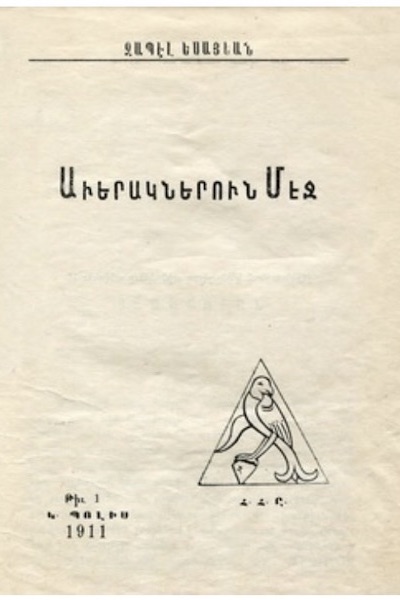
Writing between 1909–10, the novelist Zabel Yesayan produced perhaps one of the most compelling narratives in Western Armenian on the Massacres of Cilicia, which she titled Averagnerun mej [In the Ruins, 1911]. In June 1909, Yesayan traveled to Cilicia as a member of a delegation sent by the Armenian Patriarchate in Constantinople to bear witness to the destruction, assess the losses, and provide immediate material aid to the survivors. As Rubina Peroomian notes in Literary Responses to Catastrophe (1990), the literature of disaster produced by Yesayan was far removed from her earlier writings, which were predominantly works of fiction. Like any witness account, Yesayan’s Averagnerun mej is a first-person narrative that incorporates survivor testimony taken in the form of interviews, and provides the reader with comments and observations. Her tone is as objective as can be, yet charged with emotion. She invokes the concept of foreignness as an estrangement from herself and, in a larger sense, a humanity that has become bereft of its own humanity, a citizenry bereft of empathy. She writes in the Preface:
[. . .] I would like to explain here the state of soul in which this book was written. I want the reader to know that my impressions have not been modified by any kind of political orientation, nor have they been embittered by nationalist prejudice, traditional feelings of retribution, or reciprocal racial hatred of any kind. [. . .]
So that the reader would not be affected by prejudice and preconceived feelings, I would have even liked them to forget the author’s nationality in order to remember that what these pages speak of—sometimes pain, sometimes indignation, sometimes sorrow, sometimes despair—comes from human sentiment alone.
My task, then, is to communicate to all the members of our nation, as well as our [Turkish] compatriots who have remained strangers to our instincts and our pains, the black life of infinite misery that I lived during these three months. (7-8)
To write well, objectively, Yesayan must perform foreignness: she asks the reader to “forget the author’s nationality,” to accept her as a foreigner and hence her foreign way and manner of narrating. By employing this “foreignizing” device, Yesayan abstains from familiar references or practices, starting with the very genre of the text. She abandons fiction in order to explore a new terrain that is foreign to her—the realm of nonfiction.
The first chapter, titled “To Cilicia,” opens with a description of the night before the delegation’s arrival in Mersin: “The more we approached the threshold of catastrophe, the more reality escaped my perception and I earnestly couldn’t believe that tomorrow morning we would arrive in Mersin—Adana . . . Cilicia . . . ! For weeks those names had been lodged in a corner of our mind—there was an open wound there, which, when touched, shook your whole being with a painful shudder” (10). Besides being the literal translation of the Greek word τραῦμα, the trope of the wound evokes Josef Breuer and Sigmund Freud’s 1892 conception of psychical trauma as a Kränkung, an injury, a mortification—“a foreign body” within one’s mind. The opening in Yesayan’s testimony is suggestive of an arrival, which strangely resembles a flight from a traumatic landscape, a desire to postpone the witnessing of catastrophe, and hence a deferment of the encounter with catastrophe itself. The description that follows this statement is nothing if not uncanny in the Freudian sense; Yesayan is filled both with an “impatience” to see and witness the ruins after the catastrophe and a foreboding horror, which she paradoxically anticipates, as though it were something already familiar: “The very idea of being thrust into the chest of catastrophe filled us with melancholy impatience, and although we silently paced around the deck of the steamship until late in the night, without communicating our feelings to each other, I was convinced that the same feverish curiosity had been occupying everyone’s minds” (11). For her, Cilicia, the historical home of the Armenians, has acquired a new quality of unhomeliness, both literally (as homes have been destroyed and families murdered) and figuratively; the name Cilicia is now associated with trauma.
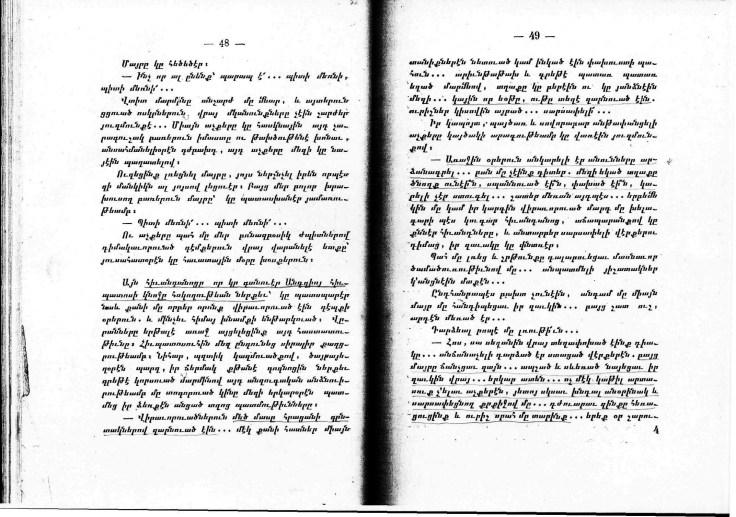
From time to time Yesayan returns to the pervasive shameless gaze of those who had committed the crimes and the shame of the survivors who were called to testify to their own dehumanization. In The Historiographic Perversion, Marc Nichanian analyzes testimony as the confession of shame, proposing that “shame itself is its own testimony” (118). Here, too, one is confronted with strangeness, a strange emotion, when a person is asked to reveal a wound, to show it in public: “One can try to say of what one is ashamed, but shame itself, how could one say it, communicate it verbally? It can come to the surface in the form of a blushing, a terror. It can invade me, seize me, no longer leave me” (Nichanian 118). Yesayan describes such a scene in her fourth chapter on the orphans, in which she narrates her encounter with an eight-year-old girl who had been raped. Feeling utterly “bewildered and ashamed,” Yesayan holds the child’s hand “without asking any questions” (41). For Yesayan, asking the girl for a testimony is “something as monstrous as complicity in the crime” (41). The discourse of testimony, as Nichanian argues, is the discourse of the executioner defying the survivor to prove her trauma, over and over again, only to refute it. Yesayan declares that we cannot exclude the survivor from humanity and from truth if she cannot produce words to testify; there is no need to repeat the details, one need only look into the eyes of the child to see her trauma:
Oh, the slight, pain-stricken . . . forsaken creature! Where in that little body had the terrible sorrow made its nest? How her muscles were still throbbing, nerve by nerve, with revolt at the abuse that she had suffered . . .
A stupefying heat surged into my brain.
—Mairig . . . ! Mairig . . . !
Was it she who enunciated that supreme call, like the other orphans, who often sought their mothers when they were in pain or homesick, or was it I who cried out those words? I do not know. I took her in my arms, rocking her weightless body on my knees, so that in my frantic sorrow, she might at least momentarily forget her own, forget herself . . . (43-44)
Here Yesayan breaks the boundaries between self and other in order to step outside of herself and to show unconditional empathy in an instance of what Kaja Silverman, following Max Scheler, has called “heteropathic identification” (Silverman 22). In this shared moment of solemnity, Yesayan offers her own voice to mourn the girl’s suffering, so “she might at least momentarily forget” that which is impossible to name, describe, or translate. Yesayan, in other words, testifies to the impossibility of testifying in language. She does not attempt to bridge the gap between the experience and language, and in fact reinforces that gap through the repeated ellipses—the silent, nonverbal manifestations of trauma that impede the flow of the narrative. This excess betrays the difficulty or impossibility of verbal expression, marking a limit that has been reached in language.
The ellipses in Yesayan act as the brittle line between the experience and its deferral, between the rational and irrational, human and inhuman, living and lifeless, crossed and re-crossed by those who perpetrated the crimes and those who suffered them. The mad frenzy of the uniformed and disciplined soldiers who used their bayonets to kill and mutilate the bodies of the dead is juxtaposed against the madness of the mothers who murdered their own children to save them from the bayonets. The bestiality of the executioners is juxtaposed against the reduction of victims to the state of animals. The life granted to a handful of orphans is juxtaposed against the deathliness of those very same children. By marking this line, Yesayan articulates the madness brought by the “Armenian policy”—the policy to exterminate members of a group regardless of their age, gender, or political affiliation. This madness is total, it invades, it cannot be contained or quarantined, it affects the survivor and witness alike, as in the case of Yesayan’s experience in the presence of the eight-year-old girl.
The discourse of madness is consistently present in all testimonies as something nonverbal and always improper like Yesayan’s ellipses that thwart the proper sentence, the coherence and fluency of the narrative. In her translation of the catastrophe, Yesayan catalyzes her own foreignness in the language that she writes by the very choice of a genre that is not her own, and she foreignizes the language of reportage by employing the ellipsis as the main trope—the sign of the untellable.
Perhaps it is this “inappropriateness,” this excess, that has led G. M. Goshgarian to remove most of the ellipses in his English translation of Averagnerun mej published by the Armenian International Women’s Association (AIWA) in 2016. My original study of this omission, included in my dissertation in 2012, referred to the three chapters of the book that appear in Marc Nichanian’s Writers of Disaster. There, the eighteen ellipses in Chapter 2, “In the Ruins,” had been reduced to six; the thirty-five ellipses in Chapter 3, “The Church Service,” were cut down to five; while out of a hundred and sixty ellipses in Chapter 4, “The Orphans,” which had been translated partially, a mere thirty-eight remained. Nichanian’s volume, which was published in 2002, included no translator’s note that would explain, among other things, the raison d’etre of the omitted ellipses. The same chapters in AIWA’s publication of the whole book contain essentially the same reduced number of ellipses as in Nichanian’s volume, despite the fact that the text has undergone a global revision. Curiously, the AIWA publication includes a two-page translator’s note at the end of the book, in which Goshgarian tersely explains: “I have followed the [Armenian] text of the 2010 [Aras] edition as faithfully as I was able to without sacrificing readability. I have, however, sharply reduced the number of ellipses in the original out of a sense that English is less tolerant of them than other languages, notably French, a language that Yesayan used often and that may well have influenced her Armenian in this respect as in others” (In the Ruins 259). It is clear from the comment that Goshgarian was familiar with my argument on what was being lost in translation through the (dis)appearance of the ellipses, and he tried to explain here, in a sentence, what had guided his approach. Whose or which English might he be alluding to: Laurence Sterne’s, William Faulkner’s, Toni Morrison’s English, or the English of the instructions on a Tylenol bottle? It is preposterous to make such statements on what the English language is tolerant or intolerant of in a post-Venutian era, when practitioners and theorists of translation have properly dismantled the myth of “fluent English” (Venuti) and of “the mythical English reader” (Hur).
Imagine reading the French novelist Louis-Ferdinand Céline’s texts, which heavily rely on ellipses and exclamation marks, without the ellipses in English translation. Céline is hailed for his excessive use of ellipses and celebrated for developing an eccentric system of punctuation. There would have been such an uproar if Céline’s ellipses—like Emily Dickinson’s dashes that once were removed by her first editors—had been edited out in the manner that Yesayan’s were. This careless—or, rather, uncaring—approach to Yesayan’s stylistic device is an example of the colonial legacies of translation that ought to be questioned and called to accountability. Translation into English should no longer be “an amusement,” as it was for Edward FitzGerald, at the expense of the text.
Works Cited
Avagyan, Shushan. Traumatic Infidelities: Translating the Literature of the Armenian Genocide. Diss. Illinois State U, Normal, IL, 2012.
Breuer, Josef, and Sigmund Freud. “On The Psychical Mechanism of Hysterical Phenomena.” In Freud, Sigmund. The Standard Edition of the Complete Psychological Works of Sigmund Freud, Volume II (1893-1895): Studies on Hysteria. Translated by James Strachey, Hogarth Press, 1974. 1-19.
Hur, Anton. “The Mythical English Reader.” In Violent Phenomena: 21 Essays on Translation. Ed. Kavita Bhanot and Jeremy Tiang. London: Tilted Axis Press, 2022. 77-82.
Letters of Edward FitzGerald, i, London: Macmillan and Co., 1894. 319.
Nichanian, Marc. The Historiographic Perversion. Trans. Gil Anidjar. U of Columbia P, 2009.
—. Writers of Disaster: Armenian Literature in the Twentieth Century. London: Gomidas Institute, 2002.
Peroomian, Rubina. The Armenian Literary Responses to Catastrophe Compared with the Jewish Experience. Diss. U of California, 1989. Ann Arbor: UMI, 1990.
Scheler, Max. The Nature of Sympathy. Trans. Peter Heath. New Haven: Yale UP, 1954. 18-19.
Silverman, Kaja. The Threshold of the Visible World. New York: Routledge, 1996.
Venuti, Lawrence. The Scandals of Translation: Towards an Ethics of Difference. London: Routledge, 1998.
—. The Translator’s Invisibility: A History of Translation. London: Routledge, 1995.
Yesayan, Zabel. Averagnerun mej [In the Ruins]. Constantinople: n.p., 1911.
—. In the Ruins. Trans. G. M. Goshgarian. AIWA Press, 2016.

Shushan Avagyan is the author of A Book, Untitled (2006) and co-author of The Women of Zarubyan Street (2014). She has translated a volume of Shushanik Kurghinian’s poetry and the critical works of Viktor Shklovsky and Boris Arvatov. She lives in Yerevan and teaches at the American University of Armenia. (Author photo courtesy of Lusine Talalyan)
Originally published on Hopscotch Translation
Tuesday, October 28, 2025

 hopscotchtranslation.com