
The Demistification of Elegy: Review of Emmanuel Hocquard’s Elegies, translated by Cole Swensen
by Samuel E. Martin
Hocquard considered poetry – and poetic elegy in particular – as an occasion to elucidate the workings of language.
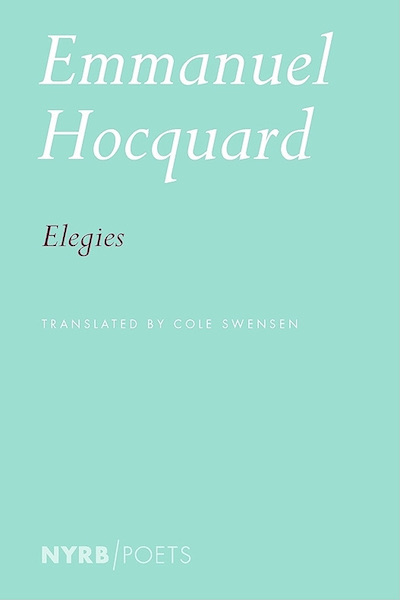
Hocquard, Emmanuel. Elegies, translated from the French by Cole Swensen. NYRB Poets, 2026. ISBN 9781681379920. 160 pages. Paperback $20.00.
In a short essay collected in Emmanuel Hocquard: La poésie mode d’emploi, Pascalle Monnier recalls that the poet harbored a soft spot for Miss Havisham in Great Expectations. Dickens’s character, she suggests, embodies Hocquard’s idiosyncratic conception of elegy. Both the grieving spinster and the Hocquardian elegist salvage the remnants of a ruined past and (re)place them at the center of a quotidian practice of repetition. When I read Monnier’s essay, I noticed that in her spelling of Miss Avisham’s name, the first letter H had evaporated, presumably because this was how she had encountered the name in a French translation of the novel. Although I felt sorry that Miss Avisham had not managed to keep her name intact, I had to admit that the new spelling could be useful for teaching French pronunciation; it illustrated the fact that the letter h is never huffed in French as it is in English. Maybe this clarifying function was another reason why Emmanuel Ocquard had been fond of the character.
More recently, during a visit to my parents in Michigan, as I pondered what to say about Cole Swensen’s new translation of the Elegies, I accompanied my father on his daily walks through the neighborhoods of Grand Rapids. It seemed a reasonable way to approach my review, given that one of Swensen’s books – my favorite, in fact – sets out “to honor the millennia-old connection between walking and writing” (OWO 109). On a snowy morning just after the turn of the new year, midway along one of Dad’s standard routes, we passed a familiar landmark.

Would Mister E. Hocquard have been sufficiently intrigued by the look of this establishment to step inside? I thought of the silent four-minute video on YouTube that shows him smoking a cigarette in Paris on April 17, 1985. And then there’s the end of Elegy 1.2:
You can come. Because you’ll never be
otherwise.
Together we’ll smoke menthol cigarettes
As we watch the second ferry leave.
And after that, well, we’ll see. (9)
“I used to smoke Benson & Hedges menthol cigarettes,” Dad piped up. “I don’t know if they’re even still around. That was a long time ago.” They are indeed still very much around – which doesn’t make them any less “elegiable” (i.e. worthy of elegy), to use Olivier Cadiot’s word that Emmanuel Hocquard cites in ma haie (my hedge). The Elegies are littered with such everyday objects; regardless of whether they existed “a long time ago” (say, in the mid-twentieth century) or a very long time ago (in the days, say, of Herodotus or Qin Shi Huang, who share space in Elegy 2.2), the poet catalogs them side by side and in exactly the same manner. By collapsing temporal and geographical distances and refusing to blur or blunt anecdotal detail with pathos, Hocquard brings the (h)edges of the perceptible world into sharp relief. As his friend Xavier Person writes:
Whereas the classic elegist likes anecdotes for the memories they represent, what Emmanuel Hocquard calls the “inverse elegist” sees the anecdote instead as a window or a clue that, however tiny, is liable to set him on a fresh track. […] It poses the question of transparency; it brings transparency into question. It is likewise a strange love story, with the clarity of a dream that vanishes or a fog that lifts. (QL 82-83)
Like Wittgenstein in philosophy, Hocquard considered poetry – and poetic elegy in particular – as an occasion to elucidate the workings of language. He also shared Wittgenstein’s taste for mystery novels, especially the hardboiled American variety epitomized by Raymond Chandler and Dashiell Hammett. In the rare instances when the Elegies appear to stray into recognizable lyric terrain (where “leaves [are] brushed by the ancient wind of winter nights,” as in Elegy 5.1), the rational, prosaic language of the private eye intervenes to set a course correction.
[…] the garden gate doesn’t creak in the rain,
which already proved nothing
And would lead us today to think that the case
is closed, that the sound of the leaves
is the sound of the leaves, and the silence,
a happy necessity. (87)
The temptation, I suppose, is to think of the translator as an elucidator in turn. Wittgenstein himself compared translating lyric poetry to solving a mathematical problem; if this proposition held for translating unlyric poetry, Cole Swensen would surely be a prime contender for this year’s Carl Friedrich Gauss Prize. Yet it bears mentioning that Emmanuel Hocquard expressed misgivings about bilingual editions of translation, precisely on the grounds that the facing-page format “implies something like the sign = between the two texts” (mh 403). In the NYRB edition of the Elegies, rather than the English words on the right-hand side “solving” or “speaking for” the French words on the left, we are looking at two distinct texts, each of which speaks for itself. No doubt this double self-sufficiency explains the publisher’s decision not to include any supplementary material with the poems. Still, I initially found myself regretting the absence of a preface of some kind. Swensen contributed a splendid essay in 2020 to Emmanuel Hocquard: La poésie mode d’emploi, which I’ve only seen in Nathalie Koble’s French translation in that volume. My sleuthing instinct tells me that the English title was “Emmanuel Hocquard: The Invention of the Translator,” but so far, no witnesses have come forward to corroborate my deduction. At any rate, the essay might have made for a fitting translator’s note, I thought.
However, there you have to admit
that time has worn nothing out.
No, in fact, everything is terribly
intact.
Who would come back to reminisce?
Because it’s here, nowhere else;
Now and thus,
Neither before nor ever other. (3-5)
Geoff Dyer demonstrates superbly in The Missing of the Somme that the First World War was fought precisely so that it would be remembered and its soldiers be missed, e.g. in elegiac poetry. Emmanuel Hocquard, the inverse elegist, would seem to have composed elegies in order that nothing be missed, including (which is to say not including) a translator’s note for the American edition.
The second reason that Hocquard gave for distrusting bilingual (and specifically French-American) volumes of poetry was that such editions create an illusion of proximity, “unless the entire North Atlantic Ocean could be contained in the fold separating two pages” (mh 403). At the top of Cole Swensen’s translation of Elegy 7.6, a buoy washes up unexpectedly on the right-hand page, as if the ocean had filled the crevice before being suddenly vaporized:
April 4
buoy
water
ice
&
snow (147)
The French word for buoy is bouée; it bobs up a few pages earlier in Elegy 7.3. The French word in Elegy 7.6, meanwhile, is buée (the o of the ocean has indeed vanished), one of three words for water vapor that occur elsewhere in the book – buée, brume, brouillard – all of which Swensen translates as “mist.” That buée should in this case have become a buoy is clearly a mistranslation in the most literal sense of the word. It is also, unarguably, a demistification. I like it.
Postscript
In one of the texts that make up ma haie, Emmanuel Hocquard details the circumstances in which, as a history student in the late 1960s, he inadvertently hit upon what would become his frequent poetic method. His professor assigned him to translate and analyze a page from a Latin historian:
The text I had to work with was a passage from Livy’s History of Rome that related the somber tale of a murder committed in Rome in 440 B.C. According to Livy, it was an open-and-shut case: a certain Spurius Mælius, accused by the nobles of the ultimate crime of aspiring to royalty, had been declared sacer by the Senate, which meant he could legally be liquidated by anyone who came along. And that’s precisely what happened. Amid widespread indifference, he was bumped off in the middle of the forum by a certain Servilius Ahala. When the murder had been carried out, people praised Ahala for having saved the Republic, and the case was closed. (mh 18)
Over the course of his own “investigation,” Hocquard determined that Livy had played fast and loose with the facts. “In reality, it had been a murder pure and simple, against a backdrop (just like in a Raymond Chandler novel) of economic and political interests that Mælius’s activities had upset” (mh 19). Hocquard chose several translated fragments from the documents he had consulted and rearranged them in the form of a poem, “Spurius Mælius.”
We have, in short, a poet who could be said to engage in legal observation of a kind, even at a remove of more than two millennia; and we have spuri(o)us justification for the brutal murder of a citizen, committed in broad daylight and approved by a dictator. The case of Emmanuel Hocquard and Spurius Mælius elucidates a great deal.
i.m. Renée Good, “woman much missed”
Works Cited
Translations from the French are my own unless otherwise indicated.
EH: Emmanuel Hocquard: La poésie mode d’emploi, edited by Nathalie Koble, Abigail Lang, Michel Murat, and Jean-François Puff (Dijon: Les presses du réel, 2020).
mh: Emmanuel Hocquard, ma haie: Un privé à Tanger 2 (Paris: Éditions P.O.L., 2001).
OWO: Cole Swensen, On Walking On (New York: Nightboat Books, 2017).
QL: Xavier Person, “Le secret de la quiche Lorraine,” in Hippocampe (Issue 14, Summer 2017, pp. 81-84).

Samuel Martin teaches French at the University of Pennsylvania. He has translated works by several contemporary writers including Jean-Christophe Bailly and Georges Didi-Huberman; his translation of Didi-Huberman’s Bark was a co-winner of the French-American Foundation Translation Prize and was longlisted for the PEN Translation Prize.
Originally published on Hopscotch Translation
Tuesday, January 13, 2026

 hopscotchtranslation.com