
“Not Sacrifice the Ease of the French”: Jean de La Fontaine, Marianne Moore, and the Principle of Equivalence (Part II.a)
by Vincent Kling
Translation as a form of adaptation is different from the much-deplored and much-misunderstood “cultural appropriation,” which projects and exploits, distorting the very nature of the original, instead of empowering reciprocal understanding and respect.
Anyone contemplating the craft of literary translation will soon encounter statements about how good or how bad a given rendering is and may wonder on what premises such assessments are reached. In the first part of this essay, we cleared away some of the false standards of judgment, especially the tendency to dismiss translations either because they contain some lexical errors or because they fall short of imagined perfection. That first part proposed two principles: Leopold Federmair calls for “equivalence,” some strong congruity—not identity—that makes the translated version balance against the original like an equation; George Saunders, concerned to help writers find their voices, judges translations based on tone, balance, cadence, and structure, not necessarily consulting the original.
These considerations arose in the first place from noting an odd phenomenon. Acclaimed poet Marianne Moore published her keenly anticipated versions of Jean de La Fontaine’s fables in 1954, only to see them greeted with reviews that were unexpectedly noncommittal, vague, and hesitant. There were some scattered negative reviews and one or two laudatory ones, but it was clear that most reviewers and later critics simply did not know what to say when faced with translations they considered faulty without being able to pinpoint why.
From this one case, then, was born the broader quest for clear overall standards for judgment, drawing on practical instances and concrete examples and avoiding the tendency of translation theory to disregard actual renderings in favor of abstractions that do not help develop responsible discriminations. We will end up returning to the starting point, Moore and La Fontaine with—it is hoped—enhanced clarity about equivalence and other applicable criteria, which can be arrived at in part by looking, over the next three installments, at 1) instances of success, 2) instances that playfully challenge the insights of Federmair and Saunders, and 3) instances of what can only be called failures.
- Equivalence: Aspects and Approaches
Hearing Secret Harmonies?: Respecting Prosody
Chatbots are being expanded and refined so quickly that any statement made at noon today about their capabilities could be obsolete by three. AI can compose a formally impeccable Petrarchan sonnet or pantoum about barbecue sauce, for example, or could conceivably write the whole history of the Germanic tribal migrations in limericks. It can produce prose “in the style of” almost any author, though with less assurance for relative lack of ability to negotiate individual formal markers. Still, a “Kafka AI Project” is working to complete the author’s unfinished novels (Rodden); GPT-4 is said to be far advanced with its version of The Trial (in German? in English?), disregarding Cynthia Ozick’s contention that it is well-nigh impossible to translate Kafka in the first place (Ozick).
When the term prosody extends beyond fixed verse patterns to include those elements of intonation, stress, rhythm, cadence, accentuation, and phrasal and clausal accretion inherent in any given language, then only the listening ear, it seems (at least for the time being), can find satisfactory equivalences between one language and another. Moving even slightly past lexical meaning (flower = Blume = fleur) calls for making judgments that require considering the heft and pace, the patterns of rising and falling emphases in a language. Equivalence means not identity but adaptation and accommodation, so the process calls for that elusive quality of Sprachgefühl, a trust in hunches, a reliance on intuition and instinct in hewing to the original while finding as complete an expression as possible of rhythm and tone, pacing and balance. It will be instructive to see what GPT-4 comes up with; if it is to work well, it will need to create the cadences and rhythms of Kafka’s German or whatever English version it is expanding. Meantime, reliance on the ear is what explains how translations, like those of Thomas Mann by Helen T. Lowe-Porter (discussed in Part I of this essay), can be effective and even forceful despite lexical errors, like performances by musically inspired pianists given to playing wrong notes from time to time.
In a recent conversation, conductor and trumpet player Bob Schiavinato proposed that translating has strong similarities to performing or conducting a piece of music, in fact, reminding me that I had made a similar point in a talk about literary translation (Kling, Acceptance Speech). No two pianists hear and play Ravel’s Le tombeau de Couperin or Schumann’s Kreisleriana in the same way, though they are reading the same score; even precise metronome markings do not guarantee that two performers will take a given work at the identical tempo. Creating an equivalence between the notes on the page and the sounds produced always involves interpretation arising from individual sensibility, taste, technique, and experience. Again, as mentioned earlier in connection with Leopold Federmair (about comparing from one language to another) and George Saunders (about concentrating on the translated text only), listeners do not necessarily have to be able to read the score in order to sense the impact of a performance; judgment begins and ends with attentive hearing. It seems appropriate, then, to requisition the title of a novel by Anthony Powell, Hearing Secret Harmonies, for designating aspects of that “between-the-lines” or “beyond-the-notes” quality of prosody without which a translation is likely to plod.
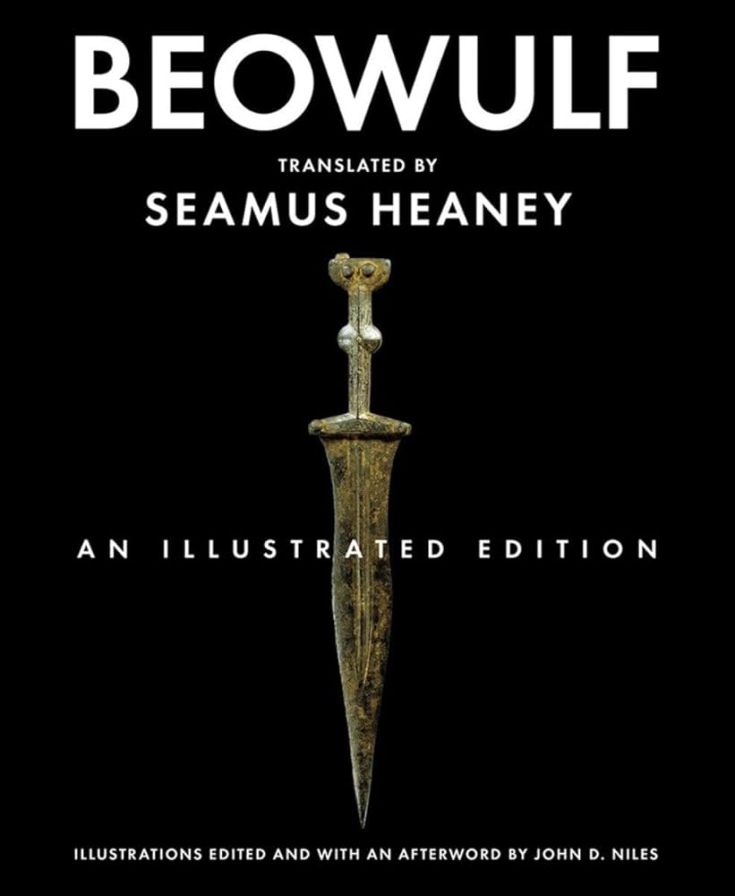
Hearing, after all, is the major faculty translators almost always stress as essential to their work. Seamus Heaney’s comment in the preface to his translation of Beowulf is pertinent: he was searching for the “tuning fork” that would enable him to find the right key and sound the right pitch for the music of the poem. He found it in the memory of storytelling in his home. He felt “. . . lucky to hear this enabling note almost straight away, a familiar local voice, one that had belonged to the relatives of my father. . . The words they uttered came across with a weighty distinctness, phonetic units as separate and defined as delph platters on a dresser shelf” (Beowulf xvi-xxvi). The common element is oral delivery, and not just in the case of Beowulf, which has undergone a revival through recitations in the original (as well as it can be reconstructed), with harp or lyre, by singer-actors like Benjamin Bagby (available on YouTube). It is no exaggeration, for that matter, to say that all literature calls for being heard, from nursery rhymes to the intricate elaborations of William Faulkner, from the formal majesty of Jean Racine to the hellzapoppin guttersnipe French of Raymond Queneau’s Zazie dans le métro. The poetic devices of Old English verse—alliteration, caesura, set number of stressed syllables per line—are first and foremost aids to memory and recitation, after all, and did not arise as aesthetic effects detached from practical function, though sound of course underpins and even enacts sense here too, as in all good literature. Comparing Heaney’s version of Caedmon’s Hymn with any other translation additionally shows the advantage of meticulous attention to sound (Heaney 88), for it incorporates more of the features of the original than do other translations while fully succeeding as a poem in twentieth-century English.
Damion Searls (108-109) proposes an organic, physical metaphor to explain the feel for the response to sound as instinctive and intuitive. “Like proprioception—the bodily sense that tells us where our body is in space (whether we’re sitting or standing, if we’re balanced or about to fall over)—the translator’s ‘ear’ is used in making countless small adjustments; it’s not a matter of conscious semantic decisions.” We hear the tuning fork, then, but it can guide us only if it is apprehended by that indwelling faculty that governs the whole organism. The scope of that faculty, its anchoring in a complete set of internal perceptions, encompasses both Federmair’s and Saunders’s criteria.
Lack of regard for sound partly accounts for the scant success of later translators in their attempts to revise C. K. Scott Moncrieff’s rendering of Marcel Proust’s À la recherche du temps perdu as Remembrance of Things Past. Clearly the title Moncrieff chose does not replicate Proust’s, and that divergence, instead of being judged a valid cultural equivalent with implications worth pondering, became one argument for calling Moncrieff’s whole project into question. But newer versions, however conscientiously prepared by competent poet-translators, seem never to have found that “tuning fork” Heaney mentions and accordingly sound awkward, even choppy, compared to Moncrieff. Adam Gopnik proposes that Moncrieff modeled his cadences on those of Henry James, whose orotund rhythms, despite considerable differences, bear marked similarity in pacing and structure to Proust’s and therefore have a companionable, kindred ring that provides an apt reference point to readers and listeners of English. In any case, revisions of Moncrieff’s work were published in 1981 and again in 1992, only to have Yale University Press bring back Moncrieff’s translation, edited by William C. Carter, and under the title In Search of Lost Time, a prosy literalism that forfeits the rhythmic elegance of Proust’s and Moncrieff’s original titles.
It is not surprising, then, that a highly acclaimed translator from German, John E. Woods, in an address and workshop he gave during a symposium held at Binghamton University in 2012, strongly emphasized the ear as the translator’s indispensable tool. Woods, whose versions of Arno Schmidt, Thomas Mann, Patrick Süskind, Alfred Döblin, Christoph Ransmayr, and other authors earned merited acclaim, stated that he would begin every day’s work by carefully reading out loud several times whatever he had produced the day before and would be certain something was wrong if he stumbled or balked. He trusted his ear as the most competent of all judges, and anyone wishing to test the efficacy of his method need only read, preferably aloud, his renderings of Schmidt, especially Evening Edged in Gold, which won the National Book Award and the PEN Prize for Translation. In persuasive testimony to his approach, Woods negotiates the extreme intricacies, the neologisms, the portmanteau words, the allusions, the double entendres, and the multilayered syntax with almost unexampled aplomb and ingenuity.
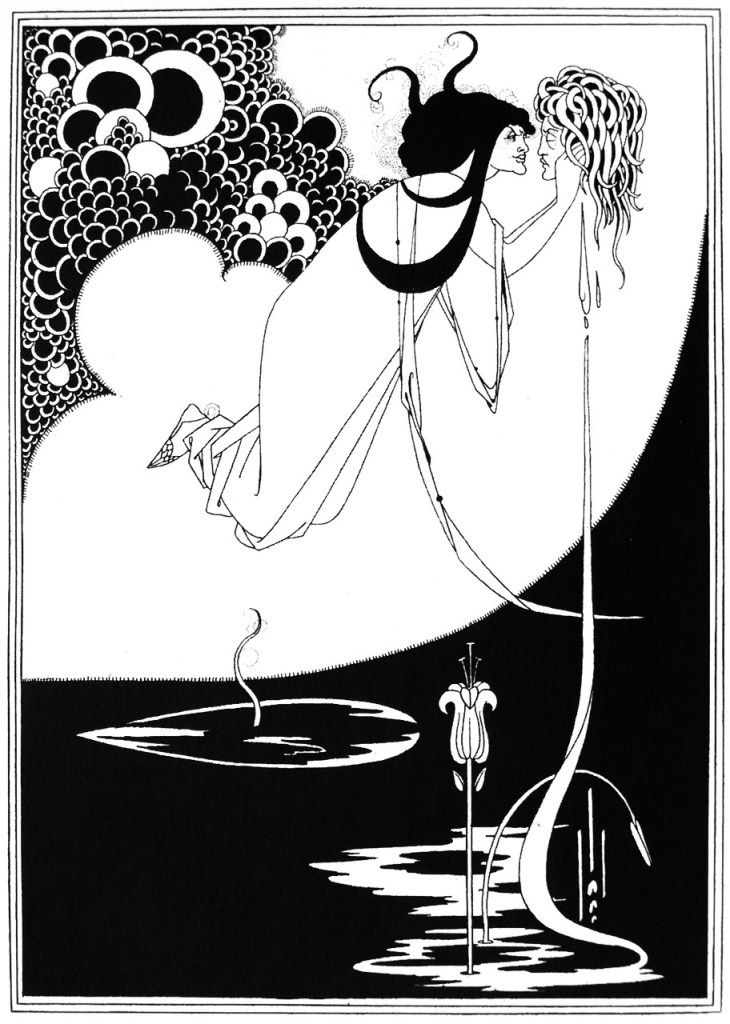
from the illustrations for Oscar Wilde’s Salomé, c. 1893-1894
Music from Earlier Times: Looking—or Hearing—Backward
Relying on the ear opens almost unlimited possibilities in capturing those secret harmonies, “secret” only because they will not align themselves in another language without patient attention. Our earlier mention of Samuel Beckett brings to mind another instance of an Irish author writing in French and translating his own work into English. Oscar Wilde composed his one-act play Salomé as a vehicle for Sarah Bernhardt and then asked his companion Lord Alfred Douglas to translate it into English. The result was so deficient, Nina Hartmann points out (29), that Wilde virtually recomposed the play in English himself to rescue the play from Lord Alfred’s efforts. We do not know what the English translation was like before Wilde revised it, but he created a different music, shifting the register of the language from a straightforward contemporary French (“Il y avait une âcre saveur sur tes lèvres. Était-ce la saveur du sang? . . . Mais, peut-être est-ce la saveur de l’amour.”) to an appropriately archaic English (“There was a bitter taste on thy lips. Was it the taste of blood? . . . But perchance it is the taste of love.”). Wilde evoked the Biblical time period by using pronouns and possessive adjectives like “thy” and obsolescent adverbs like “perchance” no longer in common use. French, largely settled into its modern vocabulary earlier than English, does not offer such ready opportunity for characterizing archaisms, but English gave Wilde an opportunity to echo “period” language, creating another kind of equivalence that moves past flat replication. Similarly, translator and poet Louise Morgan Sill selected older terms when rendering Paul Claudel’s play L’annonce faite à Marie into English. Modern “annonce” becomes King-James Biblical “tidings,” (The Tidings Brought to Mary), adding an additional aural color to both content and theme. Similarly, Dorothy Bussy, one of André Gide’s translators, was alert enough to render the titles of his works based on the Bible with wording from the King James Version: Si le grain ne meurt became If It Die, La porte étroite became Strait is the Gate, Les nourritures terrestres became The Fruits of the Earth. Any non-Biblical equivalent would have missed the tone.
That strategy of reverting to an authentic-sounding older layer of a language—again, navigated by ear—often appears within and across the Germanic languages, too, since their contemporary vocabulary accommodates older words and expressions more readily than does modern French. Across languages, Charles Archer, who translated several of Ibsen’s plays from contemporary Norwegian into contemporary English, skillfully drew on whole layers of syntax and usage, grammar and vocabulary, sentence structure and rhythmic emphasis to devise an older stratum of English in his translation of Sigrid Undset’s Kristin Lavransdatter (1920-1922), set in the early fourteenth century. Adroitly avoiding clumsy “ye-olde” locutions, Archer in effect translated British English of the 1920s into an idiom not historically anchored in any specific period but persuasive in echoing older-sounding language. Tina Nunnally, who published a recent translation of Undset’s tetralogy Olaf Audunssøn, notes how easy it was for earlier translators to fall into “awkward phrasing that gives the story a stumbling rhythm” as well as “strange syntax and wording . . . meant to imitate archaic speech patterns” (Nunnally). It is all the more to Archer’s credit, then, that his use of dated language vividly evokes a past era without oddity or quaintness; he listened carefully to capture expressions and rhythmic patterns with idiomatic persuasiveness.
Hugo von Hofmannsthal’s translation/adaptation of the early modern English Everyman by way of early modern German illustrates his effort to create a total work of art all of whose aspects would combine into a complete experience of ritual theater. He wrote Jedermann (Everyman) in 1911 but found the perfect backdrop only in 1920, after he helped found the Salzburg Festival, on the square in front of the cathedral in that city with the actual bells from the tower and voices calling Everyman to judgment. The English original was written down in the fifteenth century, and Hans Sachs composed a version in the mid-sixteenth century. Hofmannsthal amalgamated them and used other sources as the basis for his play, skillfully recreating a folk-like German from about 1550 in his aim at “modesty” (Hofmannsthal 12). Like most of such efforts, the language is not a historical linguist’s replica of “actual” spoken German at that time, but a stylization, like Luther’s translation of the Bible, which virtually codified modern German. The stanza form is Knittelvers, a four-line unit that can easily fall into doggerel. Heinz Rölleke, Hofmannsthal’s editor, says that the language gives a feeling akin to looking at old woodcuts (7) and characterizes it as “contrived in its archaizing and yet genuinely unified and consistent, both folksy and highly sophisticated” in its diction (9) (my translation). Jedermann continues to be a major offering at the Salzburg Festival each year, every performance sold out long in advance. The language plays no little part in the fascination audiences feel for this late-medieval morality play. Hofmannsthal was exceptionally adept at this kind of ventriloquizing throughout his career; Der Rosenkavalier draws on inventive French-influenced salon German to suggest the aristocratic milieu of Vienna around 1750, and Die Frau ohne Schatten uses a German replete with color and action to recreate the language and aura of a literary fairy tale.
Within languages, Marie Borroff made a virtuosic translation from Middle English of Sir Gawain and the Green Knight. Written in a West Country English harder to read than Chaucer’s, the poem features both the old Germanic devices of alliteration distributed across a caesura and the newer device of rhyme, with the alliterative lines pivoting (“bob and wheel”) into rhyming four-line stanzas. Very few translations handle these devices as dexterously as Borroff’s, especially since she is fulfilling a task opposite to that of Archer, resorting rather seldom to the color of archaism and adeptly producing a version in clear, idiomatic modern English while preserving all the structural and metrical features of the original. Archer leads the reader to the past; Borroff leads the reader to the present. The comments in her introduction show keen awareness of the need for equivalence.
It has seemed to me that a modern verse translation . . . must fulfill certain requirements deriving from the nature of the original style. First, it must so far as possible preserve the formulaic character of the language. . . . Second, the diction of the translation must reflect that of the original poem. . . . Finally, a modern translation . . . must . . . reproduce both the metrical variety of the original and its cumulative momentum. . . . I believe that I have . . . produced a translation more like the original than others I have seen . . . (Pearl Poet xii-xiii).
It might not be beside the point, either, that Borroff’s parents were both musicians and her sister Edith a musicologist and composer. (Barbara Wright, acclaimed translator of Raymond Queneau and others, was a trained pianist and music critic, just to cite another example.)
Again inside the same language, it was instructive for me, with scant knowledge of Swedish, to learn that Ingmar Bergman purposely turned to a conspicuously outdated version of his native language for his films, and not just those set in the past. Jan Holmberg, the speaker who introduced a Bergman retrospective sponsored by the Lightbox Film Center in Philadelphia in 2018, made the point that Bergman purposely set himself at odds with the image the Sweden of his time was eager to propagate—resolutely socialist and secular, modernizing its identity as the home of Volvo and Saab and Ikea, liberal in sexual matters, resolutely egalitarian, and working to cast off the burdens, as they were perceived, of general Nordic gloom and dark Scandinavian Lutheranism. Once more, the sound of the language, in this case its archaic quality, immediately orients viewers who know Swedish to the deliberately untimely thematic content.
But just as we seem to be approaching consensus about this principle of translation, we are reminded of David Bellos’s idea about the inherent elusiveness of central agreement (see Part I of this essay). Tina Nunnally, cited earlier, makes a persuasive argument against this archaizing. As her reviewer puts it, Nunnally, working deliberately to cast Undset’s Olaf Audunssøn into “everyday American English,” “outlines an interesting and perhaps not finally resolvable debate about translation and style.” Nunnally consistently uses a “clean and modern . . . style,” because she finds earlier archaizing versions “dusty and dull”; she sees herself as “an art restorer who seeks to remove accumulated grime and dust” from Undset’s prose (Sørbø 376). We are then back to the criteria advanced by Saunders (again, see Part I); the ear, the voice, the sound will ascertain functional equivalence, even when translators are working from opposite approaches.

Appropriation, Adaptation, Mediation, Interpretation?: Cultural Transfer through Translation
C. S. Lewis is falsely credited with saying, “We read to know we are not alone”; in the biographical film Shadowlands, a student tells Lewis that his father, a village school teacher, always says that to his pupils, and Lewis is impressed enough to pass it along in his seminar. False, yes, but the attribution aptly points up the ability of literature to resonate inside the reader. Aristotle argued strongly that literature does not have a moral aim but rather a mimetic function, enacting experience in a way that allows readers to identify with times, places, experiences, and cultures beyond their own and bringing about moral illumination not through precept but through observation.
Even in a work not translated from another language, that mimesis, that commonality in bridging times and places, cannot be achieved without mediation as a way of achieving equivalence. To use Faulkner’s terms, if a character’s “griefs do not grieve on any universal bones,” then there is no meaningful impact. (If any example from recent decades were needed to show this impact as real, the overwhelming reaction to the Harry Potter novels represents a triumph of mediation, of identity between character and reader.) All the more intrinsic, inherent, and inevitable in its work of mediation, then, must any translation be, striving as it does to make one culture and one language understandable in terms of another. Beyond the ear alone, beyond listening to Heaney’s “tuning fork,” the ability to find equivalence, necessarily demands that kind of cultural transmission.
Translation as a form of adaptation is different from the much-deplored and much-misunderstood “cultural appropriation,” which projects and exploits, distorting the very nature of the original, instead of empowering reciprocal understanding and respect. The translator, then, dare not be insensitive to the registers of appreciative cultural transfer. One especially egregious example of degradation and mockery through cultural appropriation, with its condescension and resultant dehumanization, was the minstrel show; no one would dream of staging one today, and blackface performances of Othello or The Emperor Jones, not taboo even a relatively few decades ago, are unthinkable today. (But in the second coming of Trump, it’s wise never to say never.) What of the widespread refusal by many pianists to play or even learn Debussy’s “Golliwog’s Cakewalk,” though, because of what is perceived in the twenty-first century—but not in the composer’s day—as racial stereotyping? This is a subject of deep concern and earnest debate, fascinating to pursue by Googling “Golliwog’s Cakewalk Controversy.” And to continue with music, was the Frenchman Ravel transgressing (despite his birthplace in the Pyrenees) when he drew on Spanish culture for “Alborada del gracioso” or L’heure espagnole or on Viennese culture for the Valses nobles et sentimentales or La valse or on aspects of Roma and Sinti culture in Tzigane? Or did he not instead create respectful, complex fusions mediating between and bringing into reciprocal illumination his Parisian milieu and those cultures from which he borrowed? What wrong did Benjamin Britten do by reverently adapting the ritualistic Nōh plays he saw in Japan to the liturgical Western ceremonies of his church parables? To prohibit works of fiction and drama, opera and orchestral music, painting and sculpture on themes and settings from, say, the Near East, Middle East, and Far East for their purported distortions would banish thousands of items. No more Scheherazade or Aïda, no more Nativity scenes, no more Symphonie Turangalîla, no more Salammbô or Turandot, no more Kim or Passage to India. Monolithic ideology would wipe out large swathes of the canon. But there is, after all, an approach to cultural mediation and adaptation that brings about mutual understanding and deep appreciation based on respect and admiration instead of stereotyping, as Goethe proved in fusing Near Eastern culture with European tradition in his West-Östlicher Diwan (1819). In this work and others that proceed from respect and even reverence, translators can find models for fair equivalences.
Mediation is often necessary even within the same language, for that matter. U.S. Americans not from the South are often baffled on hearing idioms like “The devil is beating his wife” (it’s raining but the sun is shining) or “That dog won’t hunt” (expressing doubt about a lame excuse); because Austrian German took so many terms for food from surrounding Czech and Hungarian, visitors from Germany looking at a restaurant menu may not understand what “Powidl” is (plum butter) or could be unsure when offered a “Golatsche” (a kind of danish) for breakfast. Even more important, then, is cultural mediation in translating, for the entire enterprise is an act of adaptation on the level of the very words. When we return to Marianne Moore in Part III, we will argue that she was deficient in mediation and adaptation, overbalancing in a direction of her own, listening more to herself than to La Fontaine, and overlooking a crucially characteristic aspect of his culture.
How translators understand the cultures between which they are attempting to mediate, or what assumptions they are making, conscious or otherwise, will of course affect their results. The translator’s choices cannot help amounting to an interpretation. Consider two translations of a short story by Heimito von Doderer entitled “Trethofen.” The root -tret in German has to do with kicking or stomping, and the suffix -hofen refers to a village or a town. In the story, a traveling salesman stays overnight at a small town in which the standard and universal form of greeting on the street among men is a hard kick instead of a handshake or a nod or a lift of the hat. In his bafflement, the narrating visitor keeps asking whether the practice is based on custom (“Ist’s der Brauch?”). As an American, I had a mental image of a “wholesome” small town like Thornton Wilder’s Grover’s Corners, to which the bizarre, violent form of greeting would be a startling contrast—Grover’s Corners meets Shirley Jackson’s “The Lottery” (though with not quite such fatal consequences). That image guided me to translate the two roots as plainly as I could, devising the deliberately Yankee-ish-sounding title “Kickbury.” (I tend to stay fairly close to the original anyway, and I have at times been justly criticized for that.) Raymond Voyat’s translations into French are often marked by wider latitude, hinting at cultural implications beyond the lexical. He gave the town Trethofen the name “Saint-Crépin-les-Bottes” (roughly “Saint Crispin of the Boots”), invoking the patron saint of shoemakers and thus faintly suggesting layers of ritual perhaps grounded in well-nigh forgotten religious practice, still today a feature of village and small-town life in many places, and seizing on the fact that relatively more towns are named after saints in Europe than in America. Each of us touched on the ritual, I more tacitly, Voyat more openly, each responding from his own premises to the unsettling discrepancy between ordinary small-town routine and bizarre social custom.
This is another point at which readers can be invited to participate, to decide for themselves which of the two renderings of the title “Trethofen” works better if a choice is to be made in the first place. It would be odd if the judgments all fell to one side, though, since the impact of a translation depends on some apprehension by the reader of what modality or supposition the translator was working from. In Doderer, Kling went for “plain,” Voyat for “fancy,” and it might be reductivist to label one as right and the other wrong, because the translators’ choices occupy somewhat different terrains, approaching the original from different premises.
John Dryden’s Three Modes of Translation Revisited
In 1680, John Dryden (1631-1700) codified different translational premises or aims, and they remain helpful today as a guide to “placing” a translation. Dryden was active as a poet, critic, and translator in the second half of the seventeenth century, his time parallel with that of La Fontaine (1621-1695). This was an age—the point will come into its own later—when the activity of translation was being pondered with more deliberation than ever before. To be sure, translation has been practiced since the very beginnings of writing, but as the vernacular languages began to displace Latin even in learned circles—it was no longer considered axiomatic that all readers fully commanded the language of Rome—translation began to grow more conscious of itself, to classify its aims and practices with greater awareness. An author of acclaimed satires and allegories, Dryden has also long been celebrated as a great translator. “The elegies on Dryden’s death included in Luctus Britannici and The Nine Muses (both 1700) pay repeated tribute to Dryden’s having made available to English readers in vibrant and accessible form the riches of classical poetry through his renderings of Homer, Horace, Juvenal, Lucretius, Ovid, Persius, Theocritus, and Virgil” (Hopkins).
Dryden’s clarity in differentiating various aims and intentions keeps his insights workable, as mentioned a moment ago. His three categories represent not so much firm dividing lines as a kind of sliding scale of correspondences. His first category is “metaphrase,” the aim to translate word for word, maintaining as literal a correspondence as possible between the original and the translated version. (This approach is probably what many readers think of as “translation.”) “Paraphrase” captures the meaning and sense of the original but exercises greater latitude in departure from lexical meaning. His third category, “imitation,” involves free rendering and encourages the translator to see the original as a springboard for creating virtually a new work while hewing to the original in a recognizable way; “the translator assumes the liberty not only to vary from words and sense, but to forsake them both as he sees occasion” (Dryden quoted in Currell). Dryden further points out that imitation is to be used carefully, and the extent to which Moore’s widespread and ill-advised resort to it compromised La Fontaine’s practice and intent is coextensive with the extent of the critical misgiving about her version.
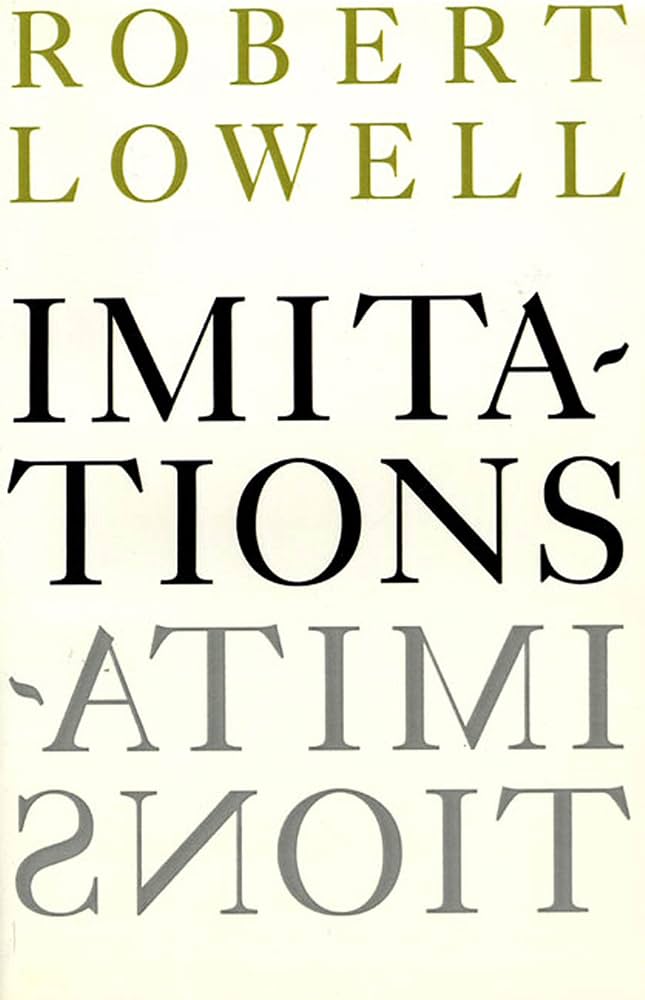
Anyone objecting that Dryden, Pope, and numerous other Augustan poets added rhymes to Virgil and Ovid and Homer and Horace is probably applying the criterion or method of “metaphrase” when the translators themselves were aiming at “paraphrase.” While no translator today would add rhymes to Virgil or Homer—let alone render the verses as heroic couplets—it is questionable whether Dryden or Pope could even have imagined not producing versions in the high Augustan style. “Imitation” was universally indulged in the eighteenth century, as in the moral epistles of Pope and his Imitations of Horace, to cite just one example. The practice continues, as witness the modernizing of Horace in Anthony Hecht’s “Application for a Grant” (Collected Poems 239) (http://www.bestpoems.cc/poems/ec27327.html) or the weightier effort of Robert Lowell in his book titled Imitations. Lowell pushes the concept in his title about as far as it could go, translating “classic” voices into current colloquial American English redolent of his own voice and weaving memoir and autobiography into a volume that he wanted to have read as a unity. Nadia Hilliard argues in the journal Bishop-Lowell Studies that Imitations
offers a distinctive logic of translation that enables him [Lowell] to incorporate personal history into his rendering of other poets’ work. In doing so, he posits a radical challenge to mainstream theories of literary translation by weaving an autobiographical narrative with the original poems, re-presenting the words of the original poets in his own voice . . . Ultimately, Imitations performs Lowell’s response to problems of agency and determinism, authorship, and objectivity in translation and the writing of history.
Lowell’s Nachdichtungen, as they would aptly be called in German, along with his personal history, require some reframing of ideas about translation, but they remain within a set of generally accepted criteria; later we will see an instance of a “translator” who progressively abandoned her original until the new versions no longer had anything whatever to do with the source.
We can see translators working across the continuum of Dryden’s categories, as noted about Hecht in the first installment of this essay. He remained close to metaphrase in his renderings of Baudelaire, Charles d’Orléans, Voltaire, and Goethe but responded playfully to Horace in the “Application for a Grant” and other such exercises. Likewise, Hofmannsthal, academically trained as a Romanist, made “faithful” or “straightforward” (metaphrase) translations of Molière and Calderón, among others, while also practicing imitation through amalgamations of English and German in Jedermann, stating that the older versions are “erneuert” (restored) in his renderings, or through drawing on Calderón’s La vida es sueño (Life Is a Dream) to create Der Turm (The Tower), a play directly adapting the Spanish masterpiece from about 1635 to the political and religious strife of the 1920s, with equally timely contemplations of dream versus reality, rebellion versus conformity, and violence versus pacifism. Almost every publishing season sees not only new translations of Homer, but also novels and plays that are highly creative “imitations” based on the Iliad and the Odyssey. To sum up, then, it would be a categorical misapplication to praise Hofmannsthal for his “faithful” translation of Molière’s Le bourgeois gentilhomme as Der Bürger als Edelmann while chiding him for revamping the same play as his libretto for Ariadne auf Naxos, or to apply the same standard to his metaphrastic translations of Calderón without grasping the extent of his creative imitation in Der Turm. For our purpose, however, the sketch of Dryden’s categories may serve as a reminder that readers assessing a translation must bear the translator’s aim in mind.
At this point, then, we have looked at three modes for assessing translation, one historical (Dryden) and two contemporary. Just to review: we can draw on Federmair’s principle of equivalence, balancing almost as an equation the rendering into another language of the original; Saunders, empowering readers who may not know the language of the original, calls for careful attention to tone, style, and authenticity of voice as criteria, placing emphasis on the translated work as an intrinsic artifact. (Searls combines the two modern approaches with his metaphor of an instinctive, organic sense of choice not primarily governed by lexical considerations.) Dryden reminds readers that not every translation is aiming at the same level of lexical accuracy or unaltered reflection of the original. None of these modes is or could be scientific, but they can all come into play when judging quality or value. Both Saunders and Dryden bear out the fundamental principle of equivalence, as far as it can be determined, since any translation must by its nature strive to replicate the original.
In the following installments, we will ponder their criteria as we examine two instances of successful equivalences, two that challenge settled concepts of equivalence through highly eccentric and playful renderings—what poet Brad Leithauser calls “folly” (261-276)—and two that appear to be distinct failures, despite the esteem in which the translators are held. Not to forget, too, that these ways of judging are working their way toward a fair insight into what went wrong with Moore’s La Fontaine.
REFERENCES: For a complete list of the works cited in this essay, please visit the References page HERE. (The page will open in a new tab.)

Vincent Kling is a professor of German and comparative literature at La Salle University. He has published translations of works by Gert Jonke, Heimito von Doderer, Hugo von Hofmannsthal, Gerhard Fritsch, Werner Kofler, and Aglaja Veteranyi. His translation of Veteranyi’s novel Why the Child Is Cooking in the Polenta was awarded the Schlegel-Tieck Prize in 2013. His translation of Doderer’s The Strudlhof Steps was published by New York Review Books in 2021 and was awarded the Helen and Kurt Wolff Prize in 2022.
Originally published on Hopscotch Translation
Tuesday, February 10, 2026

 hopscotchtranslation.com