
Silent in Transit: Anne Carson’s translation play
by Carolina Iribarren
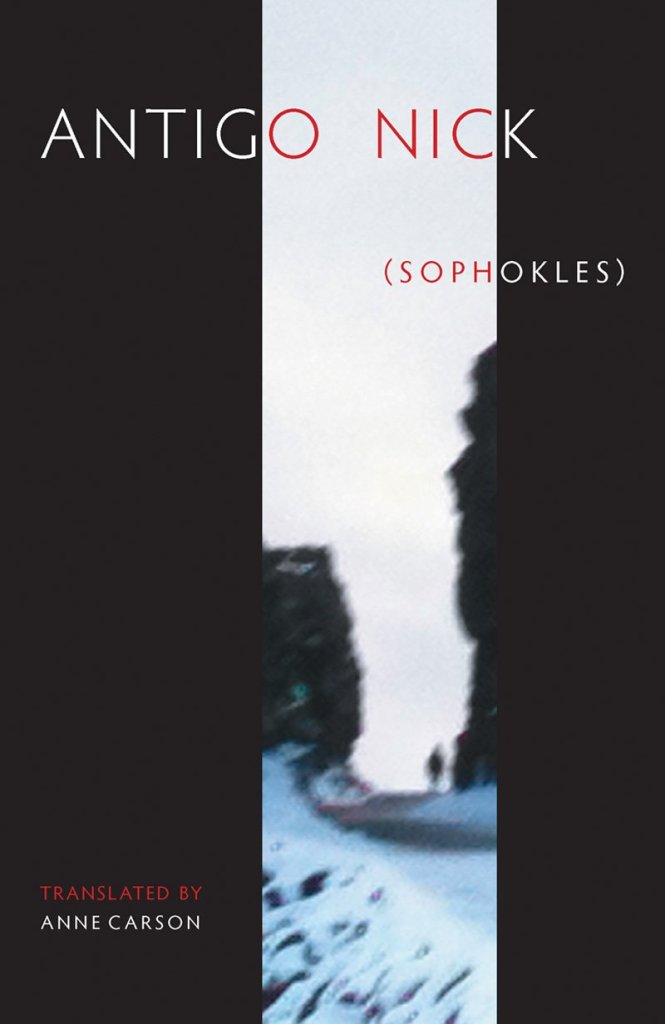
Neither her first nor her most recent translation of an ancient Greek text, Antigonick stands out all the same in Carson’s corpus due to the explicit critical treatment that the activity of translation per se receives throughout the book—an activity which, for Carson, is always embroiled in structures of silence.
What makes a translation bad? According to literary critic and translation theorist Barbara Johnson, everything. “To translate is to traduce—the betrayal of the original in the process of transmitting it is inherent in translation. In other words, ‘traduce’ is a bad translation of a pun on the inevitable badness of translations,” Johnson writes in the 2003 essay “Correctional Facilities.”[1] Always caught in the difference between one language and another, between one literary language and another, translation signifies above all an operation to which the impossibility of having two make one is fundamental. Yet what makes a translation bad—truly bad, as in unreadable—is not the transfer of inaccurate material or even the inaccurate transfer of material (though these things are bad), but rather silence, or the failure to speak in passing. “The enormous danger inherent in all translations,” observed the philosopher Walter Benjamin in his famous 1923 essay “The Task of the Translator,” rests in the possibility that “the gates of a language thus expanded and modified may slam shut and enclose the translator with silence.”[2]
Silence—the various ways it hangs over the activity of translation, indexing the ever-present failure to deliver language into being—is a question the poet and translator Anne Carson has turned to again and again in her work. “Silence,” she writes in her 2008 essay “Variations on the Right to Remain Silent,” “is as important as words in the practice and study of translation.”[3] For Carson, as for the avant-garde composer John Cage (famous for having complicated the presumed equivalence between silence and the absence of deliberate sound) from whom she draws inspiration, silence is not a given, a simple fact of nature. Though taken for granted in everyday life, silence as Carson conceives it is a far more complex phenomenon, its status cutting effortlessly through the aesthetic and the political all the while edging irresistibly on the unrepresentable, the supernatural, the occult.
According to Carson, there are two kinds of silence facing the translator: “physical” silence and “metaphysical” silence. Physical silence refers to a textual absence that is material in nature: “when you are looking at, say, a poem of Sappho’s inscribed on a papyrus from two thousand years ago that has been torn in half. Half the poem is empty space” (7). This type of silence is determined by material necessity; it represents a more or less straightforward matter of have and have-not. Metaphysical silence, on the other hand, bespeaks a far more elusive condition, being something that takes place “inside words themselves”: for instance, when “a word does not intend to be translatable” or when “a word goes silent in transit” (7). Make a few substitutions and Carson’s poem “TV Men” illustrates strikingly well what is at stake in this type of lexical intractability:
[Translator] hunkers down close to the [text].
[Language]
stains him in a blind place. Cracks appear. And the silence—
a silence that starts so deep
under the rock
he can hear it ringing.[4]
Metaphysical silence, in other words, underscores a resistance within language itself to the act of translation; it marks “the point where one language cannot be translated into another” (“Variations” 7). Carson provides a striking example of this occurrence in the essay “The Gender of Sound”: viz. the ancient Greek word ololyga, as found in a lyric fragment by the archaic poet Alcaeus of Mytilene:
….I dwell keeping my feet outside of evils
where the Lesbian women in their contests for beauty
come and go with trailing robes
and all around reverberates
an otherworldly echo of women’s awful yearly shrieking (ololygas)….
(Glass, Irony, and God 123)
Ololyga, Carson explains, betokens “a ritual shout peculiar to females,” and importantly it “does not signify anything except [its] own sound” (Glass 125). In other words, ololyga’s essence lies deep within itself; no English approximation, however factual (e.g., “awful yearly shrieking”), can touch it. For as Carson puts it in “Variations on the Right to Remain Silent,” “English has different sounds. English falls silent” (7). Curiously, it is precisely this sense of linguistic incommensurability, and the intransigence by which it is companioned, that for Carson makes the whole act of translation “maddeningly attractive” (“Variations” 8).
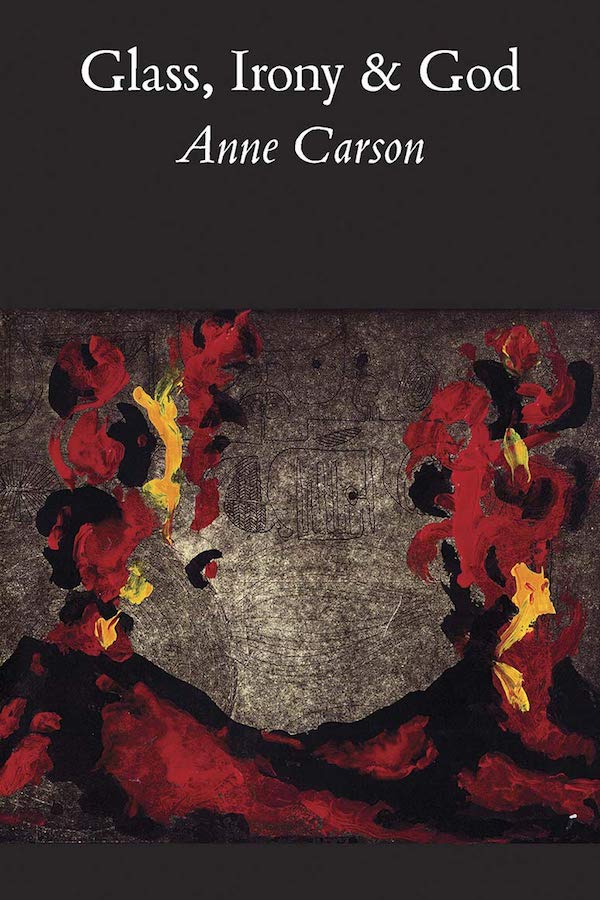

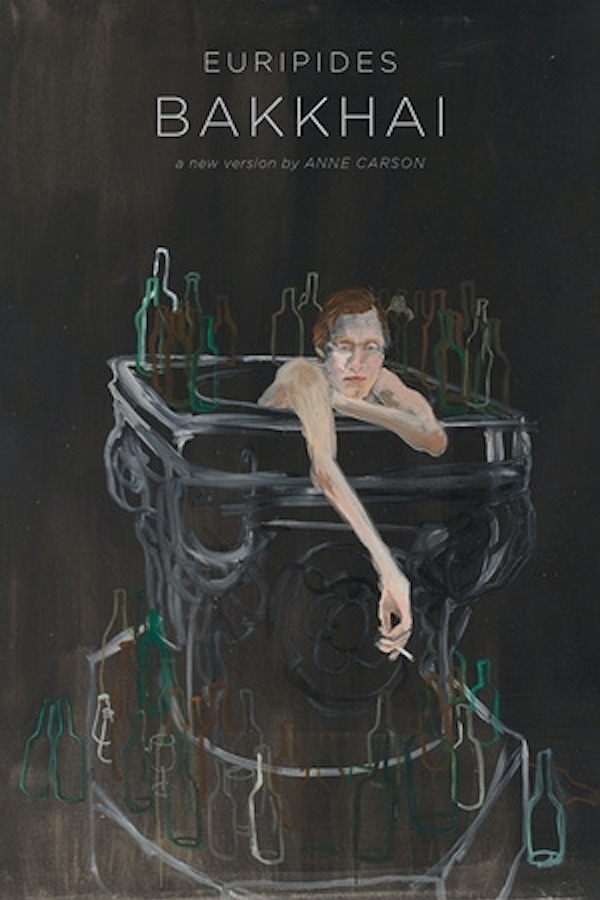
Carson’s mad love of the untranslatable—of the word that falls silent, that stops as it were on its tracks—figures most palpably in her 2012 translation of Sophocles’ ~441 BC play Antigone.[5] Neither her first (Electra, 2001) nor her most recent translation (Bakkhai, 2015) of an ancient Greek text, Antigonick stands out all the same in Carson’s corpus due to the explicit critical treatment that the activity of translation per se receives throughout the book—an activity which, for Carson, is always embroiled in structures of silence.
The critical elaboration gets going straight away, in the translator’s preface. Titled “the task of the translator of antigone” in obvious reference to Benjamin’s essay, Carson’s preface takes the form of an extended apostrophe.
dear Antigone:
your name in Greek means something like ‘against birth’ or ‘instead of
being born’
what is there instead of being born?
Thus kicks off Carson’s ode (elegy?) to Antigone, who in the translator’s hands oscillates vertiginously between her role as tragic character and a figuration of translation as such. In this respect, the use of apostrophe is important. Long regarded as the privileged figure of speech through which to sound the fraught relationship between life and death, self and other, presence and absence (cf. Shelley’s “Ode to the West Wind”), it supplies Carson with the perfect rhetorical means with which to ruminate on translation and its collusion with silence:
dear Antigone: you also are someone keeping faith
[…]
your plan
is to sew yourself your own shroud using the tiniest of stitches
how to translate this?
[…]
dear Antigone,
I take it as the task of the translator
to forbid that you should ever lose your screams (3-6)
By means of juxtaposition and contrast (of what is present and vocal and that which is not), the idea that silence is not simply a matter of archival lacunae or sensory lapse but a “jar on the nerves” (a phrase Carson gleans from Virignia Woolf’s To The Lighthouse) is thus thrown into bold relief. Linguistic elements which, for some reason or other, resist assimilation point to the silences embedded in a text. For Carson, this resistance is always as much a matter of politics—its versification at least—as of aesthetics and metaphysics. Take, for example, the following stanza, in which the specters of state oppression responsible for Antigone’s harrowing silencing over the course of the play are evoked in tandem with Cage’s experimental music:
Antigone, you do not,
any more than John Cage, aspire to a condition of silence
you want us to listen to the sound of what happens
when everything normal/musical/careful/conventional or pious is taken
away
Translation, as Carson sees it, involves listening closely, attentively, to “many small pieces of silence” (Cage quoted by Carson), whether these be the product of abusive state power or avant-garde experiments. It denotes a mode of readerly engagement that seeks to seize, and where possible give expression to, the affective resonances silence bears within a text.
This is all less Delphic than it sounds; as Carson (again quoting Cage) bluntly puts it, “There are things to hear and things to see and that’s what theater is.”[6] Admittedly influenced by psychoanalytic theory, Carson’s ideas on silence are shored up in (though not reducible to) questions about the unconscious and the repressed. “My problem,” she writes earlier in the preface, “is to get you and your problem / across into English from ancient Greek / all that lies hidden in these people, your people / crimes and horror and years together, a family, what we call a family…” (Here again we encounter the shadows of the political in the form of state-sanctioned generational trauma.) Like the analyst’s, the task of the translator is to be on the lookout for, to register, whatever is significant but buried, without always knowing where to find it or what to do with it.
Psychoanalysis is not Carson’s sole or even main interpretative framework, however. Carson’s overt reference to Cage above—and to Bertolt Brecht, to G.W.F. Hegel, to Jacques Lacan, to Judith Butler, George Eliot, Slavoj Žižek, Jean Anouilh, John Ashbery, and Samuel Beckett elsewhere in Antigonick’s three-and-a-half-page preface—is typical. Indeed, one of the things the Canadian poet is best known for is for juxtaposing several languages, discourses, registers, conventions all at once. Ancient Greek, formal and informal varieties of English, and the modern language we call critical theory crop up repeatedly in her works. (A case of just such bricolaging that recently caught my attention is the poem “Kant’s Question about Monica Vitti,” from Carson’s 2005 genre-melding Decreation: Poetry, Essays, Opera, whose opening lines read: “It was hidden in her and it gave Kant pleasure. / L’Eclisse begins with a wind blowing Monica Vitti’s hair. She is inside a room….”)[7] Carson’s capacity—or will—to navigate multiple registers, to play with intertextuality, is significant. One of Benjamin’s most original contributions to the field of translation studies—evidently in play in Carson’s own translational ideas and experiments—lies in his having conceived of the translating process in vitalist terms, thereby coining an apt metaphor through which to understand the ongoing and profound relationship between a translation and its original. In Benjamin’s view, no literary form is better equipped to infuse texts with a transformative life-sustaining spur than translation:
Translation is so far removed from being the sterile equation of two dead languages that of all literary forms it is the one charged with the special mission of watching over the maturing process of the original language and the birth pangs of its own. […] In [translations] the life of the originals attains its latest, continually renewed, and most complete unfolding.[8]
Carson’s numerous citations, her eagerness to render an elite classical tradition into colloquial terms active in Anglophone contexts today, her oddball neologisms (e.g., “noonsunstink,” “birdgrief,” “childreftgravecry,” “dustlibation,” “donedeal,” “deadreckoning,” all of which appear on the same page of Antigonick), her accent on issues of gender and embodiment—in short, her willingness to bend, extend, and cut existing ways of seeing, writing, and thinking, can all be seen as an attempt precisely at keeping ancient Greek texts alive so many hundreds of years after their inception.
The contours of this afterlife sharpen and grow bolder when Carson’s translation and the two standard scholarly editions of Antigone are set side by side. Let’s look into a well-known passage, from the famous “Ode to Man”:

The first of these excerpts stems from Robert Fagles’s translation of Sophocles (Penguin, 1982); the second from Elizabeth Wyckoff’s (University of Chicago Press, 2013); the third belongs to Carson, and it appears very different.[9] Of all the features that single it out, economy of language is perhaps foremost: while Fagles’s rendition is composed of 79 words and Wyckoff’s of 63, Carson’s has 31. Such word-pinching is characteristic of Antigonick, which compared to most other translations currently in circulation (I did not check Hölderlin’s, for instance) turns out to be rather wee. One explanation for this discrepancy is that, against the grain of standard classicist practice, Carson tends not to fill in with probable paraphrases the elisions present in the original manuscript; instead, entire lines and spaces are left blank to signal these silences (“A silence already filled with noises,” as Ashbery writes), or else are dramatized by dint of scant verbalization: “I delete this line […] here I posit a lacuna,” Carson has Haimon say (25).
Yet Carson more than compensates for this prosaic austerity by elsewhere tapping into what we might call the deconstructionist strand of her aesthetics of silence. The eye-catching string of lone words in the excerpt above is in this regard emblematic: rather than settling for a single word in English that encapsulates more or less the semantic range of an ancient Greek term, Carson opts for amplification and proliferation of ambiguity instead. Though it might drive home the commonplace point that translation is never a matter of tit for tat, this translational tack often does more to blur the tragic dynamics and characters at hand than to enhance them. Here is a striking example of just such indistinctness:
Kreon: no let’s split hairs a while longer
I’d say
you’re the only one in Thebes who sees things this way wouldn’t you
you’re autonomous
autarchic
autodidactic
autodomestic
autoempathic
autotherapeutic
autohistorical
autometaphorical
autoerotic
and
autobeguiled (19-20)
Many of these terms belong to the same lexical field: “autonomous and “autarchic,” for instance, mean roughly the same thing, as do “autoerotic” and the mock “autobeguiled”; still, their semantic overlap is ultimately only partial, the word “roughly” doing much of the work of synonymy here. This exactly is Carson’s point: certain words may be similar, share this or that orthographic or semantic feature, but they are also, crucially, worlds apart, each occupying its own lexical niche. Which is why in her translation Carson chooses to mess with the scales, to have ten English words amount to a single one in Greek. As she writes in “Variations on the Right to Remain Silent,” “This kind of linguistic decision is simply a measure of foreignness, an acknowledgment of the fact that languages are not sciences of one another, you cannot match them item for item” (7). And yet does the everyday fact not remain: heap words on top of each other and their power to signify dims? Yes, when faced with stylized polysemy of the kind Carson seems to favor in Antigonick, I think it is critical to ask, does this language work? to what effect? I for one sometimes shudder at, and feel my experience of reading weighed down by, Carson’s penchant for the untranslatable, the highly theoretical, and the abstract.
To return to the comparison with Antigone’s other translators, though, there can be no doubt that Carson’s approach to translation is (to borrow one of their choice terms) ingenious. Gone are Fagles’s meticulousness and Wyckoff’s attempt at lyricism, literary tricks designed to make us forget what Virginia Woolf never lost sight of: namely, that “we do not know how the words sounded, or where precisely we ought to laugh, or how the actors acted,” or that “between this foreign people and ourselves there is not only difference of race and tongue but a tremendous breach of tradition.”[10] Carson’s unorthodox approach at least makes the text feel alien. Whether this distance and aridness are enough to make Carson’s a better translation, however, is hard to say. A much more interesting and promising question, it seems to me, is to what extent a practice of translation attuned to silence such as Carson’s purports to be gets at some new aspect, some new face, of that vast and tremulous reality we positively call language. Does Carson’s taxonomy of silences complicate and enrich our feel for language, or does it merely help us not to be able to tell the difference between the two? “There’s no such thing as silence […] I can hear twenty different sounds on a night like this without counting your voices,” declares Mr. Erskine in Woolf’s Jacob’s Room. But then again, I do not think we are meant to bank on his opinions.
NOTES:
[1] Barbara Johnson, “Correctional Facilities,” in The Barbara Johnson Reader: The Surprise of Otherness (Durham: Duke University Press, 2014), 168.
[2] Walter Benjamin, “The Task of the Translator,” in Selected Writings, vol. 1, 1913-1926, eds. Marcus Bullock and Michael W. Jennings (Cambridge: Harvard University Press, 1996), 262.
[3] Anne Carson, “Variations on the Right to Remain Silent,” in Nay Rather (London: Sylph Editions, 2014), 7.
[4] The original reads: “Hektor hunkers down close to the sand. / The eunuch winter sun / stains him in a blind place. Cracks appear. And the silence— / a silence that starts so deep / under the rock / he can hear it ringing” (Anne Carson, Glass, Irony, and God [New York: New Directions, 1995], 57).
[5] Sophocles, Antigonick, trans. Anne Carson (New York: New Directions, 2012).
[6] Anne Carson, An Oresteia: Agamemnon by Aiskhylos, Elektra by Sophokles, Orestes by Euripides (New York: Faber and Faber, 2009), xi.
[7] Anne Carson, “Kant’s Question About Monica Vitti,” in Decreation: Poetry, Essays, Opera (New York: Knopf, 2005), 70.
[8] Benjamin, “The Task of the Translator,” 255-56.
[9] Sophocles: The Three Theban Plays, trans. Robert Fagles (New York: Penguin, 1982), 77; Sophocles I, eds. David Greene and Richmond Lattimore (Chicago: University of Chicago Press, 2013), 34; Antigonick, 16.
[10] Virginia Woolf, “On Not Knowing Greek,” in The Common Reader, First Series, ed. Andrew McNeillie (New York: Harcourt Brace Jovanovich, 1984), 23.
Carolina Iribarren is a PhD student in French at Princeton. Her first translation—a book on Deleuze, Peirce, and Bergson, cotranslated with Noah Rawlings—is forthcoming. She is currently an associate editor at Post45.
Originally published on Hopscotch Translation
Tuesday, February 1, 2022

 hopscotchtranslation.com