
Translator, Academia, Opus Tertiary: On some unnecessary and useless translations of Jorge Luis Borges’ “Tlön, Uqbar, Orbis Tertius”
by Jack Rockwell
“[Borges] es poseedor de un clima, de un cuerpo, de una ascendencia, de un hacer algo, de un no hacer nada de un presente, de un pasado, de un porvenir y hasta de una muerte que es suya. ¡Cuidado con torcerle una sola palabra de las que dejó escritas!”
No hay ejercicio intellectual que no sea finalmente inútil.—Jorge Luis Borges, “Pierre Menard, autor del Quijote”
[There is no intellectual exercise that is not ultimately useless.[1]]
I have found that Borges’ writing results in two types of translators. They might be liminally described by the two categories he suggests in his essay “Las dos maneras de traducir”: one practices literality, and the other paraphrase; one Romantic, and one Classical. In the mentioned essay, Borges purports to display each of the two types of translation in relation to one another, each with its strengths, each with its weaknesses. In the case of translating Borges, however, one mode is correct: Borges “… es poseedor de un clima, de un cuerpo, de una ascendencia, de un hacer algo, de un no hacer nada de un presente, de un pasado, de un porvenir y hasta de una muerte que es suya. ¡Cuidado con torcerle una sola palabra de las que dejó escritas!” [… is possessed of a climate, of a body, of an origin, of something done, of something not done, of a present, of a past, of a future and even a death that’s his own. Be careful twisting even one of the words that he left written!] (“Las dos maneras,” 3). Even his mistranslators are astute enough to recognize that “Borges’ prose style is characterized by a determined economy of resources in which every word is weighted, every word (every mark of punctuation) tells” (Hurley, “A Note on the Translation,” Collected Fictions, 519). The delicate value of each individual sign in relation to all those surrounding it will never be completely preserved in translation, but to imagine that they comprise “[una] perfección absoluta… una obtención de verdad poética, que, una vez agenciada [por Borges], puede (y debe) ser aprovechada por todos [sus traductores]” [[an] absolute perfection… an obtention of poetic truth that, once procured [by Borges], can (and should) be taken hold of by all [of his translators]] is antithetical to everything Borges believed about reading and writing (“Las dos maneras,” 2). Andrew Hurley regularly sacrifices elements of Borges’ text that, in my translation and in James E. Irby’s, can be shown to be at the very least partially recreated in English. I’ll argue that his re-representations of Borges’ text do not contribute anything valuable to the Anglophone reader who wishes to approximate the experience of reading Borges, only destroying potentially recuperable meanings. Irby’s translation, in many such cases, offers preferable strategies.
Briefly I’ll outline a system of value to rest such a claim upon. Hurley, in a poorly executed attempt to prop up a positive narrative around his translations of Borges, references Lawrence Venuti:
In book after book, article after article, anthology introduction after anthology introduction, Lawrence Venuti, for instance, talks about, and bemoans, the dominant Anglo-American translation ideology of what he calls “fluency,” which is a strategy that consists of reducing the hills and valleys and chasms and skyscrapers of the stylistic landscape of the original text into one broad pampas of target-language sameness. In a word, simplification or flattening of the source-language style into “acceptability”, “readability” in the target language. And as I see when I read translations, Venuti may be right, this may be going on. (“What I Lost When I Translated Borges,” 290)
Venuti challenges the notion that a good translation reads as though it were a text originally written in the target language, arguing this erases the presence of the translator and elements of the culture it is translating out of. These consequences are politically in line with the consolidation of cultural hegemony, especially in the context of an Anglo-American-centric capitalist market for the production and distribution of texts. The informed reader should want to avoid “the narcissistic experience of recognizing his or her own culture in a cultural other,” especially if their own culture is already a dominant imperial power (Venuti, “Introduction,” 5). Rather, they should recognize and value its difference whenever possible, and thus a good translation does not obfuscate but makes apparent such difference.
The attribution of value to difference is not a new concept put forth by Venuti. It has echoes in many articulations of theories of meaning and poetics. At the most basic level, Saussure recognized that difference is the foundation of all linguistic meaning—signs can only signify meaning because they are different from other signs. Other theorists have taken the value of difference to higher levels, citing its importance in the aesthetic appreciation of meaning. In 1926, Borges wrote in passing “…lo lejano, lo forastero, siempre es belleza… Todo se vuelve poético en la distancia” [… the faraway, the foreign, is always beautiful… Everything becomes poetic in the distance] (“Las dos maneras,” 3). One year before that, Viktor Shklovsky published his Theory of Prose, the first chapter of which—“Art as Device”—functions well as a stand-alone essay on poetics. In it, he argues that art is the presentation of recognizable things in an unrecognized, and therefore interesting, way. He measures this interest across a dichotomy of “automized” perception and “perception-for-the-first-time,” the latter being the condition for the perception of an object to have valuable meaning. Good art causes the reader to view the objects it represents as “intentionally removed from the domain of automized perception” (Theory of Prose, 12). This removal is achieved by “chang[ing] its form without chang[ing] this essence”—in other words, using novel form to present an object that is recognized “to be,” that is, to have previously for the reader had a “being” derivative of other forms of representation (Ibid, 6). Recognition is deferred because the form of the object’s representation is not the form the viewer is accustomed to seeing such an object presented in. The deferral of this recognition increases its value—the reader feels to have worked harder for it, or perhaps to have encountered something more rare.
Shklovsky continues to argue that such “enstrangement”[2] should exist at the level of language in written art:
These conditions are also met by ‘poetic language.’ According to Aristotle, poetic language ought to have the character of something foreign, something outlandish about it. In practice, such language is often quite literally foreign: just as Sumerian might have been regarded as a ‘poetic language’ by an Assyrian, so Latin was considered poetic by many in medieval Europe. Similarly, Arabic was thought poetic by a Persian and Old Bulgarian was regarded likewise by a Russian. (Shklovsky, Theory of Prose, 12)
His recognition of an element of distance or foreignness of poetic language echoes Borges’ sentiment, and would provide an aesthetic justification to accompany Venuti’s political argument for the translated text to intentionally indicate the difference of the foreign.
Let us return to the passage of Hurley’s I reproduced above. The last sentence is almost Trumpian in its use of the speculative “may be,” as if giving himself an “out” if he were to be held to task for that statement. Perhaps the most remarkable thing about Hurley’s own comments on his translation process is that he defends the same ideas that I have about translations, and then goes on the claim that his rewriting of Borges meets those conditions instead of defying them. In response to a particularly aggressive critic of his work, he writes:
Obviously this person believes that the English of a translation should be “fluent”, as Venuti defines that word: perfectly “normal” English, with none of the small shocks and momentos de asombro that the original author may have attempted to achieve in his or her text. (“What I Lost,” 296)
Yet somehow in the next paragraph, Hurley gives an example of “literalizing” a “fluent”-ing translation as if it were the most natural thing in the world: “Somewhere else there are ‘concave’ hands: cupped, of course.”
More frustrating is when he makes a significant departure from a sign-by-sign translation for no reason other than to “render… Borges in the style that I hear when I listen to him,” offering no justification for his changes other than a personal interpretation, assuming that as mediator of the text from Spanish to English his ideas about it are important enough to justify their instantiation in the language of the other’s text (“A Note on the Translation,” Hurley 519). One example that he gives in “What I Lost When I Translated Borges,” seemingly without irony, is an unnecessarily complicated path by which he translates what I gather to have been “espléndida” into “glorious,” not in and of itself a particularly controversial decision:
In “The Dead Man” there is a “splendid” woman: Her red hair glows; indeed, I believe that in Borges, splendid always has either the etymological sense of glowing or the sense only slightly metaphorized from that of glorious. (297)
What’s truly bizarre about these explanations is that “concave” and “splendid” are offered in English; breath is not wasted on the actual word in Spanish from which he is translating. He unapologetically begets erasure of the Spanish language in the very defense of his continued erasure of Borges’ language to make his text reflect what he “believe[s]” it to have meant.[3] By offering English words as alternatives to the English words he chose to translate into, he betrays that he suspects these alternatives would have been better re-representations of the individual signs he is translating.
But the most surprising alterations that Hurley makes, this time absolutely without justification or explanation, are at the highest level of structure of the stories—the placement of text into distinct paragraphs. It begins with the very first paragraph of “Tlön, Uqbar, Orbis Tertius,” which in my copy of Ficciones runs thirteen sentences across thirty-six lines, reaching halfway down the story’s second page, from “Debo a la conjunción…” to “El examen estéril de uno de los atlas de Justus Perthes fortalició mi duda” (15-16). Hurley breaks this behemoth up into three separate paragraphs, the first swing of the axe falling after only three sentences. (Irby makes no such modifications.)
Such re-structurings of Borges’ prose occur throughout the translated text; I will not attempt to catalog them thoroughly, but I will point out one more excruciating and particularly aggressive example. In “Tlön,” there is a passage where Borges introduces a refutation of the subjective idealism that governs its imagined universe:
El martes, X atraviesa un camino desierto y pierde nueve monedas de cobre. El jueves, Y encuentra en el camino cuatro monedas, algo herrumbradas por la lluvia del miércoles. El viernes, Z descubre tres monedas en el camino. El viernes de mañana, X encuentra dos monedas en el corredor de su casa. [El heresiarca quería deducir de esa historia la realidad—id est la continuidad—de las nueve monedas recuperadas.] Es absurdo (afirmaba) imaginar que cuatro de las monedas no han existido entre el martes y el jueves, tres entre el martes y la tarde del viernes, dos entre el martes y la madrugada del viernes. Es lógico pensar que han existido –siquiera de algún modo secreto, de comprensión vedada a los hombres– en todos los momentos de esos tres plazos.
Tuesday, X walks a deserted road and loses nine copper coins. Thursday, Y finds on the road four coins, somewhat rusted by Wednesday’s rain. Friday, Z discovers three coins on the road. On Friday morning, X finds two coins in the hallway of their home. [The arch-heretic wanted to deduce from this story the reality—id est the continuity—of the nine recovered coins.] It’s absurd (he affirmed) to imagine that four of the coins have not existed between Tuesday and Thursday, three between Tuesday and Friday afternoon, two between Tuesday and Friday morning. It’s logical to think that they have existed—if by some secret mode of understanding hidden to men—in all the moments of those three periods.
He constructs it to stand out from the text surrounding it by placing it within quotation marks, in a specially indented paragraph of slightly smaller font than the rest of the text, separated from the paragraphs preceding and following it by extra whitespace:
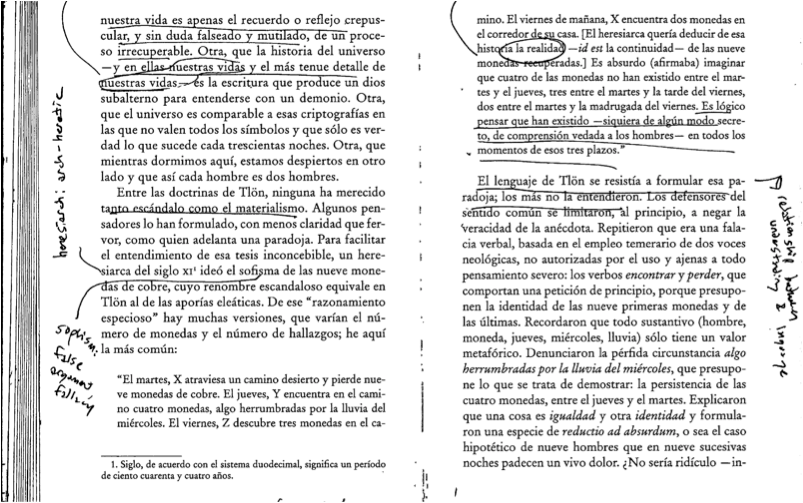
It is a form not dissimilar to how I’ve included block quotes in this writing; it can be found running from pages 26 to 27 of my 2012 reprinting of Ficciones (with a copyright date of 1995). Irby, when re-representing this section of the text, made some modifications to the form by which it stands out from the surrounding text. The paragraph is formatted the same as those around it, but its text is in italics:
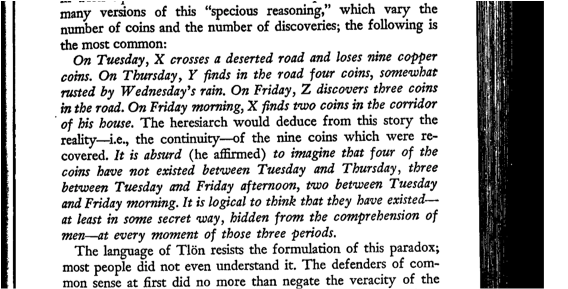
While I don’t particularly agree with this decision to change the formatting, not seeing why it’s necessary, at the very least the entire paragraph is reproduced with some formatting distinction from those around it. Hurley combines the change in whitespace and font size with italics, but only applies the change to the first four sentences of the six that comprise the paragraph. The rest of the section is offered as a continuation of the paragraph preceding the mock-in-line citation:
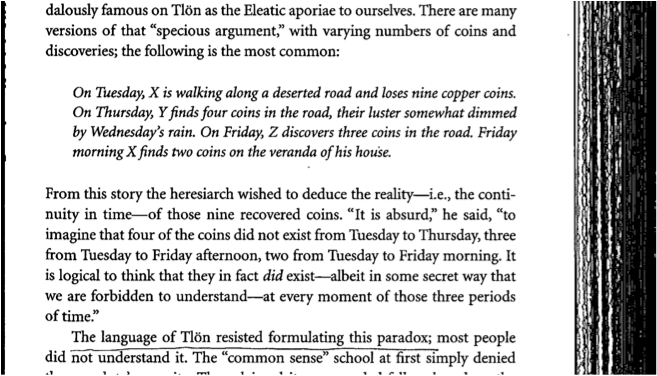
A reasoning can be divined for Hurley’s re-structuring of this text: it is fallacious, but it is not completely random. The paragraph is composed of six sentences. The fourth, in Ficciones, is surrounded by brackets, and is an interjection of the narrative voice into the prose he is allegedly quoting, a commentary on it. The sentences on either side of this delineation have different functions: The first three recount events, and the last two interpret these events as a refutation of subjective idealism, suggesting a basic materialism. Hurley was not wrong to deduce this difference, or something like it, but by creating a formal distinction between the first half and the second where there was none before, he robs the reader of his translation of the chance to discover this distinction themself, a discovery that Shklovsky might say would be a vital element of the experience of the text as a work of art. Furthermore, by erasing the formal difference between the fourth sentence and the fifth and sixth—brackets being a common technique in academic criticism by which a critic adds their own language to a quoted portion of someone else’s text—he robs the text of one of the many elements by which it might be perceived to mock academia and criticism, or writers in general. (Irby also sacrifices the brackets, instead of de-italicizing the sentence.) Dismissing any clear formal choice that any writer made in the construction of their text as unimportant is an arrogant gesture, especially if, like the distinction between particular typographical signs and paragraph breaks for differentiating between sections of text, that choice is completely reproducible in the target language. It’s telling to me that he makes no mention of these glaring adjustments to the text in his “Translator’s Note,” nor in “What I Lost,” for what could he possibly say? What could possibly make one arrangement of text into paragraphs affect meaning so differently in English than in Spanish to warrant its rearrangement in translation?
The language of this paragraph is as good as any to point out how Hurley makes similarly unforgivable departures from the language of Borges. He translates, for example, “El jueves, Y encuentra en el camino cuatro monedas, algo herrumbradas por la lluvia del miércoles” as “On Thursday, Y finds four coins in the road, their luster somewhat dimmed by Wednesday’s rain” (Ficciones 27, Collected Fictions 75). There is no luster explicitly referenced in Borges’ text to be dimmed, nor a dimming of it, though perhaps one might imagine that, if herrumbradas, the coins might lose some of the luster they may have had before. But is the phrase “algo herrumbradas” so irrecuperable in translation to English that it must be substituted by an imagined consequence of it? No, argues Irby in his translation: “On Thursday, Y finds in the road four coins, somewhat rusted by Wednesday’s rain” (Labyrinths, 11). I agree: My translation reads “On Thursday, Y finds on the road four coins, somewhat rusted by Wednesday’s rain.” Indeed, Irby goes so far as to replicate the verb-descriptive clause order as it appeared in Spanish, which Hurley also changes to an order more commonly appearing in English. Is that not quite literally what Venuti describes as “fluent”-ing? The consequences of these individual changes are small, considered alone, but repeated again and again throughout the translation they create an immeasurably different story.
If Hurley can be said to be trying, as he insists in “What I Lost,” to make “…a good-faith effort to show the reader in that other language, whatever the language might be, why this writer was prized for his or her writing as well as his or her stories…,” then it’s incomprehensible to me why he thought it was appropriate to re-distribute and re-represent Borges’ text in such a way, as if it were not a brutal erasure of the writing style he claims to wish to preserve (290). If he read Venuti’s introduction to Rethinking Translation: Discourse, Subjectivity, Ideology, he might recognize himself in the discussion of the demand for fluency translations into English perpetrated by the power dynamic between the Anglo-American world and most everybody else in the context of late-twentieth-century capitalism. The traces of this capitalist drive are everywhere in the “Penguins Classics Deluxe Edition” of Borges’ Collected Fictions from which I read his work.
All of this is not to deny the interpretive role that a translator necessarily plays when translating a literary text; as Karen Emmerich very persuasively puts it in Literary Translation and the Making of Originals, any translation of a work “embod[ies] interpretations of what and how… [a literary work] means” (25). Indeed, the best possible defense for Hurley’s work that I can imagine could be derived from Emmerich’s conception of the translator as a “trans-lingual editor,” and as a literary translation as not a re-production of a stable, existing source text, but rather as one of many textual iterations of the work produced across many languages. However, in this case we would simply adjust our critique from one of Hurley’s translation practices, to one of his editorial practices; and in either case, the comparative success of Irby’s translation condemns Hurley’s to failure.
Writing in 1962, when Venuti was just nine or ten years old, Irby espouses a translation philosophy that aligns well with his ideas:
“Narrative prose is usually easier to translate than verse, but Borges’ prose raises difficulties not unlike those of poetry, because of its constant creative deformations and cunning artifices. Writers as diverse as George Moore and Vladimir Nabokov have argued that translations should sound like translations. Certainly, since Borges’ language does not read “smoothly” in Spanish, there is no reason it should in English… Borges’s use of colons and semicolons in place of causal connectives… give[s] static, elliptical, and overlapping effects [to his prose].” (Labyrinths, “Introduction,” xx)
Unlike Hurley’s, in practice, Irby’s translation actually reflects this philosophy. Throughout it one sees the same closeness to Borges’ structure and language in relation to Hurley’s text that I’ve demonstrated in the selected passages. This closeness, from word choices and order in individual sentences to the level of larger structural features, such as the discussed division and arrangement of paragraphs, preserves or re-creates essential features of Borges’ text which Hurley opts to edit away, features that, as I hope I have made apparent, are both essential aesthetic arguments of Borges’ fiction, and completely recuperable in English translation. Indeed, Irby’s translation of “Tlön, Uqbar, Orbis Tertius” is at once more beautiful, more faithful, and more politically justifiable than Hurley’s, thus succeeding where Hurley’s fails across multiple different paradigms for evaluating translations, and rendering the latter, in the final analysis, unnecessary.
Notes:
[1] This, and any other translations from Spanish that are not attributed to another translator, are my own.
[2] Some debate exists about the translation of this word from Russian into English. Shklovsky coined the neologism “ostranenie” in Russian—some translators have simply re-represented this word as “defamiliarization,” but Alexandra Berlina argues for “enstrangement” for reasons detailed in her introduction to her translation of Art, as Device. See Berlina, 2015.
[3] It is not without some satisfaction that I note his unusual use of the colon and semicolon in writing this sentence is, in fact, a structure common to Borges’ fiction; even though he destroys stylistic elements of Borges’ prose in translation, these elements live on in his own writing. If his style has invaded how countless readers will perceive Borges, Borges has at least invaded the style within which he believes to write himself.
Works Cited:
Basile, Jonathan. “About the Library.” https://libraryofbabel.info/About.html, last accessed 5.17.18.
Berlina, Alexandra. “Translating ‘Art, as Device.’” Poetics Today (2015) 36 (3): 151–174.
Borges, Jorge Luis. Ficciones. Vintage Español, 2012.
Borges, Jorge Luis. “Las dos maneras de traducir.” Cervantes Virtual. http://www.cervantesvirtual.com/descargaPdf/las-dos-maneras-de-traducir/, last accessed 5.17.18.
Borges, Jorge Luis, and Andrew Hurley. Collected Fictions. Penguin Books, 1998.
Borges, Jorge Luis, et al. Labyrinths. New Directions, 2007.
Emmerich, Karen. Literary Translation and the Making of Originals. Bloomsbury Academic, 2017.
Hurley, Andrew. “A Note on the Translation.” Collected Fictions. Penguin Books, 1998.
Hurley, Andrew. “What I Lost When I Translated Jorge Luis Borges.” https://periodicos.ufsc.br/index.php/traducao/article/viewFile/5537/4995, last accessed 5.17.18.
Irby, James E. “Introduction.” Labyrinths. New Directions, 2007.
Shklovsky, Victor. “Art as Device.” Theory Of Prose. Dalkey Archive Press, 1991.

Jack Rockwell is a writer and translator from Brooklyn, New York. His work has appeared in Rust + Moth, Agora Mag, Wilder Voice, and more. He works at Archipelago Books, and will start an MFA in Literary Translation at the University of Iowa in the fall.
Originally published on Hopscotch Translation
Tuesday, May 3, 2022

 hopscotchtranslation.com