
A #MeToo Classic: Review of Fang Si-Chi’s First Love Paradise by Lin Yi-Han, translated by Jenna Tang
by Yooj Chun
Paradise, like consent, is a concept often willfully misconstrued, elusive and undefinable.
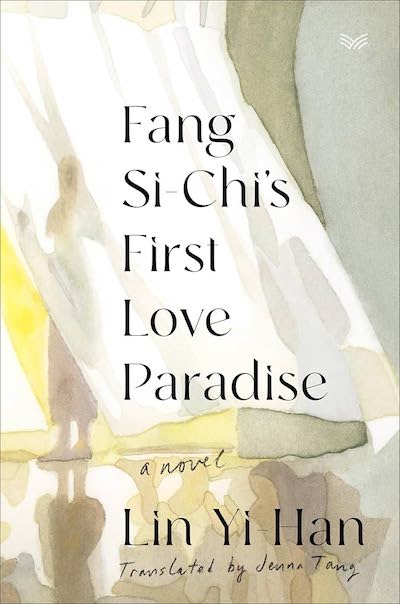
Fang Si-Chi’s First Love Paradise, by Lin Yi-Han, translated from the Chinese by Jenna Tang. HarperCollins, May 2024, $27.99. ISBN 9780063319431
Content Advisory: The following piece contains immediate details of suicide and sexual violence.
When my best friend killed herself in her college dorm, rumors of sexual abuse floated around campus for months afterwards. Even after friends and family denied the story and dug up evidence to the contrary, that narrative came circling back. As a male friend once said, with a bizarre sense of certainty: “She was raped, so she killed herself. End of the story.” It is a damning punchline, one that flattens a life into two violent acts. A crude summary that does not do justice to a life cut short.
No wonder I was triggered when I came across Fang Si-Chi’s First Love Paradise, a best-selling Taiwanese #MeToo novel. Many assumed the novel to be autobiographical, and the tragic suicide of the young female writer became an integral part of the book’s widespread fame. The public ate up the story of a woman killed by rape – Lin Yi-Han’s story of survival over sexual abuse is primarily known for the death of its author. As Iwen in the novel ironically observes: “Think about it: your readers will be so lucky to read what you write. They won’t even need to experience anything to learn this world has a dark side.” Here, Lin Yi-Han presciently addresses her readers, warning those who think reading pain is akin to experiencing it.
I am uninterested in drawing a parallel between Lin Yi-Han’s own life and the tragic life of Fang Si-Chi in the novel. I also detest the popular tendency to draw a causal link between rape and death. What I am interested in is the time between rape and death, the time of survival that ranges from a few minutes to decades from survivor to survivor. During this in-between time, all survivors of sexual violence must do something – they must tell a story, first to oneself, later, perhaps, to others.
Fang Si-Chi’s First Love Paradise is a novel about sexual violence – it is also about stories that incubate and enable such violence, as well as stories that strive to name and expose abuse. The eponymous heroine, Fang Si-Chi, is sexually assaulted by her neighbor and a renowned teacher of Chinese literature, Lee Guo-Hua, at the age of thirteen. Groomed by Teacher Lee, the abuse continues for years afterwards. Si-Chi, in her diary, writes : “I have to love Teacher Lee or I’ll be in too much pain.” Never once does Si-Chi name what is being done to her in its true name, although she realizes something is amiss. “He forced himself inside of me, and I apologized for it.” A sense of confused hurt shimmers beneath her words; yet it takes Si-Chi years to realize that the term “love,” offered by Teacher Lee, is deeply inadequate for the violence inflicted on her. The novel is Si-Chi’s journey of trying to find the right words.
Si-Chi’s task is a hard one, if only because her world is full of literary, cultural, and social language that demeans and belittles her experience. Indeed, literature functions as an accomplice to violence against girls and women throughout the novel. Iwen, Si-Chi’s beautiful and brilliant neighbor, drops a Comparative Literature PhD program to marry a wife-beater. She is first lured into marriage through her love of literature. Watching Yi-Wei, her would-be abuser, waiting in the rain for her, Iwen is reminded of a “folktale about the lovers at Blue Bridge.” Classical literature gives Iwen a green light. “Shortly thereafter, they were engaged.”
Likewise, Si-Chi’s abuse is justified by Teacher Lee through his prolific references to classical literature. “I have a collection of Nobel Prize-winning literature”, says Teacher Lee, inviting Si-Chi to his apartment. Later, Si-Chi is assaulted against a wall of bookshelves full of prize-winning anthologies. Teacher Lee gifts Si-Chi books, quoting lines from ancient Chinese literature, likening her body to “Zhao Feiyan’s breasts” which were “the tender domain for Emperor Cheng of Han.” Lee’s abuse is masked as romance, as Lee leans into his literary learning to manipulate Si Chi.
Lin Yi-Han is deliberate in the dazzling array of literary and cultural references she chooses. She is intent on showing that literature, and culture at large, is complicit in sexual violence. Si-Chi struggles to name the violence committed against her because of the wealth of textual authority patriarchy and misogyny wield in this world. As Si-Chi wryly notes, “I already know that association, symbolism, and metaphor are the most dangerous things in the world.”
The cruelest metaphor Teacher Lee wields is from Si-Chi’s writing itself. Quoting an essay she had composed for homework, Lee states, “you said, ‘In love, I often see paradise.’” This love-paradise, Lee opines, is a perfect imagery for their illicit relationship. Paradise, like consent, is a concept often willfully misconstrued, elusive and undefinable. It is difficult to picture paradise. It is difficult for Si-Chi to picture rape, when she is only given images of romance.
Some of the novel’s most brilliant passages are when Si-Chi fights for narrative control. When Teacher Lee cloyingly observes, “You’re like the painter Cao Zhonda with the tight garments, and I’m Wu Daozi with the floaty clothes,” Si-Chi retorts, “We’re a dynasty apart ourselves.” In one scene, Si-Chi quotes One Hundred Years of Solitude. “If he started to knock on the door, he would need to keep knocking on it.” When Teacher Lee responds, “I opened the door already,” Si-Chi replies, “I know. I’m talking about myself.” Si-Chi here fights Lee Guo-Hua’s narrative of sexual conquest and turns it into a painful metaphor of repeated violence. She proposes different ways of reading, prying open the crevices of violence glossed over by Teacher Lee. Jenna Tang’s clear yet heartbreaking translation expertly covers the range of Sinophone literary references Lin Yi-Han draws upon. The fact we need no gloss for many of Teacher Lee’s metaphors is simultaneously a testament to Tang’s mastery of craft and to the ubiquitousness of manipulative rhetoric.
If these are the small triumphs offered in the book, the most heartbreaking moments are when Si-Chi tries but fails to articulate her experience to other women. She attempts confession to her friends and family, but in a language that is uncertain and full of doubt. “I think Teacher Lee is acting weird,” Si-Chi offers to her friend Iwen, and to her mother she sheepishly murmurs, “I heard there’s a student who’s in a relationship with a teacher.” These pleas for help fall on deaf ears, not because of lack of love – the book is as much a story about deep friendships between women as it is a story of abuse – but because of a lack of a common language to speak about sexual violence. When Si-Chi ultimately loses language, all of her suffering “locked deep inside her body,” Si-Chi’s best friend Yi-Ting realizes this “wasn’t the fault of people who learn literature; rather, literature itself let them down.” It would be up to her, Yi-Ting realizes, to write a book of rage, a book that tells the world about the other side of Teacher Lee’s paradise. The women in the novel learn that they must stop reading and start writing to create change. They require a new classic to fight literature’s centuries-long complicity in sexual violence.
We need a #MeToo classic because we need a common language, a new way of reading for women to talk about sexual violence. I remember the years surrounding the #MeToo movement as being rife with fundamental questions about reading. “Why does the blurb to Samuel Richardson’s Pamela say Mr. B tries to seduce Pamela, when he attempts to physically assault her at least twice?” a colleague asked me; another friend wondered why we had never found it odd that Hyun Jin-Geun’s One Lucky Day, featured in many Korean textbooks, invited us to normalize domestic violence. The classics came first. The questions came later.
Iwen, in the novel, declares her dislike for Victorian novels. “If the word classic has a negative meaning, my definition would be: an act of taking everything for granted.” Years after the #MeToo movement, we are still faced with walls of texts that take everything for granted. Legal, literary and cultural texts are still built and maintained by men. Such is the power of classics. Systems as powerfully built like patriarchy never fight with bodies. It is not merely against Teacher Lee’s body that Si-Chi has to fight, in the end; it is against centuries of accumulated texts. For centuries, it has been women’s bodies against men’s words.
#MeToo brought with it an illusion that women’s words finally had weight. Yet, so much of the movement was powered by the physical spectacle of women’s pain – it required video footage of crying women and photos of actresses in press conferences. In 2020, when I was caught up in a sexual harassment lawsuit, my lawyers told me that my honest testament would be all the evidence they needed, that my words would be enough; this wasn’t the case. The night before the court day they advised something else. “You want to dress modestly, maybe dark colors. Don’t dye your hair until the trial is over. You might want to cry a little too, don’t be too calm and collected or they’ll think you’re lying. But don’t be hysterical either.” Scripts of rape are pre-written before individuals step into a particular scenario of violence. Even now, it is rarely “he said, she said.” On the contrary, it is often how she presents her body against a classical grammar of sexual violence.
This is why I call for #MeToo classics. This is why I ask us to take women’s living words over the deaths of their bodies. This is not to say we cannot mourn Lin Yi-Han and her truly phenomenal talent – rather, this is to suggest that we must build a common language of sexual abuse that require neither women’s dead bodies nor performances of bodily abjection in order to be believed. Creating an analogy between rape and death is almost as fatal as creating one between rape and love.
The translator, Jenna Tang, is all too aware of this. She is sensitive to the dangers of translating traumatic stories about women, especially when the stories are from Asia. Instead of playing on the spectacle of pain, Tang focuses on equipping Yi-Han’s characters with lucid voices. Lin Yi-Han’s lyrical and complex prose is translated in a way that preserves much of its poetic beauty, with an added dimension of crisp, crystalline narrative voice that renders the often high-flown style of the original text more approachable. Tang fought to make the cover of the text as subtle as possible. “I didn’t want people to treat this novel as a spectacle,” she once told me. On the cover, we do not see a central female silhouette which is a convention with so many other Asian women’s translated fiction – instead, we see a small figure hidden behind a curtain. Talking to Tang about her particular struggles with translating this book, I was reminded of the critic Saidiya Hartman and her archival work concerning lives of Black women. In a piece called “An Unnamed Girl,” Hartman shows a photograph of a naked, prepubescent Black child she had found in the archive. On the page, the text discussing the heartbreaking implications of economic, racial, and sexual violence implied in the photograph gently covers the photograph itself, as if to shield the body from the sight of voyeuristic readers. In many ways, Tang’s translation reminds me of this type of work; a difficult and intricate work of naming violence whilst holding a protective gentleness around the victims.
Likewise, reading this book many times over, I was struck by the amount of compassion Lin Yi-Han extends to the girls and women in her novel. For the colossal amount of trauma and violence against women depicted in the book, not a single character dies. Lin Yi-Han’s novel, then, is ultimately one of survival. Indeed, it goes beyond mere survival – as Jenna Tang writes in her Note, the text is not just about “a paradise of love, but a paradise borne of a love for literature that speaks deeply from within her.” Lin Yi-Han believes that despite everything, survival, and even love, is possible. She believes that the first love paradise can still be Fang Si-Chi’s.
Yooj Chun is a PhD Candidate in English Literature at Harvard. She is interested in drama, interactive literature, video games, translation, and transnational and postcolonial literatures. She is also a literary translator of Korean into English. She is currently working on her first novel translation, Heejoo Lee’s Phantom Limb Pain.
Originally published on Hopscotch Translation
Tuesday, September 24, 2024

 hopscotchtranslation.com