
Hopscotch Editors’ 2024 Reading Recap and 2025 Preview
With the new year underway, we wanted to share some of our reading highlights in translation from 2024 and look ahead to what 2025 has in store!


Chris Clarke
It was another busy year in translation in 2024, and another seems to be on tap for 2025. This past year, I likely read more writing in translation than any other year, thanks to being invited to sit on the jury for the French-American Translation Prize. The 2023 Prize for Fiction went to Frank Wynne’s translation of Mathias Énard’s The Annual Banquet of the Gravedigger’s Guild (New Directions, Dec. ’23), whereas the non-fiction prize went to the co-translation of Louise Dupin’s Work on Women by Angela Hunter and Rebecca Wilkin (Oxford University Press, Jul. ’23). I was a big fan of both projects, and each had made my top-5 list for their respective categories before the voting began. Wynne’s recreation of Énard’s Rabelaisian exuberance was masterful and spellbinding, and it was one of my reading year’s highlights. The Dupin volume was very impressive, not only in the accuracy and intelligibility of its prose, but in its editorial process; Hunter and Wilkin built this volume from the ground up, as it does not exist in this form in French.
Alas, the prize system is a cumulative exercise, and there are always books that one juror loves that others don’t notice during the initial free-for-all. Some of the titles that stood out for me from this prize cycle, on the literary side, include: Daniel Levin Becker’s translation of The Birthday Party by Laurent Mauvignier (Transit Books, Feb. ‘23), which did make the shortlist; On the Isle of Antioch by Amin Maalouf (tr. Natasha Lehrer, World Editions, Dec. ‘23), Blues in the Blood by Julien Delmaire (tr. Teresa Lavender Fagan, Seagull Books, Dec. ‘23 ). A few of the non-fiction translations that impressed me were To Govern Is To Serve by Jacques Dalarun (tr. Sean Field, Cornell University Press, Feb. ‘23), The Limits of the Useful by Georges Bataille (tr. Cory Austin Knudsen, M.I.T. Press, Feb. ‘23), The Syriac World: In Search of a Forgotten Christianity by Françoise Chatonnet (tr. Jeffrey Haines, Yale University Press, June ’23), and Michel Serres’s Hermes I: Communication (tr. Louise Burchill, University of Minnesota Press, Dec. ’23).
I’d also like to briefly wave my arms about a delightful lost classic that I discovered while reading for this prize: Songs for the Gusle by Prosper Merimée, translated by Laura Nagle (Frayed Edge Press, Mar. ‘23). Props to Laura Nagle for bringing this fascinating and curious work to our attention and providing it with the translator’s touch that it deserves, and for Frayed Edge Press for publishing it. It was truly one of those “What is this?” moments for me, where the grin slowly spreads as you realize what’s going on.

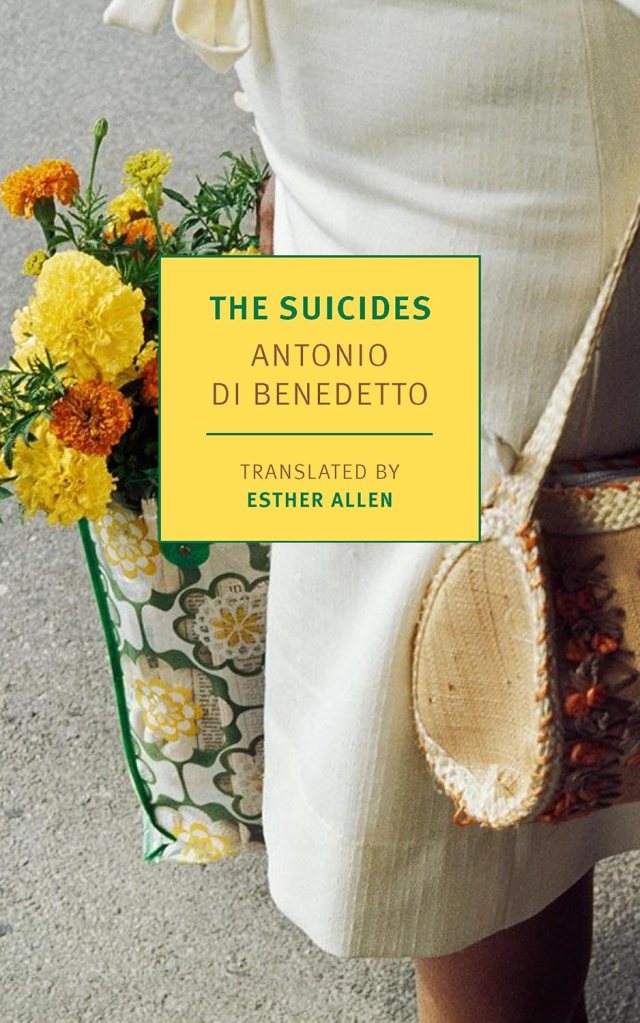

There are already many exciting announcements on 2025’s publisher lists in the early going, and just back from a brief holiday, my fresh to-read pile is already knee-high. NYRB Classics have definitely started the year off with a bang, as I’ve already stacked up four : Charlotte Mandell’s long awaited retranslation of Paul Valéry’s Monsieur Teste (3 Dec. ‘24), Lawrence Venuti’s new Dino Buzzati collection The Bewitched Bourgeois – Fifty Stories (7 Jan. ‘25), the highly recommended The Rest is Silence by Augusto Moterroso (10 Dec. ‘24), and last but definitely not least, the final volume in the Esther Allen-translated trilogy by Antonio Di Benedetto, The Suicides (14 Jan. ‘25). I hate to shine all the limelight on a single publisher like this, but damn is that a great month of releases.
Other highlights for me, either forthcoming or still waiting patiently in the to-read pile, include Mariana Enriquez’s A Sunny Place for Shady People (tr. Megan McDowell, Hogarth, ‘24), The Stolen Heart by Andrey Kurkov (tr. Boris Dralyuk, MacLehose, February ‘25), Good and Evil and Other Stories by Samanta Schweblin (tr. Megan McDowell, again, she never rests!, Knopf, September ‘25). I’m also looking forward to going back for another long dig into Odile Cisneros’s translation of Haroldo de Campos’s Galáxias (Ugly Duckling Presse, August ‘24). I’m pleased to see that some Hélène Bessette will finally be available in English; I’ve been reading Bessette in French for years, and I know colleagues have pitched her books to US publishers tirelessly, but it seems to have taken the powerhouse combination of Fitzcarraldo Editions, New Directions, and Kate Briggs to finally get things rolling (Lili is Crying, tr. Briggs, June ‘25). I’m also intrigued by the forthcoming Speaking in Tongues (Liveright, May ’25), reported to be a conversation about writing, language, and translation between the Nobel Laureate J. M. Coetzee and translator Mariana Dimópulos.


And, highlight of highlights, at long last, Bill Johnston’s retranslation of Stanislaw Lem’s Solaris will finally see the light of day in a highly anticipated letterpress edition from Conversation Tree Press (June ‘25). This translation has been bogged down in the worst sort of estate complications, leaving us only with a dated relay translation from via French. No longer! Hopefully a trade edition follows, we’ll see what the estate permits.
Instead of listing still more, I’d better get reading. Happy reading-in-translation and happy translating in 2025, for those of you who partake!
Chris Clarke
Samuel Martin

Since I’ve been gearing up for a while now to teach an undergraduate French course on translation for the first time this spring, I’m aware that the scope of my literary reading has (paradoxically) narrowed, at least in terms of the languages I’ve been attending to, not to mention the uphill battle to concentrate on reading anything at all these days. Yet from the mire of recent months, two tiny chapbooks of poetry have floated up and kept me company. Huda Fakhreddine’s translation of Ibrahim Nasrallah’s Palestinian, published by World Poetry Books, feels at once excruciating and crucial, a window of language smashed open to look out on the desolation of the genocide in Gaza. Meanwhile, Armen Davoudian has worked wonders translating the Farsi of Fatemeh Shams into English. I hope I’d have spotted their gorgeous collaborative chapbook for Ugly Duckling Presse even had it not been for the serendipitous title… Their voices have been echoing and blending in my head ever since I had the good fortune to hear them read together in Philadelphia in the fall.
On the prose side of things, I was very taken with Ari Gautier’s novel Lakshmi’s Secret Diary, translated from the French by Sheela Mahadevan and published by Columbia University Press. Lakshmi is a gregarious temple elephant in Pondicherry, once the capital of French India. Writing his anthropomorphic fable in French, Gautier will have had to balance attentive localized detail with an awareness of Western readers’ tendency to project exoticizing expectations onto unfamiliar texts and places, something the novel addresses head-on: “This world made up of vendors – some with stalls, others wandering about selling their wares – autorickshaw drivers, beggars, the elephant who blesses people, the spiritual dog with three legs… all this contributes to exactly what the foreign tourist is looking for: folklore” (15). As for Sheela Mahadevan, she will have faced the added challenge of ensuring that Gautier’s voice in English translation still sounds distinct from those of his prominent Anglophone Indian contemporaries; in this, I think she succeeds admirably.
I also feel honor-bound to mention my debt to Charlie Louth’s Crossings: Essays on Poetry and Translation from Hölderlin to Jaccottet, even though anyone interested in dipping into it will almost certainly need access to a research library. Crossings gathers many of Louth’s articles of the past twenty-five years or so, focusing on a Germanic (and, to a lesser extent, Francophone) lineage that includes Hölderlin, Goethe, Rilke, Kafka, Celan, and Jaccottet, as well as on some of their Anglophone translators (Michael Hamburger, Michael Hofmann, Derek Mahon, Don Paterson, et al.). Louth’s own insights as a translator enrich his critical readings, which are always instructive and often luminous.
2025 already has a lot to answer for, but on the poetry translation front, at least, there are reasons for enthusiasm. As ever, the latest issues of Modern Poetry in Translation (now under the editorship of Janani Ambikapathy) have brought many more voices to my attention and primed me to look out for tantalizing new titles, including Anna Gual’s Unnameable, translated from the Catalan by AKaiser and due out in the summer from Zephyr Press. In the spring, the consistently excellent NYRB Poets series will be making a place for a new selection from Ian Hideo Levy’s acclaimed translation of the Man’yōshū. And the star of Haitian poet Jean D’Amérique has lately – and justly – been in the ascendant; July will see Conor Bracken’s translation of Workshop of Silence become one of the inaugural titles in the Global Black Writers in Translation series from Vanderbilt University Press. Welcome news, indeed.
Samuel Martin
Originally published on Hopscotch Translation
Tuesday, January 28, 2025

 hopscotchtranslation.com