
The Visitor Peering over My Shoulder
by Jean-Yves Masson
I was busy translating Hofmannsthal when I suddenly had the physical certainty that he was with me in the room…

In the spring of 2025, Isabelle Baladine Howald, a co-editor of the long-running French poetry website Poesibao, invited the poet and translator Jean-Yves Masson to reflect on the notion of “hauntology” as it pertained to his own experience. Hopscotch is pleased to present Masson’s response in English translation. Many thanks to the author and to Poesibao for their kind permission to reproduce this essay.
As I ponder Isabelle Baladine Howald’s prompt based on the word “hauntology,” which Jacques Derrida coined in 1993 and which made an impression on both of us, I realize I am unable to point to any one work, whether poem or book, that could be said to have had the power to “haunt” me in my experience as a reader and translator. I have, of course, fallen in love with poems to the point of reciting them to myself nonstop as if gripped by fever, pacing in circles at home or walking down the street; indeed, I’ve been known to feel transported by their rhythm and to remain under their spell for days on end. Yet they don’t “haunt” me, inasmuch as these moments of enthusiasm, which have always been pleasurable, are situated very precisely in time, most often at the moment of discovery, and are only of limited duration. “Haunting” suggests something more diffuse, more unsettling, perhaps, but mainly longer-lasting: whatever haunts you comes back after a while, refuses to fade, and never goes away altogether. I always enjoy returning to the poems I love, and I’ve happily reread some of my favorite novels (of which there are few); since I’m constantly reading and rereading, it’s like a small treasure piled up over time. Nevertheless, these works don’t “haunt” me, and I could say the same of the films, music, and paintings I love. Their place in my life is clearly defined; I’m not obsessed by them.
Authors, on the other hand, do haunt me – just a small handful, but with great consistency. I’m never haunted by a given text, only by the poet himself. Perhaps one will assume I mean the poet’s entire work; it isn’t that. It is the author in person with whom I maintain a bond, such that he can visit me at home, as it were, and sometimes let me sense his presence. I’ve noticed that bonds of this sort are forged especially during the work of translation. Some of the authors I’ve translated – for translation, in the fullest sense, is more than just a book here or a poem there: it implies translating an author extensively over a prolonged period – have left me with the feeling that they were present at my side. They accompany me, quite literally. I’m well aware that this sensation could be taken to mean simply that over the course of the translation process, the authors have become “part of me.” You can put it like that if you wish, but it effectively reduces the phenomenon to a metaphor, which doesn’t correspond to my actual experience.
One of the very first authors I translated, and also one of those on whom I would end up working the most, was Hugo von Hofmannsthal. At this very moment, in fact, I’m translating another of his plays. While I haven’t devoted my entire life to his work, I realize that it will soon be forty years since I began translating him. At first, I approached him with curiosity and an interest that was more intellectual than genuinely poetic. I had read the celebrated Lord Chandos Letter, which naturally fascinated me, and I knew that the text, although fictional, had often been seen as having an autobiographical dimension. In the imaginary letter, a young aristocrat of the Elizabethan era, who has begun to make his name as an author, writes to an older mentor, the illustrious Francis Bacon, to announce that in spite of his promising start, he has made the irrevocable decision to stop writing and that nothing more ought to be expected of him.
I found it strange that this text about renouncing literature – and poetry in particular – should be abundantly cited and studied, but that no readers (aside from scholars of German literature) should have been sufficiently curious to read the poems that Hofmannsthal had written beforehand. He was thirty by the time he wrote the letter, yet he had been a teenage prodigy, precocious in a way reminiscent of Rimbaud. When I realized that the majority of Hofmannsthal’s poems had yet to be translated into French (in fact, unpublished translations existed, though I didn’t know it at the time), I set myself to the task. Before long I was deeply invested in the project, and I gradually discovered a poetic work of extraordinary intensity and beauty. I was translating because I wanted to understand the author’s trajectory, perhaps even to learn his secret. As I worked on his poems, I read nearly everything else he had written. I hadn’t counted on the project becoming so important to me, nor on German becoming a priority in my life; least of all could I have imagined myself becoming a permanent translator. That year (1986-1987, when I was twenty-four), I caught the translation bug, so to speak, especially since I was also taking my first steps in translating Italian, albeit from the work of a living author, Mario Luzi. Luzi was seventy-two; it was possible to meet him, and I lost no time in doing so (though that’s another story, one I’ve told elsewhere). As for Hofmannsthal, he had died in 1929 and attained classic status in German; ostensibly, he was “far away from me.” He nevertheless played a huge part in my intellectual journey. Having translated him and begun to write about him, I was led to read the authors he had held dear, those about whom he had written and whom I didn’t yet know (he was an extraordinary essayist, something altogether different from a mere “literary critic”), and, more broadly, those who had been his friends. I was already familiar with Austria; Hofmannsthal helped me see it in a new light. I could carry on endlessly listing all the things I owe him, all the things he taught me. Ultimately, to have continued translating him and writing about him was – and is – a way of repaying my debt, for he was my guide in poetry as in literature: not the only one, to be sure, but one of the most important, like Claude Debussy in the realm of music.
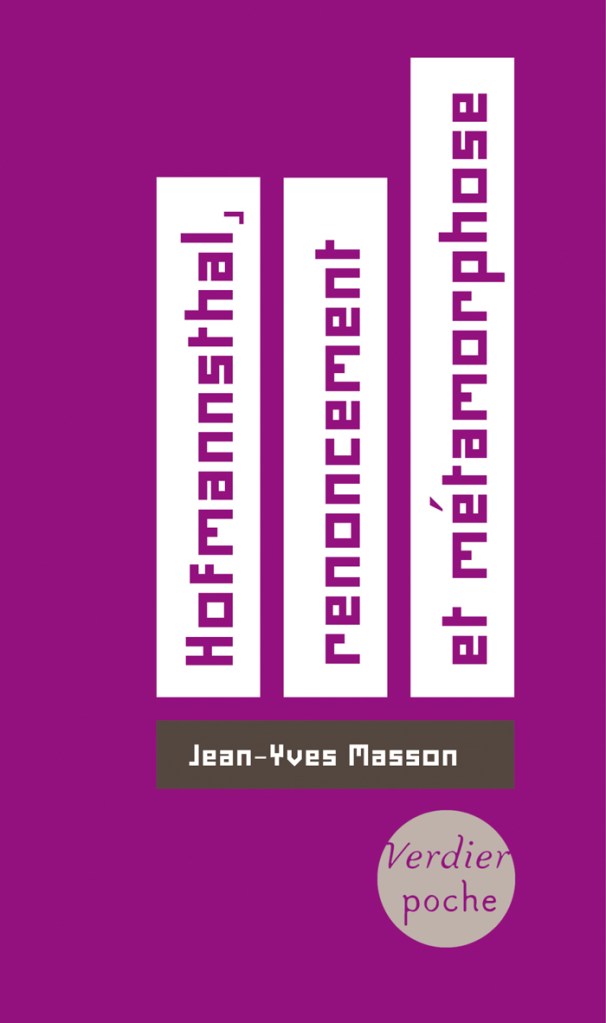
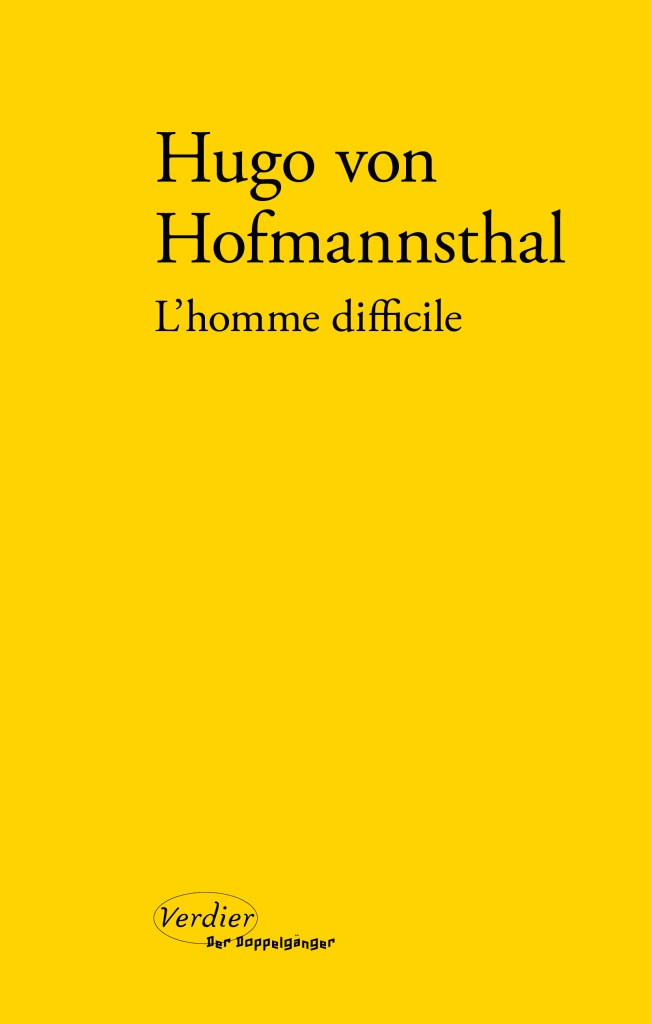

There came a day when the nature and scope of my relationship to Hofmannsthal changed, when it crossed a threshold. I was busy translating him when I suddenly had the physical certainty that he was with me in the room, standing right behind me and peering over my shoulder to see how I was coping with one of his most difficult poems. His gaze was one of well-meaning curiosity, even though it ought to have been intimidating, since I knew that Hofmannsthal wrote and spoke French admirably. At no point did his presence paralyze me in my work; on the contrary, I found it stimulating. He returned regularly as the days went on, not every day, but often enough. Whenever I encountered a point of difficulty, the poet, fully aware of the gulf between his language and mine, showed an empathetic interest in my struggle. He refrained from judging my attempted solutions, but still managed to make either his approval or disapproval known. I felt that he had come to me mainly because he was glad to be translated into French, the European language that mattered most to him (even though he knew several others). It was as though he were finally seeing an end to a lack or a delay that had been bothering him, wherever he was.
Hofmannsthal was thus the first to leave me with the conviction, which I can only base on my deep personal feeling, that an author or artist in general does not stop taking an interest in their work after leaving this world, that the work’s fate remains important to them, that what happens to it is not a matter of indifference. I’ve since revised this certainty, for I now believe that some authors, on the contrary, are not concerned with what becomes of their work – indeed, that they all but disown it. Those are special cases, however, and I won’t dwell on them here. What I am saying clearly presupposes that there is a life after death, or at least that something, which we might call the soul, prolongs its adventure beyond the limits imposed on our temporal existence. This was also the conviction of Hofmannsthal himself, whose faith grew stronger with age. I’m bound to add, though, that one of my friends, herself a renowned translator and author, once confided to me that she’d had an experience identical to mine, even though she considered herself a staunch atheist and admitted having no explanation for what had undeniably occurred to her.
If Hofmannsthal has come back to haunt me at regular intervals, it is of course because his works are among those most familiar to me. By no means, however, does this explain the phenomenon. For instance, I think I can safely say that Rilke has played a more or less comparable role in my life, albeit starting at a later stage, but I’ve never had the physical sensation of his presence at my side while reading or translating him. I have nevertheless taken great care in translating his work on a similar scale and devoted myself to it as consistently as to Hofmannsthal’s. But Rilke has never accompanied me in the same way, though I’ve been to the places where he lived; I even had the privilege of visiting the castle in Muzot where he spent his final years, and whenever I walk down certain streets in Paris I recall that he once resided there. All the same, I couldn’t claim to have had the sensation of knowing him as if we had met while he was still alive.
Quite the opposite is true for Hofmannsthal. I don’t see much of a distinction between my feelings of friendship for him and those for other poets I’ve known well. An intellectual and emotional dialogue has taken place between us; I have no other way of putting it, and neither can I offer any rational explanation. Very often I’ve felt that he was suggesting solutions to my translation problems, even when they involved writers other than himself. It’s as if he were helping me formulate my thoughts when I spoke about poetry or literature, as if we had such a spiritual affinity that I could divine his opinion of authors who had come along after him and whom he couldn’t possibly have read. Even my editorial work has benefited from his example, for he was also a remarkable anthologist and journal editor. This is the sense in which I believe I can say he haunts me, though not in a frightening way, especially since he isn’t the only one; there are five others like him, not all of them as persistent. Four are authors I’ve translated, which leads me to suspect that this experience does indeed have something to do with translation, with the particular form of reading that translation constitutes (since it is both reading and writing at once).
I would emphasize that this isn’t some sort of supernatural manifestation. I’m not a medium. I’ve never been gratified by the sight of any miracle or apparition from beyond, nor have I ever seen a ghost; I’m far too rationally minded for that. When I dream about someone who has died, I know it’s a dream. And I’ve never treated my visitors as informants; they don’t give me any insight into the place or state in which they find themselves, because I neither ask it of them nor feel compelled to know. My faith isn’t based on any material evidence, only on the testimony of the Gospels. Yet this sense that someone else is in the room with me, someone I can’t see but whose identity is quite specific, is one that I feel very strongly and with an unshakable conviction. Not every day, of course – far from it! It can’t be an outward projection of a thought or a memory within me: for one thing, it almost always happens when I least expect it; for another, I’m powerless to decide when it will happen; finally, I know with certainty what my visitor wants, what they have to say, to ask, or to examine with me, and it rarely fails to fill me with amazement. These encounters with the invisible have had a profound effect on my life, but I evidently don’t propose to go into the details, since I expect I’ve already made myself look sufficiently ridiculous in the eyes of skeptics. I care little, in fact, whether anyone believes me; had it not been for the invitation from Poesibao, I would probably never have chosen to speak about it.
As many readers will doubtless have found my strange confessions (about which I already have one or two misgivings) to be of limited interest, I’d like to add a few considerations about what I’ve learned from all this, not to say the advantage to be gained, for anyone who hasn’t had an experience like mine, in acknowledging that it is possible – in admitting the hypothesis, so to speak.
It has been my great fortune to see two of my translations of Hofmannsthal’s plays produced in the theater. I have especially strong memories of the first such occasion: in 1996, first in Lausanne and then at the Théâtre de la Colline, Jacques Lassalle staged the comedy Der Schwierige [The Difficult Man], which I had translated for Éditions Verdier. Hofmannsthal was particularly attached to this play written in the aftermath of the First World War; everyone familiar with his work agrees that it ranks among his finest achievements. He put a great deal of himself into it, and many of the hero’s traits verge on self-portraiture, which is far from the case with his other characters. Hofmannsthal would have wished the play to be staged in France, since, for all its Austrian qualities, it is imbued with a French spirit, applying the lessons he had gleaned from close study of that master of theatrical comedy, Molière. There are similarities, for example, between Der Schwierige and Le Misanthrope, though they are only visible to a trained eye.
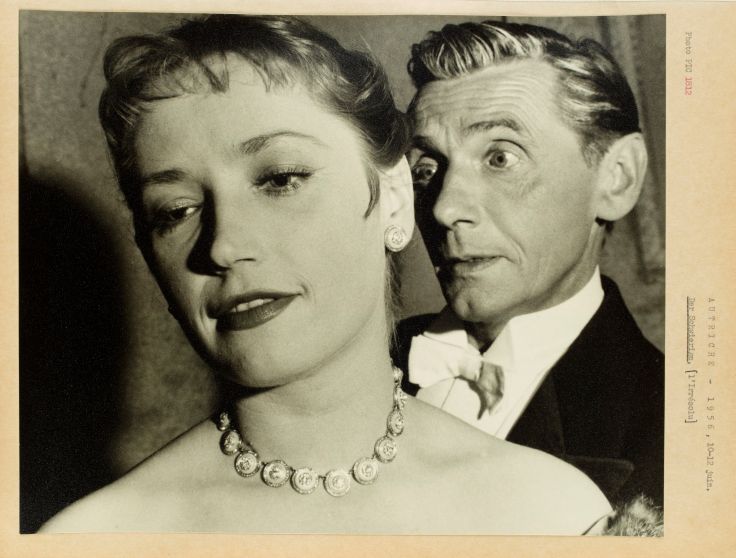
Jacques Lassalle’s production was a triumph, thanks to exceptional actors (Andrzej Seweryn in the lead role, but also Marianne Basler, Hugues Quester, Roland Amstutz – I could list the entire cast) and a highly dependable team (the set design by Rudy Sabounghi, in particular, added much to the magic of a spectacle that evoked the atmosphere of certain films by Visconti). It was a rare marvel of balance and sensitivity; the public reception confirmed as much. Having followed the rehearsals, adapting my translation here and there to suit the considerable demands of the stage (the subsequent revised edition incorporates those modifications, for that matter, and I learned a great deal from my first theatrical experience), I knew Jacques Lassalle well enough to declare with absolute sincerity what I felt on opening night. Rehearsals for a show are always an adventure, a long journey, and there had been uncomfortable moments and spells of doubt along the way; it gave me a better idea of the complicated working alchemy between the director, who is like a master builder, and the actors, each of whom has their own experience, personality, reactions, and artistic sensibility. Yet in the end, the miracle had occurred; all the elements – sets, lights, costumes, roles – had melded into a coherent whole. That night, I went up to Jacques Lassalle, with whom I’d spoken at length about Hofmannsthal over the preceding weeks and months, and made a peculiar observation: “You know, I think he is very pleased.” There was no need to specify whom I meant by “he.” Lassalle understood straightaway and smiled.
If I uttered those words, it was because I’d had the physical perception during the performance (and some of the rehearsals) that Hofmannsthal was present in the theater, that his shadow was moving along the rows of spectators, at times going up to the highest seats to judge the overall effect, at other times coming down toward the stage to observe certain details up close. I could content myself with saying that Hofmannsthal “would have been happy” to see his play performed in French, as plenty of commentators have tended to do. But no, I can’t put it any other way: his shadow haunted the performances in Lausanne and Paris, and I especially felt his presence on opening night, though I continued to do so thereafter.
What the art of the translator has in common with that of the actor or director is that they are all interpreters. A theatrical text is made to be performed; a play that hasn’t been performed doesn’t fully exist yet, just like a musical score that hasn’t yet been heard. No doubt it would be just as legitimate to ask whether, for example, a painting stored in a bank safe without ever being hung on display is somehow “dead” to the world, lying dormant and waiting for a viewer’s gaze to bring it back to life – but in the case of theater or music, at any rate, interpretation is absolutely indispensable. A work that is never performed is dead; it awaits resuscitation. One can read a play, but it’s a bit like reading a musical score: it is possible, useful, even interesting, but that isn’t what it was intended for. When I speak of my certainty that “my” author was on hand for the opening of his play, or that he was glancing over my shoulder as I was translating it (every translator is guided by the need to be faithful to the author, the desire not to betray them; it’s a highly singular relationship, even if the author has been dead for some time), I wonder if other interpreters might not gain from positing that something of the sort is also possible for them, even if they don’t feel it yet. Having had the fortunate acquaintance of a few great musicians in my life, I know that by dint of performing the composers with whom they feel the strongest affinity, they almost inevitably come to feel that those composers – by which I mean the real people who once existed in flesh and blood – are no longer strangers, and even that they end up living in one another’s company. (I’ve never actually dared ask any of my musician acquaintances whether this extends to the feeling of physical proximity that I’ve been describing; after all, there are surely multiple ways of being “haunted.”)
The greatest musical interpreters are not the ones who seek the spotlight. The inimitable color they give to the work they perform is not something they pursue for its own sake; their concern is to be as faithful as possible to what they think, or, better still, what they know to have been the composer’s creative intention. The same can be said of great actors. Yet we know that the need to be admired, praised, or applauded is also an element of the artistic vocation. Translators who labor in the shadows have less of an opportunity to show it, even though (let’s admit it) they, too, need reassuring from time to time that readers approve of their choices. This need is rarely satisfied, and hurtful remarks, which will always persist, wound them just like any other interpreters.
Dare I admit that when watching stage productions of plays especially close to my heart, I’ve sometimes reflected that the director and actors might have benefited from giving more thought to what the author would have made of their work? There are some interpreters, sadly, who don’t pause to ask themselves the question. They don’t worry or even wonder about it, and would brush it off if someone put it to them.
I know as well as anybody that one can’t stage a dead author’s work as it would have been staged during their lifetime. Not only is it impossible, but one is also expected to show how a work from the past still speaks to a contemporary audience. The same goes for the translator: the translation of an old work inevitably results – cannot fail to result – in its rejuvenation. All the same, I don’t believe for a moment that the question of what the author would have accepted or rejected is a paralyzing one for the interpreter, whatever their medium. The greatest playwrights, by virtue of having already been novel in their own time, have always known that the law of the theater is not to remain forever identical, but, on the contrary, to evolve from one age to the next, just like the other arts. It is consequently not a matter of reproducing something that once existed, but, rather, of keeping its spirit alive by embodying it in other images and other forms, while taking care not to betray it. It seems to me that theater only stands to gain from this concern for faithfulness and that the conviction of serving the author is a powerful driving force of creation. I say serving the author, rather than serving oneself, as sometimes happens in productions that fill me with suspicion, in which the original text is no more than a pretext and what you see onstage is best described as being “based on” the play, even though the title and author’s name have been retained. People are free to do as they please, and this obviously extends to rewriting, transforming, adapting – but in such cases, one shouldn’t promise the spectator that they are going to see a performance of the work advertised on the poster, for it simply isn’t true. This is happening more and more often, however, and while I’m anything but a reactionary where theater is concerned, it irks me. I struggle to imagine how one can be a translator without a certain humility; I believe that other interpreters, too, can only benefit from the awareness that they are translators in their own way, whether they are embodying a character, directing a play, or deciphering a musical score.
This, at least, is the conclusion I’ve derived from the experience related here. It is perhaps not given to everyone to feel in their bones that there is no essential difference between translating a living author (whose input can be solicited, provided they agree) and translating an author who has died long before our time, whether they remain obscure or have joined the ranks of the classics. And it would be highly imprudent to claim that this feeling is necessary, for as I’ve said, it certainly hasn’t been inspired by all of the authors I’ve translated. Yet I do find myself thinking about the potential meaning of past authors’ addresses to the “friendly reader” (Rabelais, at the outset of Gargantua: “Friendly readers, you who read this book…”). There exists a kind of reading perhaps best emblematized by translation, the kind that sees it as an encounter. Not an encounter with the “scripteur,” which the literary theory that was taught during my youth saw fit to substitute for the author (would a “scripteur” or an “instance auctoriale” really deserve so much as an hour of one’s time?), but with an individual who may or may not speak our language and whose company we seek, even when, like Rabelais, they hide behind a jaunty pseudonym (Alcofribas) and lead us on the most unlikely adventures. In all honesty, this is the only kind of reading that still holds any interest for me, including in my occupation as a professor of literature: not so that I can see into an author’s mind – I have a hard enough time penetrating the thoughts of my friends who are alive and well! – but in order that they may transform me. One can only be transformed by a genuine encounter, and reading doesn’t consist of recognizing one’s own thoughts in someone else’s work (although this can happen), but in giving way to emotion – in other words, letting oneself be transported, displaced, even disturbed by thoughts that are very much not one’s own. If I say that Hofmannsthal has “shaped” my mind, it’s because once I had read him, I was never the same again. Likewise for Montaigne. I know these men, in a way; I’ve known them personally. (I have never had cause to translate Montaigne, though I sometimes wish I had.) To be haunted by an author, one must first consent to being haunted. People may mock William Blake as a visionary when they say he received visits from Milton or Dante, but that is to miss the point. Ultimately, it comes down to a bond between poets, which nobody can deny. And even if some skeptics remain, perhaps my own experience as described here will still suffice to give an understanding of how far the bond between author and reader can go. The latter may also happen to be a translator, but in any case, I’m confident that more than one reader will have shared my experience, which has nothing visionary about it.
Translated by Samuel E. Martin

Jean-Yves Masson is a French writer, translator, and critic. He has translated over thirty books from German, Italian, and English, including works by Rainer Maria Rilke, Hugo von Hofmannsthal, Mario Luzi, and W. B. Yeats. Along with Yves Chevrel, he supervised the four-volume Histoire des traductions en langue française for Éditions Verdier. Masson is a professor of comparative literature at Sorbonne University in Paris.
Originally published on Hopscotch Translation
Tuesday, August 12, 2025

 hopscotchtranslation.com