
Riff-driven: Review of Translation Multiples: From Global Culture to Postcommunist Democracy by Kasia Szymanska
by Jess Jensen Mitchell
According to Szymanska, translation multiples are not just a potential source of readerly pleasure, but also an important political act.
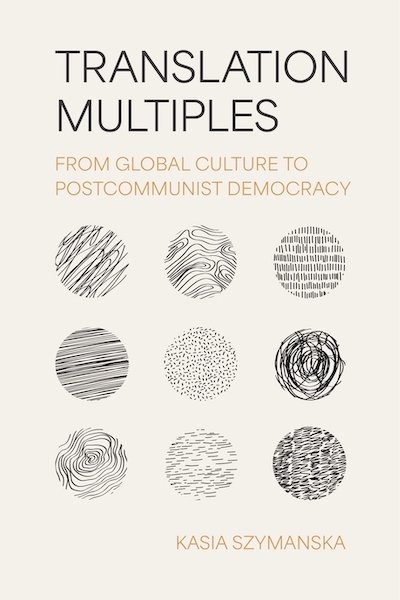
Translation Multiples: From Global Culture to Postcommunist Democracy, by Kasia Szymanska. Princeton University Press, May 2025, 248 pp., $35. ISBN 9780691265490
In 2002, the Polish alt-rock band Myslovitz released an album called Korova Milky Bar. According to band member Przemysław Myszor, the group had chosen to pay homage to A Clockwork Orange because they thought it had managed to capture the same strange, mind-altering atmosphere of their daily lives in Poland, about a decade into the country’s transition from a totalitarian communist state to a capitalist democracy. For them, the English novel (or the novel’s two complete translations into Polish by Robert Stiller, or maybe just the American film) contained clear parallels to the economic and social unrest they reflected on in their moody, Brit-pop-inflected music. Although this comparison may seem far-fetched or even wrong—Poland on the eve of its accession to the EU probably had little in common with Anthony Burgess’ dystopia—it does reveal the generative possibilities of plunking an artistic work into a radically different socio-linguistic landscape and telling the world you’re doing it.
Bold acts of translation are the lifeblood of Kasia Szymanska’s book, Translation Multiples: From Global Culture to Postcommunist Democracy. Szymanska identifies a startling range of publications on the Anglophone and Polish-language book markets in which the act of translation becomes a self-conscious, creative, and non-definitive dialogue between languages, artists, and readers. Focusing specifically on recent publications that present various translations of the same source text, she posits a new genre called the translation multiple. According to her, translation multiples are not just a potential source of readerly pleasure, but also an important political act. Szymanska writes, “Translation multiples activate readers’ ‘cognitive powers’ and teach them how to differentiate between distinct takes on the original from a palette of available options. […] In this sense, the idiom of translation multiples stretches out a polyphonic forum for different ideas, which readers need only to learn how to assess and choose from” (160).
In Szymanska’s reading of the genre, a niche and relatively new literary convention transforms into a manifesto on democratic thinking. She begins with the Anglophone book market, which is famously resistant to books in translation; according to the oft-quoted cliche, only 3% of books on the English-language market are translations. Nonetheless, many books are translated and re-translated into English. Translation multiples also have a long history; Szymanska traces roots of the genre within various literary schools, from classical scholarship to Oulipo, while also underlining that the current digital media landscape has made translation multiples at once easier to produce and all the more urgent. The Anglophone multiples discussed in the book range from canonical to avant-garde and from academic to deeply personal. I was most intrigued by the touching story behind Le Ton beau de Marot (1997), Douglas Hofstadter’s “ruminations on the art of translation” and creative act of grieving, as well as the more recent Impostures: Fifty Rogue’s Tales Translated Fifty Ways (2020), a delightful Arabic-to-English translation multiple by Michael Cooperson. Szymanska’s suggestion that translation multiples like Impostures could erode the idea of standardized, global English struck me as especially pertinent to our understanding of prestige publishing as it functions today. After all, Deepa Bhasthi’s practice of “translating with an accent” sidesteps Lawrence Venuti’s domesticating/foreignizing binary and her brave approach helped her translation of Banu Mushtaq’s Heart Lamp to win the 2025 International Booker Prize. This example gives credence to Szymanska’s idea that the global book market might actually become more local and less hegemonic through emboldened translation choices.
The second part of the book centers on the different though sometimes parallel book market in Poland, which is far more translation-rich than its larger English equivalent. Whereas the first two chapters of Translation Multiples function as a thorough and illuminating survey of foundational or noteworthy texts in the field of translation studies, the subsequent chapters center on three different case studies in the genre: the wildly experimental, post-1989 works of poet and translator Stanisław Barańczak, Robert Stiller’s triptych translation of A Clockwork Orange, and a 2012 volume of Brecht translations by Jacek St. Buras, Jakub Ekier, Andrzej Kopacki, and Piotr Sommer. Szymanska’s transition from one context to several is a brilliant defiance of old and, frankly, boring tropes about literature from behind the Iron Curtain. Sure, Translation Multiples offers necessary contextual information about Poland’s political history (keep your eyes peeled for a fascinating passage on nineteenth-century prison slang). But rather than repeating myths and over-simplifications about dissident movements and “minor” languages, she constructs a novel argument uniting her three case studies. Namely, Polish multiples—whether they compose homophonic riffs on arias, imagine a future for Poland with turbo-russified versions of nadsat, or score Brecht “for four voices and eight hands”—can be seen as fascinating creative endeavors, reactions against the Communist monopoly on publishing, as well as reflections of the pluralism, uncertainty, and possibilities generated by the period of transition to democracy.
Because of Szymanska’s optimistic underlying message buoyed by a consistent tone and prose styling, it would be easy to forget the limited appeal of various projects mentioned in the book. For example, I was fascinated by Stiller’s idea of translating A Clockwork Orange into Polish three times to suggest the possible influence of three different hegemonic powers. All the same, I did not think the American English-infused strain of nadsat in Nakręcana pomarańcza (“version A”) aged particularly well; the line “Ty szczto did get, brat?” seemed too syntactically convoluted to me. Still, we shouldn’t judge Stiller too harshly for failing to predict the anglicisms that actually have made it into Polish since 1989, especially given that the relative popularity of his translations of the dystopian novel could have actually discouraged people from incorporating any of the unique nadsat phrases into their daily speech. No one would want to become Alex, in any of his guises.
Moments of discomfort reiterate the core message of Translation Multiples: to validate multiple ways of reading texts across languages. For example, brief comparisons of different translations of works from the canon of world literature are a useful and common exercise in translation workshops. Students might examine a few sentences from the Iliad, Beowulf, or Madame Bovary, discuss them, and move on to something else. Szymanska reminds us—perhaps shockingly—that true devotees and a certain strain of conceptual artists have the patience to stay with a given work across page after page of different translations, and that seemingly gratuitous practice has inspired them to produce interesting art as a result. I don’t advise that we all read dozens of versions of Dante, but I think most people can admit that the diagram of Caroline Bergvall’s Inferno-inspired poem “VIA” looks pretty cool.
I also wondered how we can cultivate Szymanska’s celebratory, pluralist approach to translation while also maintaining a high standard of accuracy. Perhaps it is precisely through the transparency and dialogue generated by the multiple that sloppy or insensitive translations will fail to achieve an undeserved canonical status. In a moment when people can “automate their process” (two different people have suggested I program an LLM to “translate the Jess way” so I could produce ten books a year), we really should be thinking about the process, and not a single, easy answer.
As Szymanska admits, the genre of translation multiples won’t strike a chord with everyone, even as it becomes more readily available on the global market. Still, not unlike the drinks served at Korova Milk Bar, translation multiples are mind-altering, at least in their own, bookish way. They challenge traditional reading habits, just as they valiantly reveal the hidden work of the translator. An equivalency might be found in the English-language afterlife of Korova Milky Bar. Released a year after the original, Myslovitz’ self-translations into English failed to launch the band into international stardom, and they decided to concentrate their energies on the Polish market. The album did, however, lend the band a cult status in Switzerland, a deeply capitalist country where translation is ever-present, and the mean streets of transition-era Poland are far, far away.

Jess Jensen Mitchell researches and translates Polish literature. She is a PhD student at Harvard, writing a dissertation on Upper Silesia. Her translation of the “scandalous woman” Irena Krzywicka was featured in the Penguin Book of Polish Short Stories, and her first book-length translation will come out with Open Letter Books next year.
Originally published on Hopscotch Translation
Tuesday, September 9, 2025


