
Translations Come and Go, Racism Remains
by Santiago Artozqui
Regardless of the text in question, we must retranslate, not against earlier translations, but with them.

In 2020, Éditions Gallmeister published Autant en emporte le vent, a French version of Margaret Mitchell’s lone novel Gone with the Wind, in a new translation by Josette Chicheportiche. The same day, Éditions Gallimard rereleased an earlier translation by Pierre-François Caillé from 1938, accompanied by the preface that J. M. G. Le Clézio wrote in 1989, and by excerpts from the correspondence between the author and her translator. Recent events, impossible for either publishing house to have foreseen, have triggered a global, collective reflection on the place of Blacks in societies in which they are discriminated against. Without a desire to read these two translations exclusively through the lens of the Black Lives Matter movement, it is all the same interesting to note how, seen from this angle, both say “almost the same thing.”
Margaret Mitchell, Autant en emporte le vent, translated from the American English by Josette Chicheportiche, Gallmeister, Vol. 1, 720 p., 13€ – Vol. 2, 720 p., 13€.
Margaret Mitchell, Autant en emporte le vent, translated from the American English by Pierre-François Caillé, Gallimard Folio, Vol. 1, 784 p., 13€ – Vol. 2, 832 p., 13€.
Ever since its original publication, Gone with the Wind has invited superlatives. In 1936, this first novel by an unknown writer was “the most read,” “the most sold,” and, three years later, the eponymous film was “the most watched,” “the highest grossing”… The two French editions published in 2020 have not broken from this tradition—the back cover blurbs mention its “immense success,” its “mythical title,” its “unparalleled historical fresco.” Le Clézio, in his 1989 preface, climbed aboard, affirming in his opening line: “Gone with the Wind is a unique and exceptional book, it is the perfect novel,” and going on to evoke the millions of copies sold and the one hundred and twenty million viewers of the film.
This success and the position the book has taken in Western culture is enough to justify the necessity of a new translation into French, but as Marie Vrinat-Nikolov explained in Retraduire: pourquoi ? [“Retranslation: Why Bother?”, En Attendant Nadeau, 7 August 2017], all such justification is pointless: regardless of the text in question, we must retranslate, not against earlier translations, but with them. A translation is a reading, it evolves over time, and this evolution orients the placement of certain markers which, as they provide the text with a frame of reference, anchor a translation within its era.
The first of these markers is surely the title. Both French publishers stuck with Autant en emporte le vent, the octosyllabic title already crowned in France by cinematic, editorial, and commercial glory that it would have been foolish to do without. It has a better ring to it than “Emporté par le vent,” a more literal translation that is rather flat, but this embellishment diverts attention from the message: something has been carried off by the wind. This unnamed thing, central to the book’s premise, is the pro-slavery idyllic society constructed by the Whites, a sort of lost paradise where Blacks were happy and stayed in their place. The novel tells the story of Scarlett O’Hara, a wealthy heiress who is going to lose it all because of the War. What follows are fifteen hundred pages of adventures, drama, and unexpected developments during which Scarlett attempts to recover what she considers to be her due: Tara, the family plantation, the literary symbol of a Golden Age to which the American Civil War put an end. But in between the love scenes, the balls, and the battles, this “unparalleled historical fresco” offhandedly defends the idea that Blacks are inferior beings.
Consider the following excerpt, in which Pork, one of the slaves on the plantation, presents the woman he has just married to his master (Gerald). She is quick to thank her new master.
From Gone with the Wind, 1936:
When she spoke, her voice was not so slurred as most negroes’ and she chose her words more carefully.
“Good evenin’, young Misses. Mist’ Gerald, I is sorry to ‘sturb you, but I wanted to come here and thank you agin fo’ buyin’ me and my chile. Lots of gentlemens might a’ bought me but they wouldn’t a’ bought my Prissy, too, jes’ to keep me frum grievin’ and I thanks you. I’m gwine do my bes’ fo’ you and show you I ain’t forgettin’.”
“Hum–hurrump,” said Gerald, clearing his throat in embarrassment at being caught openly in an act of kindness.
Translation by Pierre-François Caillé, 1938:
Lorsqu’elle parlait, sa voix n’était pas aussi confuse que celle de la plupart des Noirs et elle s’exprimait avec plus de recherche.
— Bonsoi’, mes jeunes demoiselles. Missié Gé’ald, moi je suis t’iste de vous dé’anger, mais je voulais veni’ vous ‘eme’cier de m’avoi’achetée avec l’enfant. Des tas de missiés ils voulaient m’acheter, mais ils voulaient pas acheter ma P’issy pou’ m’empêcher d’avoi’ du chag’in et je vous ‘eme’cie. Moi je fe’ai tout ce que je pou’ai pou’ vous et pou’ vous mont’er que moi j’oublie pas.
— Hum… hum… dit Gérald en s’éclaircissant la gorge. Il était fort gêné d’être pris en flagrant délit de bonté.
Translation by Josette Chicheportiche, 2020:
Lorsqu’elle parla, sa voix n’était pas aussi confuse que celle de la plupart des Noirs et elle choisissait ses mots avec plus de soin.
— Bonsoir, jeunes demoiselles. M’sieur Gerald, je suis désolée d’vous déranger, mais je voulais venir vous remercier encore que vous m’avez achetée, moi et ma p’tite. Des tas de messieurs m’auraient peut-être achetée, mais y auraient pas acheté ma Prissy aussi pour pas que je pleure et je vous remercie. J’ferai de mon mieux pour vous et pour vous montrer que j’oublie pas.
— Hum, hum, fit Gerald, se raclant la gorge, gêné d’être pris en flagrant délit de bonté.
Evidently, on a formal level, the 1938 transliteration of Dilcey’s “patois” doesn’t hold up very well today—the colonialist echoes here are a bit too blatant—and in her translation, Josette Chicheportiche offers to this character a mode of speech that is more comfortable for the contemporary reader, simply because it is less caricatured and less crude. And yet, in the above excerpt, neither of the translators can change the implications of the two sentences that frame Dilcey’s line. In the first of these, the omniscient narrator announces that the speech that is about to follow (despite its approximated syntax) is “less slurred” and “chosen more carefully” than that of “most negroes.” In a tale that endeavors to describe an era with realism and great attention to detail, this “universal truth” is a lie, as much during the period the story takes place—when men such as Frederick Douglass distinguished themselves by their eloquence—as it would have been in the era of the book’s initial publication, when writers such as Zora Neale Hurston were authoring books destined to become classics of American literature. As for the second sentence, where the narrator informs us that Gerald is embarrassed to have been “caught openly in an act of kindness,” suffice it to say that the benevolent act that upsets his natural modesty is the purchase of two slaves, one of whom is a twelve-year-old girl.
But the most striking feature is that by comparing these two French translations, we note that the omniscient narrator, himself, has hardly changed over the past eight decades.
When she spoke, her voice was not so slurred as most negroes’ and she chose her words more carefully. (1936)
Lorsqu’elle parlait, sa voix n’était pas aussi confuse que celle de la plupart des Noirs et elle s’exprimait avec plus de recherche. (1938)
Lorsqu’elle parla, sa voix n’était pas aussi confuse que celle de la plupart des Noirs et elle choisissait ses mots avec plus de soin. (2020)
“Hum–hurrump,” said Gerald, clearing his throat in embarrassment at being caught openly in an act of kindness. (1936)
— Hum… hum… dit Gérald en s’éclaircissant la gorge. Il était fort gêné d’être pris en flagrant délit de bonté. (1938)
— Hum, hum, fit Gerald, se raclant la gorge, gêné d’être pris en flagrant délit de bonté. (2020)
The text is littered with examples of this sort. Over the course of the book’s pages, it becomes clear that this omniscient narrator’s racism—another marker that the novel hinges on—is not only more insidious, but also more deep-seated than the racism we thought we could make out in the transliteration of the slaves’ patois. Accordingly, even if it is worth pointing out the remarkable job that Josette Chicheportiche has done on the language and the overall text, the problem resides elsewhere. In this book, the slaves are happy with their lot and imagine nothing more for their lives than service to their master; that is enough to make them content, and no matter how much the translator fiddles with the syntax and refines the style, the very notion is racist, today as it was yesterday.
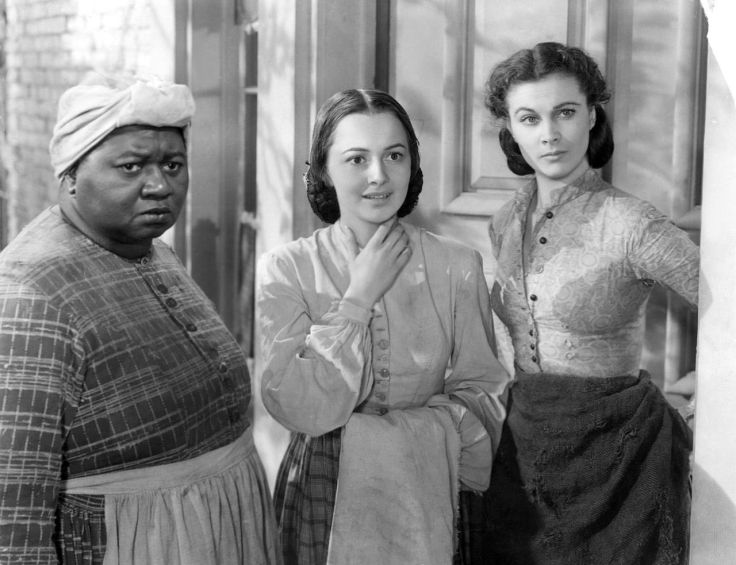
Upon the initial release of the book, and most notably among those who were campaigning for civil rights, the numerous voices that were raised against the manner it represented slavery were largely met with indifference, stifled by its sales figures. An anecdote related by John Bracey, professor of Afro-American Studies at the University of Massachusetts, Amherst, can serve to illustrate the position of American authorities when it came to race in 1939; this regards extras the city of Atlanta recruited to act in vignettes at the film’s premiere. As Bracey explained, the idea was to dress them up like slaves and have them chant spirituals. All the area churches refused, except for one: Ebenezer Baptist, where Martin Luther King, Sr., the father of Martin Luther King, Jr., was a preacher. At the premiere of Gone with the Wind, a ten-year-old Martin Luther King, Jr. found himself seated on a cotton bale, made up like a “colored” from the good old days: a symbolic incarnation of the old South, brought along to amuse the white elites.
Let us also recall that Hattie McDaniel, the black actress who played Mammy, was not permitted to attend the opening because the cinema in which it was held was reserved strictly for whites. And at the Oscar ceremonies, where she received the Academy Award for Best Supporting Actress, she was seated at the back of the hall, separate from the other actors. It makes sense that in a society like this, the arguments put forward by Gone with the Wind didn’t encounter much genuine pushback.
That brings us back to the novel, a classic that is emblematic of an important side of American history. Not that of a Golden Age, the end of which is being lamented, but that of the fraction of America who, for the past eighty years, has lauded this novel and who sees itself in the values that it defends. As to these two new publications, the novel’s translation and its retranslation…When a novel tells us that slavery was great, there’s nothing the translator can do about that, because, as Umberto Eco put it, he or she can only say “almost the same thing” as the original. And yet, the publishers are not without resources. They have the option of adding a critical apparatus if they feel the work merits it. In this case, neither of the publishers felt it necessary. However—and this has nothing to do with current events, as it was equally true months and years ago—it wouldn’t have been meaningless to warn readers that the image this novel gives of Blacks is fallacious and that slavery, as it is depicted in the novel, is not in keeping with historical facts. Some might argue that this warning is entirely contained within the very word “novel.” They would be incorrect, as the novel and works of fiction are essential to the construction of the mental image that each of us has of the society we live in, and accordingly, to what we think.
Translated by Chris Clarke
This essay originally appeared in French in En Attendant Nadeau, No. 108, on July 1, 2020. Hopscotch Translation is grateful to the author and to the team of En Attendant Nadeau for their kind permission to publish this English translation.

Santiago Artozqui is a writer and translator living just outside of Paris, France. He has translated some sixty books from English and Spanish into French. He was president of ATLAS, an organisation for the promotion of literary translation, and in 2016, he co-founded the online literary journal En attendant Nadeau and became its publishing director. He is also a member of the Outranspo (L’Ouvroir de Translation Potencial), a literary group dedicated to creative translation. His many translations include books by R. L. Stevenson, Maya Angelou, Roxane Gay, and Matthew Baker.
English translation originally published on Hopscotch Translation
Tuesday, December 9, 2025

 hopscotchtranslation.com