
211 grams: Review of Batool Abu Akleen’s 48Kg.
by Samuel E. Martin
The formula 48Kg.=211g. condenses the book’s own agonizing logic of diminishment.
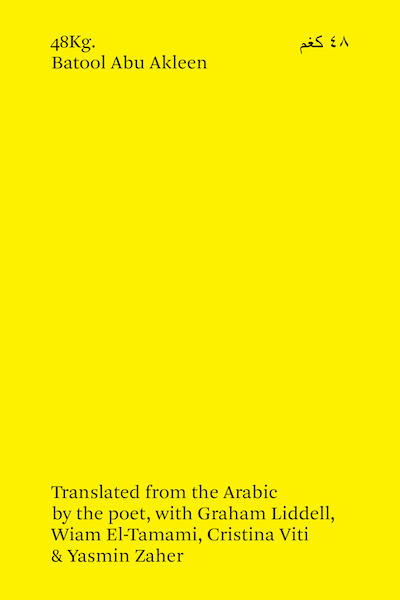
48Kg., by Batool Abu Akleen, translated from the Arabic by the poet, with Graham Liddell, Wiam El-Tamami, Cristina Viti, and Yasmin Zaher. Tenement Press, 2025, 135 pp., £17.50. ISBN 978-1-917304-03-0
Poetry may seem a flimsy thing at any time, let alone twenty-one months into a genocide. And whether one seeks either to confirm or to refute that impression, weighing a book of poems on a kitchen scale is not the method generally recommended. Then again, everything about Israel’s genocide of the Palestinians in Gaza already defies reason. Since the young Gazan poet Batool Abu Akleen has been “fighting absurdity by its own weapons” (p. 9), as Cristina Viti says in her preface to Abu Akleen’s book 48Kg., perhaps she would forgive this reader’s resorting to absurd criteria to assess her work.
48Kg. weighs two hundred and eleven grams. Another patent absurdity. One could mistake it for a conversion rate, adjusting the amount of food aid faithlessly promised by the international community into the paltry amount deemed deliverable to a famished people – a grotesque equation reminiscent of Western institutions’ “exchange rate on human [i.e., Palestinian] life,” which Omar El Akkad has scathingly denounced. The formula 48Kg.=211g. condenses the book’s own agonizing logic of diminishment: the forty-eight poems of Abu Akleen’s collection are numbered in reverse (48Kg., 47Kg., 46Kg., and so on), as if her body were wasting away or being chopped to pieces before our eyes. The poet thereby makes the reader complicit in her destruction. This terrible countdown only heightens the impact of the poems themselves, each of which is wrought with a craft that belies the poet’s age (she is scarcely out of adolescence) and a care incredible to imagine amid the carnage around her. Whatever the book’s conceit of self-disintegration, whatever the kitchen scale may read, 48Kg. carries an emotional weight that puts heftier tomes – and the conscience of nations – to shame.
Batool Abu Akleen has translated her poems from Arabic into English in collaboration with Graham Liddell, Wiam El-Tamami, Cristina Viti, Yasmin Zaher, and the editor of Tenement Press, Dominic Jaeckle. One of the further paradoxes of the collection is that the poet’s voice, spoken through several mouths, should remain recognizably hers throughout. A chasm separates the generosity of her word-sharing from the colonial covetousness of the enemy soldier described in “Life in hell”:
his smile is the smile of my mother, uprooted
when he erased her house from the city’s face.
[…]
He smiles again,
a smile he’s stolen from another mouth just now. (p. 55)
The inclusion of Abu Akleen’s Arabic texts on the left-hand pages represents both a gift to bilingual readers and a roadmap of her poetic journey. Three photographs of Gaza are reproduced at the outset – one from 1863, another from 1908, and a third showing a Byzantine mosaic being dusted off in 2022 – but the poems themselves do not make so much as a mention of Palestine, Israel, or any geographic location, for that matter. (I’m reminded of Georges Schehadé’s wry observation that brandishing the word Liban would not make his poems inherently Lebanese, just as no line of verse has ever smelled sweeter for containing the word parfum.) Instead, the geography of 48Kg. unfolds on a bodily level, with dimensions and boundaries in constant cataclysmic flux:
Mountains of concrete are swallowed by the earth
red seas are exploding from people’s bellies
& covering the land (p. 35)
Abu Akleen is a shape-shifter whose elemental and creaturely imagination can sometimes overflow or absorb the ever-constricting space around her. In “I didn’t steal the cloud” (p. 29), she is a stormy wave surging through the refugee camp; two poems later, “Judgment day” (p. 35) sees her morph into a sponge on the seafloor, except that the Red Sea has become a brine of blood. At other times, her mutations can’t keep pace with the forces of ruin. “Seagull” (p. 57) opens with brief promise (“When I saw I was white I knew I was a seagull”), much like the ugly duckling’s realization that he is a swan, but having begun at the happy tail end, the story soon unravels (“suddenly / my body melted / & I began to drown”). Genocide does not spare fairy tales, and while Gaza is very far from Kansas, it is farther still from Oz: “I put the broom between my feet / but it won’t take off” (p. 107).
Some of the starkest moments of 48Kg. find the poet fending off certain metamorphoses, declining the forms toward which fickle imagination would pull her. “I don’t want to be a dove,” she declares with almost childlike obstinacy in “Illusion” (p. 59), preferring “to grow smaller by the day” in a miniature enactment of the book’s regressive trajectory. There is nothing the least bit fanciful about the desire expressed in “I want a grave”:
I want a grave
I don’t want my corpse to be
decomposing in the middle of the street. (p. 47)
Not only is this a stunningly poignant wish; it also spurns the Western imagination that has long been pathologically incapable of recognizing Palestinian dignity either in life or in death. Batool Abu Akleen knows all too well how quickly and cynically the deaths of her fellow Gazans are commodified. In “The ice-cream van” (p. 45), co-translated with Cristina Viti in what could be seen as a horrifying yet expertly realized spin-off of Wallace Stevens’s “The Emperor of Ice Cream,” a vendor crisscrosses the city hawking the “frosty-fresh” corpses that have been refused a grave. “Second-hand ceasefire” (p. 89), co-translated with Graham Liddell, provides further illustration of the economy of death that has held sway in Gaza: “I pointed at one & said, ‘How much for a ceasefire, city size small?’ The shopkeeper said, ‘Thirty thousand martyrs, sixty thousand wounded, & ten thousand litres of blood.’” This text is as close as the book comes to outright political satire, as well as being (perhaps not coincidentally) the collection’s only prose poem; it leaves an indelible impression on both counts.
Talking of 48Kg.’s formal features, I would be remiss in not highlighting the skill with which Abu Akleen and her collaborators navigate the waters of English free verse. The lines ebb and flow with a vital pulse, and poems such as “The leaving game” (p. 51), “A lesson on colour” (p. 63), and “A trick to escape death” (p. 77) maximize the space of the page so as to draw other voices into the poet’s breath. Amid all the searing images of the book, occasional lines of iambic pentameter stand out, wielding alliteration and assonance to unforgettable effect:
I sink in mud with strawberries for sale (p. 31)
blind since the moment War became a school (p. 63)
The fat stored in my father’s flesh is melting (p. 75)
how all things in it pass or are awaited (p. 93)
A busker used to fill our street with boredom (p. 97)
I sleep & sadness haunts my orphan friend (p. 103)
he picked an arm the missile hadn’t shattered (p. 105)
Memorable though these formulations are on their own, I realize that there is yet more violence in severing them from the respective bodies of their poems. After all, Batool Abu Akleen writes of amputation and dismemberment, unbearable suffering and sorrow, in order that she, her people, and her land may yet be re-membered with the love, care, and urgency they deserve. As she says in her author’s note, “In this book, I am collecting the parts of myself I have found, in case there isn’t anyone there to do so if I am killed” (p. 21). What a heartrending thing it is to read a début collection already braced for posterity – yet what a privilege it is to have these extraordinary poems, in spite of all.

Samuel Martin teaches French at the University of Pennsylvania. He has translated works by several contemporary writers including Jean-Christophe Bailly and Georges Didi-Huberman; his translation of Didi-Huberman’s Bark was a co-winner of the French-American Foundation Translation Prize and was longlisted for the PEN Translation Prize.
Originally published on Hopscotch Translation
Tuesday, July 8, 2025

 hopscotchtranslation.com