
Techno-Poetry: On Liesl Ujvary’s Good & Safe (Sicher & Gut, 1977)
by Victor Breidenbach
Ujvary is always double-dealing, arranging her samples to investigate their subtextual machinations.
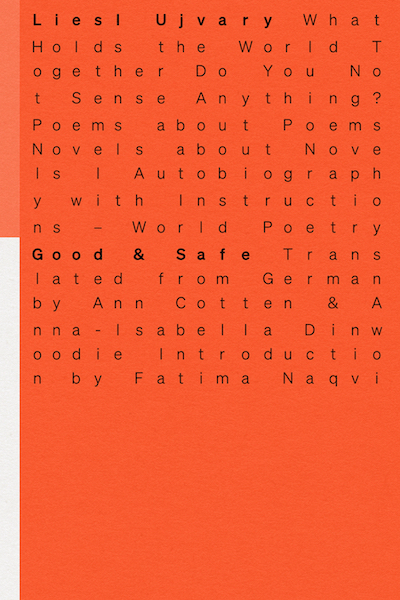
Ujvary, Liesl. Good & Safe, translated from the German by Ann Cotten and Anna-Isabella Dinwoodie. World Poetry Books, 2025. ISBN 978-1-954218-37-6. 184 pages. Paperback $20.00.
“I don’t work with instruments, I work with samples,” Liesl Ujvary says of her electronic sound art, which she started making on an Oberheim Matrix 6 in the 90s. Her 1977 poetry debut Good & Safe, newly available in a lively, idiomatic translation by Ann Cotten and Anna-Isabella Dinwoodie, uses a similar approach, looping and permuting a language of commonplaces into satirical critiques of language and its ideological coding.
One can see this method at work in the poem “Security Means Full Employment”, which orchestrates political discourse as a choir of false equivalences, modulating them into increasingly uncanny sequences such as this one:
I say: Force means violence
you say: Violence means torture
he says: Torture means dictatorship
she says: Dictatorship means lack of freedom
we say: Lack of freedom means work
you say: Work means affluence
they say: Affluence means security
(p. 33)
The choir is mimetic of how ideology is propagated; ubiquitous affirmation generates a veneer of neutrality. But in Good & Safe this programming always glitches. Statements that sound somewhat reasonable on their own are fed into a combinatorial software that overloads from its internal contradictions, introducing lag: a fraction of a second between the sentence and its seamless subsumption into the simulation. This gap could be called the abyss and/or humor, and Ujvary’s poems can be simultaneously unsettling and very funny. Force quit and reload?
Ujvary grew up in a postwar Austrian society eager to signal renewal amid many Nazi-era continuities, a consensus amnesia that favored economic and social stability over historical reckoning. In covert opposition, one of her recurring modes is an overeager complicity, a robotic, tautological affirmation of norms, orthodoxies, and advertisement slogans:
Yes, it’s true that Coca-Cola quenches your thirst. Coca-Cola quenches your thirst because we know that Coca-Cola quenches your thirst.
[…]
Yes, it’s true that we are free people. We are free people because we know that we are free people.
(p. 28)
Two years prior to Good & Safe, Ujvary published a collection of unofficial dissident poetry she’d smuggled out of the Soviet Union, and she certainly shares in the dissident’s joy of slipping one by the authorities, even if those authorities constitute the self. Her poems, which are largely lists or list-like assemblages, read like self-inventories of codes that, as if by their Eigendynamik, are allowed to subvert themselves. Take the poem called “That’s An Order!”, which is just a list of questions:
Do you want to eat?
Do you want to see?
Do you want to learn?
Do you want to drink?
Do you want to sleep?
Do you want to work?
Do you want to live?
[…]
(p. 88)
Framed by the titular command, these questions develop a threatening undertone. Imperatives become questions, compulsions become dubious privileges, as when the poem-machine “Great Authorizations” churns out this monstrosity: you may be allowed to be allowed to be required to (p. 87). It’s hard not to hear the voice of our productivity ideology thundering down by proxy of a TikTok optimisation-scientist, asking, menacingly, whether we want to be healthy, calm, and focused. By contrast, explicitly stated duties and rights are non-sequiturs such as: If you go shopping in the rain, you must write a letter to your parents (p. 29). Ujvary is always double-dealing, arranging her samples to investigate their subtextual machinations.
Conspicuously absent is any articulated counterproposal of romantic or humanistic ideals, no true language marshalled against a false one. A series of rhymed and metered poems of wistful longing are included but crossed out with faux-hand-drawn lines in a radical gesture of self-censorship. Ujvary eschews the desiring subject in favor of a more administrative mode, curating rather than creating, allowing the material to question itself. This feels like a practical approach to navigate a coded reality. Someone is drawing maps, developing strategies, identifying emergency exits.
A territory that Good & Safe extensively charts is the construction of identity. Ever deadpan, Ujvary is at her most gleefully savage in her satire of local identity. The poem “‘Have a taste’” is a long list of peoples, such as Wieners, Tyrolers, and Frankfurters, the majority of which double as trademark sausages: local identity as ground organic matter pressed into its own digestive tract, clamped, marketed, and sold. Hyperlocal identities are listed alongside sweeping external attributions, stressing a highly arbitrary and privileged capitalization on difference. In the subsequent poems, compiling identical, contradictory statements about Vienna, Salzburg, Graz, Berlin, and New York, these distinctions are torn down again:
vienna is dead
vienna’s ahead
vienna’s fun
vienna’s done
vienna’s fast-paced
vienna’s a rat race
vienna rises
vienna’s in crisis
vienna’s slow
vienna’s a freak show
[…]
(p. 49)
The city, as birthplace of the administrated self, is central to Good & Safe; nowhere are the pressures of identity formation as citizen, worker, and consumer greater. But here and elsewhere the citizens’ relationship to urban life is ambiguous. I love nature, Ujvary says in “Autobiography With Instructions” (p. 150), but the countryside features only as a weekend respite from the taxations of city life; nature is not an alternative. Her lists subvert their own order, but only very briefly give way to something amorphous, before delving into the next list.
Another aspect of identity construction Ujvary very playfully engages with is narrative identity. “The Spoon as Hero” provides a delightful, compelling template for applying the monomyth to a spoon, a concept just waiting to be actualized. A short “novel” is written entirely in the passive voice, a ghostly morning sequence of windows and doors being opened, of coffee being drunk. The pervasiveness of the list itself questions the primacy of narrative-based identity structures. Unlike narrative, lists accumulate without the logic of cause and effect, without placing the subject at the center, and without hierarchy. Ujvary’s lists are conspicuously never rankings. The list’s greater claim to objectivity is of course another kind of fiction, given how adeptly she’s pulling the strings behind the scenes.
Ujvary’s own poetic persona is expectedly shifty, especially when it performs being forthcoming. Her “Autobiography With Instructions” is a simulation of the construction of identity through a barrage of ready-made categories; rather generic autobiographical statements are followed by sets of instructions, phrased as questions, that determine the coordinates of the identity matrix. They’re simple and breezy, perhaps all too breezy to answer, with a few wildcards such as What are the advantages of self-service? (p. 153) and How long does a real party last? (p. 154) And the result does feel like a very comprehensive dinner party identity, a socially palatable self. In a starkly binary construction between the normative and the divergent, the sequence of poems “Out With It!”, subtitled “The Body”, “My Profession”, “The Apartment”, and “The Family”, offers a kind of corrective to this lightness, casting out, as with a spell, everything that is divergent and difficult, but also everything that gives us a sense of Ujvary as a concrete, agonistic person:
My profession guarantees no stable income, no job security, no health insurance, no pension in old age. Society values my profession very little. […] If I try to portray or promote any other way of living beyond the conventionally established options for human existence, my efforts are ignored, ridiculed or labeled delusional. All my colleagues find themselves in the same situation. (p. 159)
Good & Safe concludes with a quiet, cavernous poem entitled “‘Sealed Object With List Of Contents’”. This is the most spare of Ujvary’s poetic personae. You approach to find the key inside the lock, you open it, but inside is nothing but a list of contents. The list includes, among its 100 entries, a sealed object and a list of contents: a radically recursive alternative to narrative identity, or simply what’s left when you’ve elbowed your way out of the other constructions. What may offer an escape route from this semantic hall of mirrors is the visual aspect of her writing. The poem “I want to write a poem in which every line is different” is that same line repeated 16 times. The mind registers it like a barcode, and the echo of its beep is the tragicomedy of thwarted poetic intent.
In a retroactive narrative construction of Liesl Ujvary’s artistic trajectory, it’s unsurprising that her later work veers into the exploration of other technologies we’re fused with: photography, music, and film. In the arresting, futuristic/technostalgic video poetry plants on her YouTube channel, she enters the Vienna botanical gardens in an (ironic?) fairytale mode:
Today the woods are peaceful, no predators in the measurement zone. Delve further into the biosphere? Am I that brave? I will be careful.
Maybe a subtextual imperative of Good & Safe, phrased as a question, would be Do you want to explore your technologies?—be it language or the Oberheim Matrix 6. In her own words: “We aren’t born with the knowledge of how to use a minidisk recorder.”

Victor Breidenbach is a Berlin-based writer. He holds a bachelor’s degree from St. John’s College, Santa Fe. His work has appeared in Trouble, FU Review, KuK Kreuzberg, The Berliner, and The Marlowe Review. He is currently working on an experimental film called Marmalade Is More My Jam.
Originally published on Hopscotch Translation
Tuesday, April 28, 2026


