
Wonders in Aliceland
by Pierre Senges
Alice doesn’t admit translation in the traditional sense of the term. It thwarts it by presenting itself as a text (a chimera of written and spoken language) that has already been tampered with from the start.
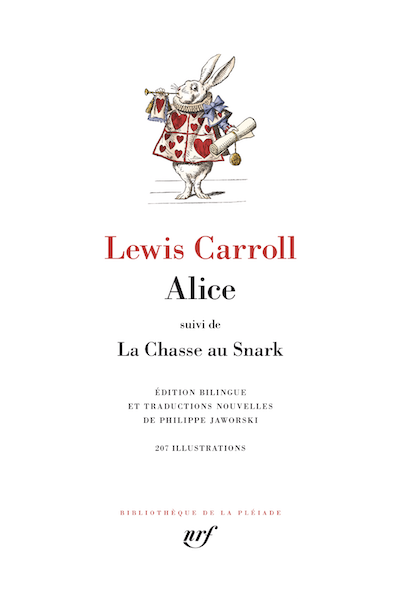
The new French edition of Lewis Carroll in the Bibliothèque de la Pléiade focuses on the two Alice books (Alice’s Adventures in Wonderland and Through the Looking-Glass), to which it adds the original manuscript text (Alice’s Adventures Under Ground), a newly discovered chapter, and The Hunting of the Snark. It is a fully bilingual edition, enabling the reader to hear the author’s language and to prolong his word games with a game of translation. This volume reflects the vital place of images in Carroll’s work, from its illustrated origin 160 years ago to their ongoing role in transmitting the text down the generations.
Carroll, Lewis. Alice suivi de La Chasse au Snark, translated by Philippe Jaworski. Bilingual edition. Gallimard, Bibliothèque de la Pléiade, 2025. ISBN 9782073114983. 1024 pages. 64 €.
Pleiadledee & Pleiadledum
In February 1856, Charles Dodgson hesitated between several possible pen names – Edgar Cuthwellis? Edgar U. C. Westhill? Louis Carroll? – before ultimately settling on Lewis Carroll. Alice would not arrive for another several years, but without her, Lewis would be little more than a reverend’s passing whim, known only to a handful of specialists. He owes her his fame, and more than a century and a half later, one would be hard-pressed to say who gave birth to whom.
After plunging down rabbit-holes and traveling across kingdoms and chessboards, Alice has at last arrived in the Bibliothèque de la Pléiade – or, rather, she has returned, having previously slid between the leather covers and fine gold lettering of Jean Gattégno’s 1990 edition. Alice never really leaves us; she vanishes through the looking-glass only to drop back in through the chimney. Even when she is away, she occupies our minds, her portraits keep us company, and her adventures, which in some cases originated in proverbs, become proverbial all over again. As I write this, Hollywood is undoubtedly casting about for the ideal actor to portray the next Mad Hatter. (It was Edward Everett Horton in the 1933 adaptation, with Cary Grant giving his best Mock Turtle.)
Unlike the twins Tweedledum and Tweedledee, who remain forever frozen in time, all translations, as we know, must eventually grow old. Philippe Jaworski’s translation for the Bibliothèque de la Pléiade is brand new; no doubt it, too, will age one day, but that day is a long way off. For now, the translation feels free and inventive. It seems to spring from the translator’s enduring love for Alice, from his desire to join in the chitchat that is the essence of her adventures – and, crucially, it unfolds alongside the English original in this bilingual edition. The English and French Alices do not proceed arm in arm like a redundant Tweedledum and Tweedledee (those two again!); instead, they cheerfully show off their differences. As Philippe Jaworski notes in his preface, a bilingual edition is always a risk, but it makes it possible “to affirm, or reaffirm, the differences between languages […]. If the translation had to be a perfect imitation […] what would be the point of translating?” Jaworski gives his reader the possibility of casting an amused, eager, or critical eye over the original text. In so doing, he affords himself greater liberty; references are no longer daunting, but permissive. An English wasp becomes a French hornet (frelon), a bat turns into an owl (chouette), and a weasel (belette) replaces a crocodile. What could be more reasonable, after all, under the aegis of an enchanter for whom the Snark is a Boojum and a theological argument a Bar of Mottled Soap? In the world of Lewis Carroll, the most radical substitutions are simply another identity principle.
Alice doesn’t admit translation in the traditional sense of the term. It thwarts it by presenting itself as a text (a chimera of written and spoken language) that has already been tampered with from the start. Rather than a translation, one would do better to speak of a “translation-conversion,” and no doubt a conversation, too – assuming the translator has gone along with the unexpected invitation to a mad tea-party and consented to his speech being mingled with that of the other characters. Jaworski sees his intervention as “akin to taking part in a verbal joust”; he allows himself to “play with the curious young Alice on every page.” This accounts for the flights of madness that keep him in sync with the specific madness of Lewis Carroll, and for the exaggerations that see him continuing to raise the bar for the master of hyperbole. It also explains why he gives himself license to indulge in typographical whims absent from the original version of Through the Looking-Glass. But every Alice is different (to say nothing of the Snark, which only becomes “curiouser and curiouser” in each new incarnation). Having more or less managed to keep a cool head, the translator adjusts his sails accordingly. He is more literal when translating the Alice Urtext (Alice’s Adventures under Ground), and when his reading takes him through the looking-glass, he forgoes typographical games.
Peeping Pom
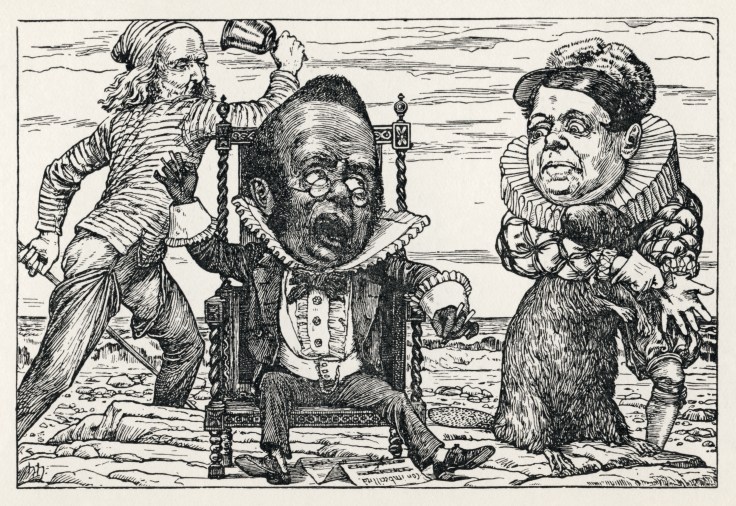
This edition of leather, fine gold, and cigarette paper is exclusively devoted to Alice’s world(s); it does not include Sylvie and Bruno, the early works, or the logic puzzles, nor, indeed, the Reverend Dodgson’s essay on eternal punishment (is it or is it not worthy of God?). It presents the manuscript of the first Alice in facsimile, augmented by Carroll’s own ungainly yet precise drawings, whose small, meticulous penstrokes must have taken hours. (The drawings were a gift for Alice Liddell, and Dodgson – as Lewis Carroll – devoted considerable time to them.) In addition to Alice’s Adventures in Wonderland and Through the Looking-Glass, the insatiable reader will find The Wasp in a Wig (a chapter that remained unpublished before resurfacing in London in 1974) and the highly enigmatic Hunting of the Snark, which Carroll himself declined to interpret. Having arrived at the end of the Snark (“Car le Snark, voyez-vous, / était bel et bien / un Boudomme”; “For the Snark was a Boojum, you see”), the reader then has a chance to catch their breath over a few translucent pages before diving into the 130-page portfolio of illustrations, comprised of some twenty artists’ work from 1900 to 1976, among them Mervyn Peake and Ralph Steadman.
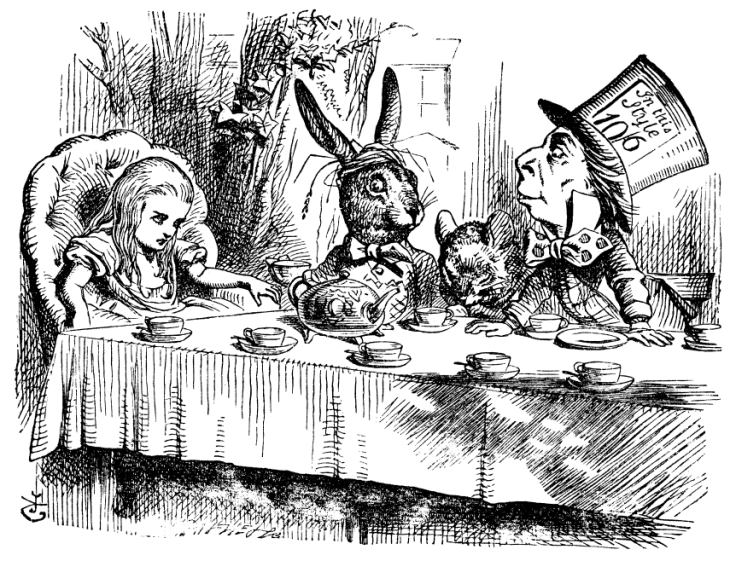
No one stays still in these pages. A rabbit hurries past without a moment to lose; a party of birds (including a dodo) have a footrace; Alice and the Red Queen run to keep in the same place. The pictures, too, refuse to stay still, as if the work’s visual dimension resisted being reduced to a bit part. Lewis Carroll was a man of words – even, as his translator puts it, a “perverse linguist” – but he was also a photographer, a man with an often avid gaze; the unforgettable illustrations (to which Sergio Aquindo has devoted a recent article) did much to push the writing forward. In the case of Through the Looking-Glass, “deciding on an illustrator was what gave Carroll the creative energy he needed”; when it came time for The Hunting of the Snark, Henry Holiday’s drawings “crystallized the creative process.” On one occasion, either out of graciousness or mischief, Carroll left it to his illustrator to select a companion for the Walrus. Would he prefer a carpenter? a butterfly? a baronet? John Tenniel, of course, opted for a carpenter.
Bewitchment
Quick as a rabbit, Lewis Carroll makes a fleeting appearance in Note 13 of Ludwig Wittgenstein’s Philosophical Investigations. Wittgenstein evokes “words ‘without meaning’ such as occur in Lewis Carroll’s poems” – no doubt a reference to the Jabberwocky (p. 10e). Not only do Carroll (a.k.a. Charles Lutwidge Dodgson) and Wittgenstein share a name and an interest in logic, but they are also preoccupied by language, how we use it and how it uses us. “The bewitchment of our understanding by the resources of our language” is a familiar phrase from Wittgenstein at Cambridge, but it could just as well have come from Carroll at Oxford (p. 52e). Yet whereas Wittgenstein undertakes to struggle against such a bewitchment, Carroll adopts a different tack: he lets language be as bewitching as it pleases in the vastness of Wonderland and the Looking-glass world. One can almost imagine that back in Oxford, where Carroll donned the the robes of the Reverend Dodgson, language reverted to acting without witchcraft once more. Carroll’s work, according to Giorgio Manganelli, is a celebration of both the rigor and the arbitrariness of linguistic rules.
“Words without meaning”: Wittgenstein puts the phrase in inverted commas (“‘ohne Bedeutung’”), for he is advancing with caution, wary of any brutish simplification of language’s complexity (p. 10). From the first lines of Alice to the last verses of the Snark, the question remains an open one: do words have meaning, or don’t they? If they do, what and how do they mean? And if they don’t, how do they behave instead? Alice is effectively one big language game. Creatures only exist by speaking or being spoken of; Alice likes insects “when they can talk” and is constantly asking the characters she meets: “What do you mean?” Lewis Carroll refrains from offering a definitive answer of his own; after all, if he found one, the book would come to a juddering halt. Alice’s endless adventures can be read as the pursuit of an ungraspable yet conceivable meaning that is lurking somewhere; in order to keep running, one needs to be able to imagine a destination, however distant. The Hunting of the Snark originated with a line of verse that popped into Carroll’s head out of nowhere, like an egg hatching from an egg: “I did not know at the time what it meant; I still do not know what it means; but I wrote it down.” When asked whether the Snark was an allegory, he pleaded ignorance; allegorical matters were the province of the Reverend Dodgson.
The Fool asks King Lear, “Can you make no use of nothing, nuncle?” The reader asks Lewis Carroll in turn whether it is possible to compose a work from the absence of meaning, even when ab-sense rises to the level of nonsense, that feather in the cap of British fine arts. In The Philosopher’s Alice, Peter Heath distinguishes nonsense from the absurd: the nonsense writer defies logical conventions, while the absurdist writer pushes them to their furthest extremity – or, rather, continues to obey them well after they have ceased to be reasonable. This art of excess is what links the Reverend Dodgson and the wizard Carroll, seemingly so incompatible with one another; it explains why The Game of Logic (1886) contains harebrained syllogisms that could very easily hold true in Wonderland.
Wonder
Philippe Jaworski reminds readers that to wonder means at once “to be astonished, to admire, to marvel, to doubt, [and] to ask oneself.” Polysemy makes translation perilous, but it is also what makes it possible in the first place. It proposes a third term somewhere between sense and nonsense; it is the playing field of literature. Above all, it ensures that Alice’s Adventures in Wonderland is the opposite of edifying literature. Alice offers neither instruction nor direction; it doesn’t denounce evil; it is neither allegorical, pedagogical, nor curative – and it thereby fulfills all the necessary conditions for a timeless work of art.
Translated by Samuel Martin (for E. B.)
This essay originally appeared in French in En Attendant Nadeau, No. 232, on November 25, 2025. Hopscotch Translation is grateful to the author and to the team of En Attendant Nadeau for their kind permission to publish this English translation.
Page references to Ludwig Wittgenstein’s Philosophical Investigations are taken from the revised 4th edition containing the German text with an English translation by G. E. M. Anscombe, P. M. S. Hacker, and Joachim Schulte (Wiley-Blackwell, 2009).

Pierre Senges is a French writer whose books have received numerous literary prizes. Among his recent works to have appeared in English translation are Ahab (Sequels) (Contra Mundum Press, 2021) and Rabelais’s Doughnuts (Sublunary Editions, 2022). Since 2023 he has been a member of the editorial board of En Attendant Nadeau.
English translation originally published on Hopscotch Translation
Tuesday, May 12, 2026


