
Strange Encounters and Needless Worries
Translator Stine An Interviews Poet Yoo Heekyung
The lyric is an inner flame in each human being, and it is through the mirror of the poem that we discover the flame burning inside ourselves.
Introduction
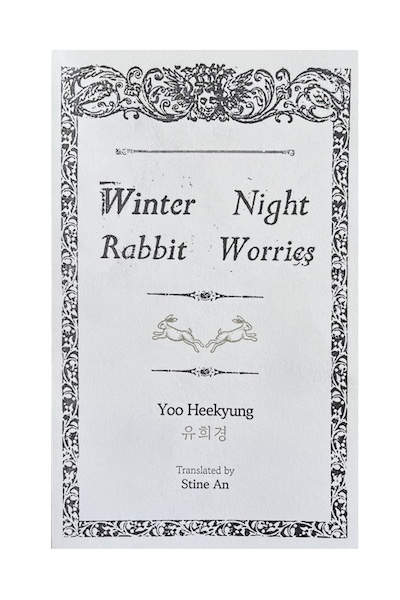
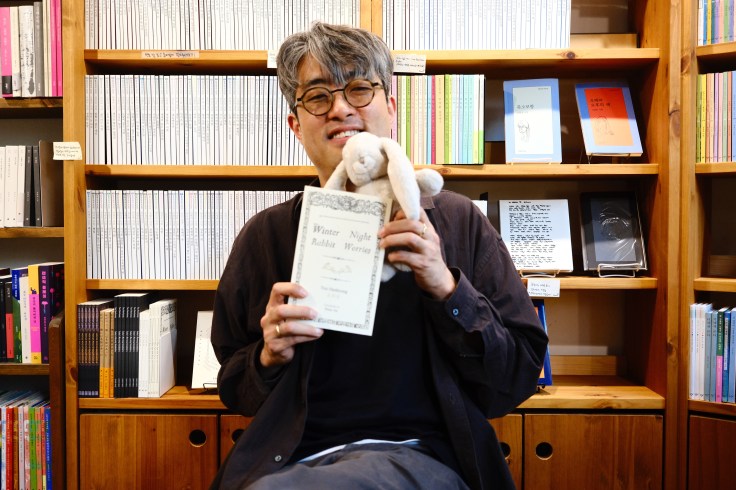
Yoo Heekyung (유희경) is a South Korean poet, playwright, and the founder of Wit N Cynical, an independent poetry bookshop and project space in the Jongno District of Seoul. His fifth poetry collection, Winter Night Rabbit Worries, 『겨울밤 토끼 걱정』 (Hyundae Munhak, 2023), available in English from Ugly Duckling Presse, gathers a series of prose poems Yoo calls iyagi, or stories, that trace the edges of memory, time, and the imagination that precedes language.
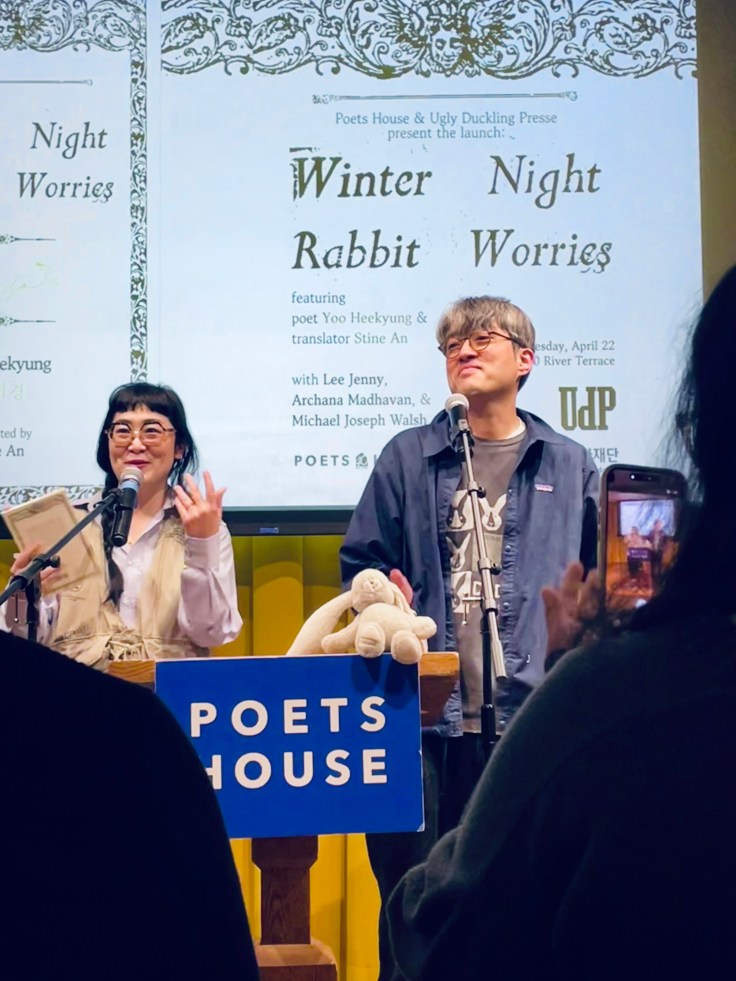
I conducted this interview in Korean over Google Docs in the spring of 2026, during and after a multi-city South Korean poetry tour that culminated in a bilingual book launch at Poets House in New York City. I translated our exchange into English and structured the answers thematically around my interests as the translator. Winter Night Rabbit Worries was my second time collaborating with Yoo Heekyung on a translation project. I was introduced to Yoo through poet-translators Don Mee Choi and Sawako Nakayasu who had worked together on Yi Sang: Selected Works (Wave Books, 2020) along with Jack Saebyok Jung and Joyelle McSweeney. Through that first introduction, I translated Yoo’s debut collection, Today’s Morning Vocabulary, 『오늘 아침 단어』 (Moonji Books, 2011), which came out with Zephyr Press in July 2025.
The title of the interview references Yoo’s sharp observation that his story-poems in Winter Night Rabbit Worries spin around the repetition of 기우 (奇遇), strange encounters, and 기우 (杞憂), needless worries, a homophonic pairing in Korean that seemed like an uncanny metaphor—the heads or tails of a coin—for literary translation and poetry alike.
The Book’s Origins & Architecture
STINE AN: I remember hearing that you almost titled this collection just Iyagi or Stories. How did you come across Winter Night Rabbit Worries as the final title, and what possibilities did that title open up for your collection?
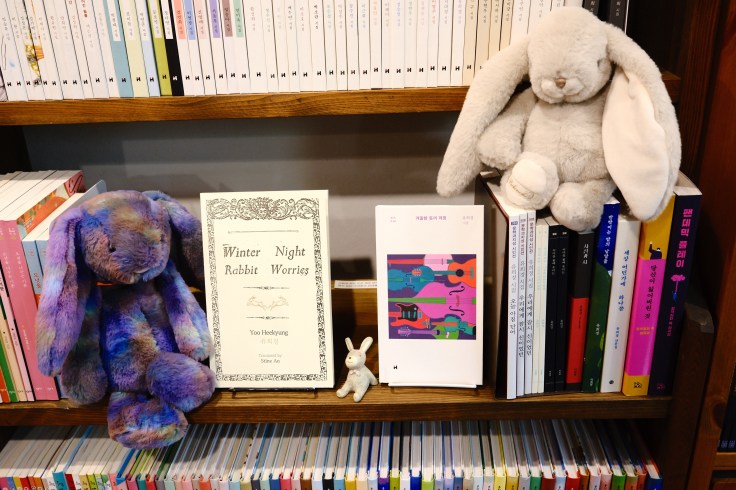
YOO HEEKYUNG: Iyagi [이야기], or stories, was my general name for this particular project. Narrative fragments had been floating around my head all throughout the planning and development of this collection, so I called it the “Stories Project” for myself. Iyagi could never have been the actual title for the collection. All literary acts depart from and return to the story, so titling my collection Stories would have been tautological. But I didn’t have an alternative title either. Even while wrapping up proofreading, I still didn’t have a title. Then one day, on complete impulse, in the middle of a conversation with the poets Kim So Yeon and Sono Kim, I asked, half-jokingly, what they thought of the title 겨울밤 토끼 걱정 (Winter Night Rabbit Worries). They loved it. And I received similarly enthusiastic responses from other poets I cherish and respect, along with the publisher and the editor for the project. I later came to see that the stories filling this collection are structured around the repetition of 기우 (奇遇) [giu], meaning “strange encounters,” and 기우 (杞憂) [giu], meaning “needless worries,” a homophonic pairing. I became convinced that 겨울밤 토끼 걱정 (Winter Night Rabbit Worries) worked well as a metaphor for my own stance toward poetic storytelling—at once endearing and a little pathetic. That’s how this title came into being.
S.A.: How does this collection fit into your larger body of work, and how did it feel to gather these story-poems?
Y.H.: The first poem in this collection is titled 이야기—원형 (原形), “Story—Etymon.” Nearly all the work for this project relates to manifesting into the written word all the things that fascinated me long before I became a poet—those characters, objects, and events, large and small, and all the stories they carry. These things become metaphors for the poetic capacity for imagination and fantasy that existed before “poet” became an established part of my identity and one of the facets that make up the person I am. What differs between the two—imagination and fantasy—is whether their realization is self-directed or passive-dependent, that is, willed or given. So working on these poems felt familiar and strange at the same time. New, and yet, at least to me, not new at all. It’s true that my work on this project was an exception to my usual practice of 시-하기 (poetry-making). Looking back at my poetry-making now, it was as if an inner voice commanded me, and this collection is the result of me following that command. I have a premonition that this won’t be the only time I’ll receive a command like that, although that exact process probably won’t repeat itself in my very next poetry collection.
S.A.: Your collection was originally published in the Hyundae Munhak PIN series. What makes the series different from other poetry series in South Korea, and how did this collection end up in the series?
Y.H.: What distinguishes Hyundae Munhak’s PIN series is how small and slim the collections are compared to other poetry series. Most South Korean poetry collections belong to a poetry series and contain an average of sixty poems, which is notably longer than the average American poetry collection. The PIN series requires roughly half that number, around thirty poems. Because of this, the format necessitates a different kind of poetry project. I judged that my Iyagi Project was well suited for the shorter length. Of course, that’s not why I chose the PIN series. The press reached out with the publication opportunity after I received the Hyundae Munhak Prize in 2020, so if anything, the series found me. At the time, I was preparing my fourth full-length poetry collection,『이다음 봄에 우리는』 (And Next Spring We Will, Achimdal Books, 2021), and I had already published a few poems from the Iyagi Project in literary journals. So the meeting of my story-poems and the PIN series is closer to a happy coincidence.
S.A.: Is there a poem in the collection that surprised you or has stayed with you unexpectedly over the years?
Y.H.: There wasn’t a particular moment of surprise. As I said, I was simply carrying out 시-하기 (poetry-making) in response to a command and obeying that inner voice. But one poem that has stayed with me is “Story—A Photo the Size of Your Palm.” That poem came from a conversation with a friend at a bar somewhere in Seoul. As I composed the lines, I became aware of a gaze resting on the story in the poem, a gaze that didn’t belong to anyone in particular. It was the speaker’s, and the poet’s, but also the listener’s, or perhaps even the reader’s, and beyond that, it even felt something like the gaze of a god watching over even them. When I considered the gaze as a kind of path, I came to understand then that a story, following along such a lonely path, is a kind of total perspective.
The Title & Its Ambiguity
S.A.: When I was translating the title, I sat with its ambiguity for a long time. We don’t know if these are the worries of a rabbit on a winter night, or if the winter night rabbit is simply in the act of worrying, or if someone is worrying about a rabbit on a winter night. I translated the title to keep the possibilities open. What did you want the title to be able to hold simultaneously?
Y.H.: Poetry written in Korean tends to conceal its subject. This is partly a feature of the Korean language, but concealing the subject also functions as a poetic strategy. By making something belong to no one in particular, you gain the possibilities to expand both the purpose of the sentence and the reach of its action. Perhaps this created the ambiguity you felt.
겨울밤 (winter night), 토끼 (rabbit), and 걱정 (worry) are each individual words. The fact that three words form a single sentence doesn’t disperse the particularity that each word possesses. As a poet, I must protect the particularity of each word. And I must allow the sentence, allow each word, to become everyone’s rather than mine alone. 겨울밤 (winter night), 토끼 (rabbit), 걱정 (worry), 겨울밤의 토끼 (a rabbit on a winter night), 겨울밤의 걱정 (a winter night’s worry), 토끼의 걱정 (a rabbit’s worry). I hope that every possible combination of circumstance, event, time, and feeling stirs something singular in the reader’s emotional world. The title poem from the collection, “Story—Winter night rabbit worries,” is about time and memory. The speaker believes “it,” the thing they’ve seen, to be a real rabbit, and simultaneously, by not believing, denies that reality, and yet the speaker remembers the idea of the rabbit, the essence of the event, that persists regardless. An alterity unrelated to reality or subjectivity: that is the nature of memory, time, and story. And Winter Night Rabbit Worries is the poetic effort to hold all of those things together.
S.A.: I translated iyagi as “story” throughout, but I kept running into the edges of that word. The story, or tale, is something we become removed from. It requires imagination to enter. It can’t be lived directly. There’s a distance built into the story that the lyric poem usually tries to collapse. So, why write a poetry collection full of stories? What does that distance give you that the more direct lyric “I” doesn’t?
Y.H.: Thank you for thinking so carefully about this. I believe a one-to-one correspondence between languages is essentially impossible. So, I don’t think there’s a problem with 이야기 (iyagi) being translated as “story.” I trust that 이야기 will carry the reader into the tonal shadows of that word, and “story” will carry the reader into its own tonal shadows.
I agree that 이야기 is a material placed between the speaker and the listener, and that through story, one can feel a distance. But I don’t think that perceived distance extends or diverges the path to personal or direct lyric. The lyric is an inner flame in each human being, and it is through the mirror of the poem that we discover the flame burning inside ourselves. In other words, the distance between the poet (subject) and the object (other) is not a condition for the lyric or has any bearing on the outcome. It’s merely a difference in the method of how you make someone feel that heat and light.
The 이야기 I’ve written in this collection are a little different from the ordinary kind. These stories have neither inciting incident nor conclusion. Nor do the individual sentences stand in ordinary causal relationship to one another. Each story is a “leaning in to whisper.” An intimate gesture to convey the vastness of the field that is the human heart, an unfathomable universe impossible to encompass. An expanse of space, an expanse of distance. In those moments, we come to rely on the inner flame of the lyric, but in an extraordinary way. To defamiliarize, to make strange, to live differently—that’s why the “story” was essential.
S.A.: The story is everywhere in the titles for your poems in this collection. What is 이야기-writing as a poetic act, and how does 이야기-writing relate to what you call 시-하기 (poetry-making)?
Y.H.: Everyone lives inside a story—as a root form, as the material between things, as a container for individual experience. So story-writing is possible only through metaphor. And for that reason, story-writing inevitably distorts. That transformation happens independent of my will. I am simply someone who tries to feel my way along that beautiful trajectory. That is the poetic act, or what in my own vocabulary I call 시-하기 (poetry-making). Story-writing and poetry-making converge at this point.
The Prose Poem
S.A.: What drew you to the prose poem as the form for this collection?
Y.H.: Formally, the decision between a prose poem or verse poem comes from rhythm. There are poems that must be sustained as a single continuous situation and poems that are focused on rendering an image. The former becomes a prose poem, and the latter, a verse poem, a lyric poem. Ultimately, the form follows what I’m writing about. The reason prose poems predominate in Winter Night Rabbit Worries is probably that most of my stories are structurally oriented toward a situation where there is a beginning and an end, a context, or a turn. But there are stories in this collection that take on the shape of verse, too. Those stories are composed of fragmentary images, such as “Story—Surface Patterns,” “Story—A Night in March” and “Story—The People Who Paint Car Lanes.” I don’t prefer one form over the other. It’s like choosing the right tool for the moment—there’s really no other way.
S.A.: What shifts when you call something a story rather than a poem? I’m interested in what that choice asks of the reader and of you as the writer.
Y.H.: I said earlier that 이야기-writing and 시-하기 (poetry-making) converge. This presupposes that 이야기-writing and 시-하기, that 이야기 and 시, are different from each other. I’ve never thought of 이야기 as a substitute word or concept for 시. I think poems contain 이야기, and 이야기 hold poems within them. The title or subtitle “이야기” signals that this poem belongs to the order of 이야기. Paradoxically, it also means that certain 이야기 are not poems at all. All to say that a poem that is a story clearly has qualities that distinguish it from an ordinary story.
S.A.: Your poems often feel like they’re listening—to silence, to what’s just outside the page. How do you know when a poem is done?
Y.H.: This collection makes frequent use of auditory images. I didn’t consciously intend this. It happened naturally. I imagine it’s because 이야기 originates from the acts of speaking and listening. And being conscious of silence, of what lies outside the poem—that’s not unique to me, and I suspect almost every poet experiences this. You can’t contain everything you mean. And you don’t dare try. Poetry is what doesn’t make language, what cannot become language. What we call poems are things that aspire toward poetry, and a poet is someone who aspires toward it. The end of a poem arrives at that point, in a state of both assent and resignation. Sometimes I feel that the end of a poem isn’t something I decide. It’s something the poem decides.
The Rabbit
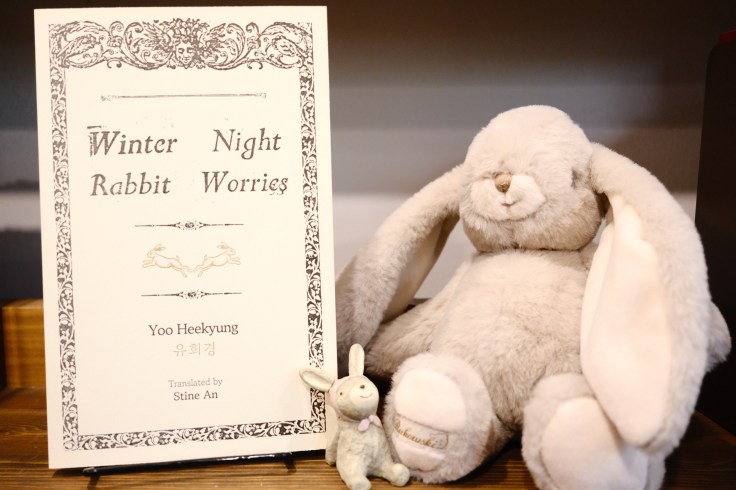
S.A.: The figure of the rabbit carries so much cultural weight—from Korean folklore, the moon, childhood. How did you end up writing about the rabbit in your title poem?
Y.H.: “Story—Winter night rabbit worries” is a poem that came from my own experience. One night, looking out the window of a second-floor coffee shop, I saw something. Without a moment’s doubt, I was convinced it was a rabbit because I had once encountered a rabbit in a nearby park. I had wondered what on earth a rabbit was doing there. I found it strange, and then spent a good while playing with it in the park. The rabbit had no fear of people whatsoever. Eventually, I headed home. That night, I kept thinking about the rabbit. I worried about it endlessly. Was it cold? Was it hungry? The next day I went back to the park. I had hoped to bring it home. But the rabbit was gone. There was no trace of it anywhere.
So that day when I looked out the window and what I was certain was that same rabbit from the park appeared before me, I looked more closely—it was a white paper bag.
In that instant, I was convinced this moment of misrecognition could tell us many things. And indeed, when I finished writing the poem and looked at what I had made, it had become a symbol with a wide net of meaning. It read as the rabbit encompassing all of what you mentioned—folklore, myth, childhood memory—with the rabbit as a story, as my story, as everyone’s story. I was quite happy with the poem, and published it without revision. As far as I recall, there were no revisions after that either. I hadn’t imagined it would become the title of the collection.
Winter, Night & Seasonal Time
S.A.: In your Instagram posts for your poetry bookshop Wit N Cynical, you return again and again to an image of yourself as a poet of the night and someone suited for winter. Why night, why winter?
Y.H.: Is that so? It’s probably because images of night and winter come up often in my posts. At night, and in winter, a person becomes alone. It’s only in solitude that reverie can begin. A personal reverie that can never be shared exactly with anyone and is, therefore, entirely one’s own. To prove the individuality of reverie, and to share its expression or evidence, as a poet, I need to make my readers lonely. That’s probably why night and winter appear so frequently as a backdrop.
And then there’s my own disposition at work. I really love being alone. It’s only when there’s no interference at all that I feel the fact of being alive. The time suited to this feeling is night, the season is winter, and whatever time it is, whatever season I’m in, I always seem to set out toward poetry from a place of night and winter.
S.A.: Winter and night are spaces of waiting. How do you write from inside them?
Y.H.: Rather than as a waiting inside winter and night, I think the more fitting reading for this collection is that winter and night themselves are waiting. I am absorbed into that waiting. I become the waiting, and I stay there.
The task given to someone who remains suspended in waiting is something like remembrance and reverie. To write about the images that remembrance brings up, the deep feelings that reverie brings, and sometimes to write about memories and the reveries themselves. That, I think, is what poetry-making is. I don’t try to distinguish between them. I simply let them be free, all the while going on being endlessly aware of them. In those moments, 이야기 is one method, and I, the poet, am a transparent subject. To borrow the title of a collection by the poet Kim Sang Hyuk (not yet translated, 『다만 이야기가 남았네』), “only the story remains.”
S.A.: Several of the April poems feel like they’re in conversation with winter even though April is spring. Tell me about the relationship between those two seasons in this book.
Y.H.: If that’s how it feels, it’s because what I described earlier, that the state of being alone comes through intact. These poems are bound up with the act of listening. More precisely, with listening to stillness. Stillness is the absence of any sound, and yet our ears want to hear even that. To be alone and absorbed in listening to stillness. If that state were converted into a time of day, it would be night. Into a season, it would be winter. Perhaps I look for winter even in April, perhaps in every moment.
S.A.: Tell me about where and when you write. How literal is the night in your poems?
Y.H.: I don’t have a fixed place or time for writing. Writing has to be possible anywhere, at any time, but that place does end up becoming fixed, at least for me. I don’t enjoy traveling, so I tend to write mostly at the bookshop or at home. The time tends to be night after the day’s work is done.
The night in the poems is literal night. But poetry-making is not unlike peering into one’s own dark interior, and it’s the effort to meet one’s solitude and to dream. The night inevitably takes on a symbolic meaning too.
S.A.: This is a wintry poetry collection coming out in late spring. I find myself wondering how we convince people to want the bitter, lonely cold of winter as they’re heading into warmth and light. How do you feel about the timing, and is there something about reading winter out of season that you think changes what the book can do?
Y.H.: For some reason, in winter I feel to the bone that the world is a phenomenon given to me alone. I run up against a kind of impossibility—that I cannot fully share with another person the world I see, the thoughts and feelings I draw from it. I find myself thinking that this is the original condition of being human. In that sense, the poems I’ve written are an offering of winter. Whether to accept that offering is up to the reader. My hope is that this collection will summon winter—that readers will sense and imagine winter through these poems, so that winter’s particular coldness and particular warmth and winter’s long, long nights arrive. I hope the readers become, within that winter, almost unbearably alone. If that’s possible, it doesn’t matter what season the reader is in.
Biographical & Emotional Origins
S.A.: The poems feel very physically present to me like they’re written from a specific body in a specific room. How autobiographical is this collection, and how much does that question even interest you?
Y.H.: I’m not sure if poetry-making that isn’t autobiographical is even possible. The reason poetry actively draws on the power of metaphor is to build a kind of bridge between the self and other so that one person’s individual experience can become a shared experience, sensation, feeling. It’s perhaps only natural that a specific body and a specific space should come through in the poems of Winter Night Rabbit Worries. Especially if we’re working with iyagi, which is a dense mass of explicit metaphor and metonymy.
A thought that came to me just now: perhaps what matters more in iyagi is the question of selection and exclusion. After the speaker’s primary reception, the listener’s secondary reception occurs, and the deliberateness that can arise in between, the intentional nakedness (since this is a story that is conscious of being a poem), might be what makes the listener conscious of the speaker. Writing it down, it feels vague. It needs more thinking. It’s not an easy question to answer.
Influences & Literary Kinship
S.A.: After Winter Night Rabbit Worries was published, you read Aloysius Bertrand’s Gaspard de la Nuit—Fantasies in the Manner of Rembrandt and Callot, the book that went on to inspire Baudelaire’s Paris Spleen, Ravel’s piano suite of the same name, even a Magritte painting. Tell me about that encounter, and what it was like to read a book that felt so close to something you’d already written.
Y.H.: In terms of order, I read Aloysius Bertrand’s Gaspard de la Nuit after I had already published Winter Night Rabbit Worries. So I can’t say that I was directly inspired by the work of Aloysius Bertrand, but the collection left such an intense impression on me that I sometimes misremember the timeline. I don’t remember how I came across the title. I most likely picked it up when it arrived at my bookshop—I always read at least a little of every poetry collection that comes through. And while reading Gaspard de la Nuit, I remember the feeling of dream–story–music–poem exploding in sequence, setting off fireworks inside my body. It was a pleasure that was hard to bear. It felt as though the boundary between my poems and the poems of Aloysius Bertrand had dissolved. A strange sensation. As if I were reading my own poems, but ones written before I was even born. There was nothing to add and nothing to take away. It’s an odd thought, but I find myself wondering whether poetry might be a shared endeavor—whether your poems and my poems aren’t separate at all, whether we are all, together, writing a single poem. There, an even stranger thought.
S.A.: You’ve mentioned that French Symbolist poetry was a major influence on contemporary Korean poetry, and Aloysius Bertrand is credited with introducing the prose poem form that heavily influenced French Symbolism. I’m curious where that lineage shows up in this book for you, and who you were actually drawing on as you wrote.
Y.H.: I’d be embarrassed to say I’ve read widely, and while I don’t read French, I’ve had many opportunities to encounter French literature and simply read this and that, as the mood took me. There’s no lineage to speak of, or if there is, it’s fragmentary. And yet, strangely, each of those fragments is faintly connected to the others. And they do influence me.
That said, I haven’t only read French literature in translation. I love Kafka too, and I sit with him often. Kafka and Baudelaire are closely connected. Baudelaire is connected to Bertrand. But the poems that have exerted the greatest influence on me are poems written in Korean. Within me live the poems of countless Korean poets—Yi Sang, Kim Hyesoon, Lee Seong-bok—and many others. They, of course, will have read Kafka and Baudelaire too. Thinking about it that way, tracing a lineage might be a pointless exercise. We simply each arrive at 이야기 from our own direction, and move on to find yet another story, each in our own direction, following a faint connection between the literature of the past and the literature of the future.
Translation & Collaboration
S.A.: We’ve worked together before, on Today’s Morning Vocabulary (Zephyr Press, 2025). How was this collaboration different, and how has your thinking about what literary translation can do shifted over time?
Y.H.: With Today’s Morning Vocabulary, I didn’t know what I was supposed to do. It was my first translated book, and I had no experience. I didn’t know how to work with a translator, or what to expect from a publisher or an editor. I had a vague sense that I shouldn’t interfere with the translation process. I can’t say I know well now either. But Winter Night Rabbit Worries was different. I thought more actively about what I could do. I tried to read through each poem at least one more time and made an effort to offer my thoughts. Whether my efforts were of any help to you or the editor, I don’t know. I’d be relieved if I wasn’t a hindrance. If there’s a next time, I think I’d bring a more knowing engagement.
Going through this whole process, I find I’ve come to look at the translation of poetry with a good deal more optimism. I now understand, however dimly, that translation is a literary event that belongs to a completely different realm from what we ordinarily call creative writing. Which is to say: my current understanding is that translation is not a matter of moving one world into another, but rather the effort that two worlds make to find a point of contact.
S.A.: In my translations, I was worried about losing the textures and tones present in your iyagi. What do you hope a translation holds onto, and what do you expect will inevitably transform?
Y.H.: It probably varies from poem to poem. And the effort we poured into this translation was precisely the effort to convey iyagi in a way that is true to iyagi, and to receive it on those same terms. By “true to iyagi,” I mean conveying the poem by drawing on the qualities that iyagi generally possesses.
As for transformation, as I mentioned, it’s inevitable. It will come, I imagine, especially from the different pictures that form in our minds for all kinds of reasons. For instance, when translating one poem, there was the word 굴 (gul). I wrote it thinking of a tunnel dug by a mole, but you had initially pictured a cave. A single word’s difference—I’m not sure if it’s a cultural difference or not—and the picture changes entirely. That was both fascinating and vertiginous. Since iyagi has a structure that lends itself to imagining scenes, even a small divergence could distort or change what the story, the poem, is trying to convey. I think of this as its own kind of fate. You can’t insert illustrations, after all. And a poem that has set out from me is no longer under my jurisdiction.
S.A.: When you imagine an English-language reader encountering Winter Night Rabbit Worries for the first time, someone who hasn’t read the original in Korean, who’s coming in entirely through my translation, what do you hope they carry with them after the first few pages?
Y.H.: That’s a difficult question. I’m not sure I’m allowed to have such a hope. But let me try to imagine it. First of all, I hope it doesn’t feel unfamiliar. I think these are stories everyone carries. At the same time, I hope there’s a sense of strangeness—that something is slightly twisted, that it doesn’t move in the expected direction. If the reader feels that, I’d be glad. I want that unexpectedness to be one aspect of what the poetry is. Even so, I hope they notice their hand turning the page. I hope they feel curious and want to understand what this is. If they can keep moving forward through familiarity and strangeness, through curiosity, I ask for nothing more. Though of course this isn’t only for those encountering the collection in English. There’s probably no need to draw a distinction. If there is simply reading, that is enough.
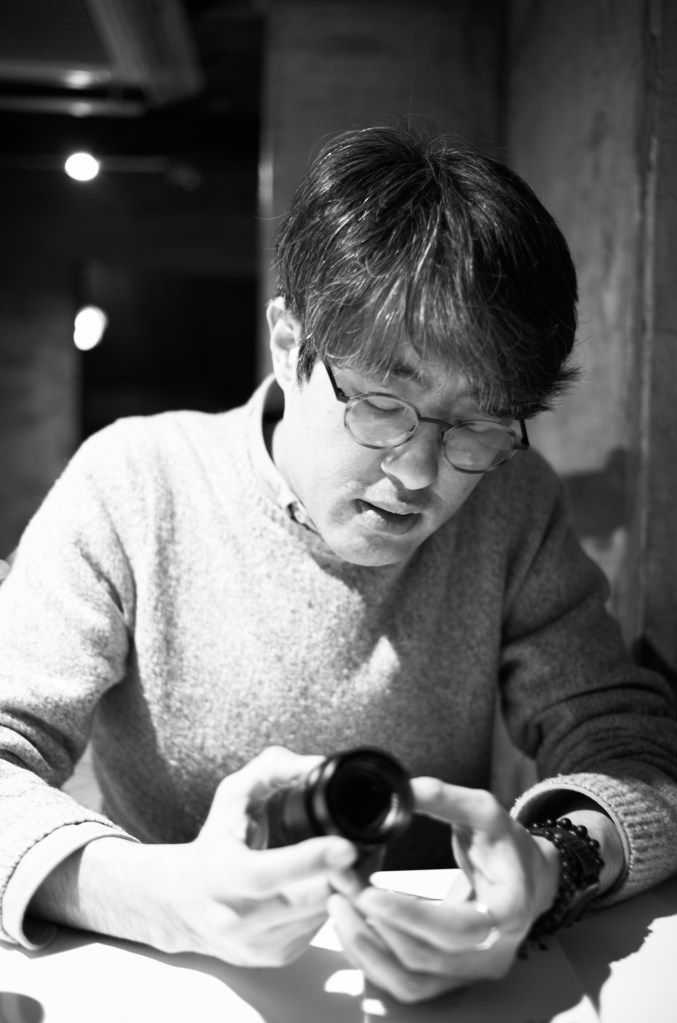
Yoo Heekyung (b. 1980) is an acclaimed Korean poet, playwright, and essayist. He is the author of over ten collections of poetry and prose, including Today’s Morning Vocabulary (『오늘 아침 단어』), Photography and Poetry (『사진과 시』), and And Next Spring We Will (『이다음 봄에 우리는』). He is a playwright with the theater company dock (독) and a member of the poetry collective jaknan (작란). A recipient of Today’s Young Artist Award from the South Korean Ministry of Culture and Hyundae Munhak Literary Award (2020), Yoo lives in Seoul where he runs the poetry bookshop and project space Wit N Cynical.
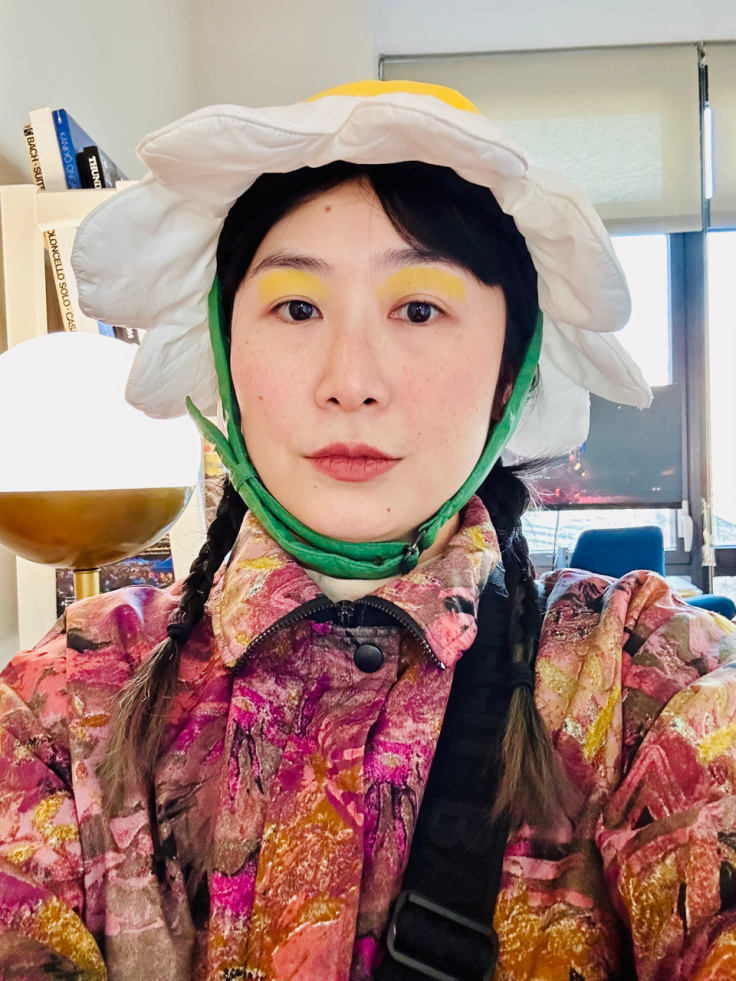
Stine An is a poet, translator, and performer in New York City. Her poems and translations appear in Best Literary Translations 2024, Poem-a-Day, Best Experimental Writing 2018, Words Without Borders, Asymptote, and elsewhere. A 2024 NEA Translation Fellow and 2022–2023 Poetry Project Emerge—Surface—Be Fellow, Stine’s debut poetry collection, B-Dragon Suite, is forthcoming from Nightboat Books in September 2026. You can find her online @gregorspamsa.
Originally published on Hopscotch Translation
Tuesday, May 26, 2026


