
On Swahili Hip-Hop and the Insufficiency of Translation
by Richard Prins
What can a translator do with a song, a dynamic sensory experience that includes actual music, of the non-verbal variety?
Brain Flavour: A Lyric History of Swahili Hip-Hop is not – for the most part – a work of translation. So I wasn’t asked, nor would it have occurred to me, to write a translator’s note. But when Hopscotch suggested writing about the book, I became curious what such a note might look like. Not just because the book contains my translations of Swahili rap songs and translations of my interviews with pioneering Swahili rappers and producers. It also explores how Swahili rappers “translated” American hip-hop to an East African context. And ultimately, the book’s success hinges on me “translating” that history for English readers.
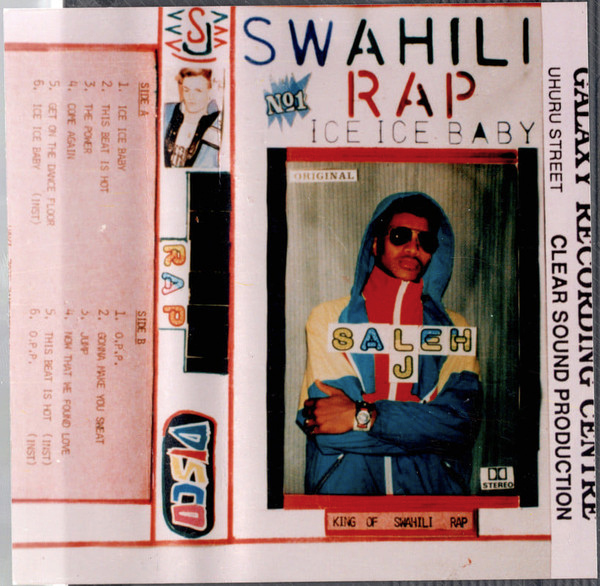
Perhaps you are rolling your eyes. Surely my scare quotes around “translate” stretch the word to the brink of tautology. But humor me, and consider this: The first Swahili rap ever recorded was a translation of “Ice Ice Baby”. Yes, that “Ice Ice Baby,”1 by one-hit-wonder Vanilla Ice, last seen rapping the Teenage Mutant Ninja Turtles theme at a New Year’s Eve Gala at Mar-a-Lago. Up until the early 1990s, Tanzania’s small hip-hop subculture viewed rap as an American art form best expressed in English. But when a teenaged Dar es Salaam resident known as Saleh J recorded a Swahili rap over the beat of “Ice Ice Baby,” he proved the language suitable for hip-hop and inspired a generation to make the music their own.
Translators often debate the merits of “foreignization” versus “domestication”; Saleh J’s interpretation of Vanilla Ice may have leapt off the spectrum entirely. Instead of admiring “girlies . . . wearin’ less than bikinis” and getting mixed up in a shootout, he rhymed about AIDS and the dangers of unprotected sex. After all, boasting of promiscuity would have been tasteless in Tanzania in 1991, the year AIDS officially surpassed malaria as the leading cause of death among adults. Rapping about guns would have been equally senseless in a society that prized its status as a haven of peace in a region reeling from bloody civil wars and prolonged liberation struggles. But even if you consider his “translation” more of a “remix” or even an “intervention,” there at the genesis of Swahili hip-hop, a local artist was undeniably interpreting a foreign musical movement and making it intelligible to his own audience.
Brain Flavour is not a history of lyrics, but rather a lyric history, in the ontological sense of a lyric essay, described (somewhat skeptically) by Philip Lopate as “a replacement of the monaural, imperially ego-confident self, the I-character voice.” In many ways I constructed this project as a challenge to my own ego-confident I-character voice. For one thing, I nurtured multivocality by including the voices of Swahili rappers via interviews and lyrics. But perhaps my most obvious intervention against my own voice is a literal replacement of “I” with “you”; the book is written entirely in the second-person. At first, this was instinctive, as personal narratives emerged most fluidly when I placed the reader directly in my shoes, insisting that the unfamiliar setting be viewed as familiar. But this resembles my approach to translating literature, where I seek to restrain my own idiosyncrasies so that the original author’s style can emerge. Dampering my own voice was an invitation for the artists’ voices to rise above my own. Just as Swahili rappers “translated” a foreign music genre for their peers and elders, I sought every angle by which I might “translate” my own perspective on their achievements.
There I go with the scare quotes again, barbed glyphs indicating nothing but the insufficiency of the word they fringe. So that’s enough of my tenuous couching of the book as an act of translation. More relevantly, it also contains many translations, including fifteen iconic Swahili rap songs. My artistic goal was to make the lyrics hit the page as dynamically as they do the eardrums. If that sounds like an exercise in failure, then I would refer you to countless arguments, academic and aphoristic, that deem translating poetry an exercise in failure. Russian linguist Roman Jakobson, for example, stated, “poetry by definition is untranslatable,” citing paranomasia, or wordplay, as the reason, where “phonemic similarity is sensed as semantic relationship.” The sounds – the poetic music – that bind a poem’s meaning cannot be reconstructed in a target language where phonemic similarities inevitably become disparities. A translator must resort to compromise and prestidigitation to insinuate that original music. But what can a translator do with a song, a dynamic sensory experience that includes actual music, of the non-verbal variety? How can a static page pulse with any semblance of the instrumentation for which its lyrics were molded?
Jakobson might have been an unlikely optimist on this matter. Right after declaring poetry untranslatable, he allowed “only creative transposition is possible,” citing as one example, “intersemiotic transposition – from one system of signs into another, e.g., from verbal art into music, dance, cinema, or painting.” In this book, I translate in the opposite direction, hoping to extract verbal art from music. And in the spirit of transposition, my first intervention while translating Swahili rap lyrics was neither verbal nor musical. Instead, it was visual – a pattern of forward-and-reverse tabulations, a repetitive visual structure to evoke the song’s repetitive musical structure. As an example, here is my translation of the first verse of LWP Majitu’s anti-police-brutality anthem “Jela”:
Yo
      don't go thinking
            everyone in jail
      is a thief
For some
      just looking suspicious
            is illicit
      Picked up
for loitering
      when you weren't
            even there
      Say a problem arises somewhere
it's no businessman
      no office flunkie
            you're all stooging
      for the police
People swear their oaths
      to eat
            Bring noise
      and you swallow a fist
Cops won't hesitate
      to eviscerate
            you
      but that won't happen to
no richie-rich kids
      You will behold
            a white horse pull up
      your hands are cuffed
taken to the station
      where you show your cash
            if you don't have cash
      say bye to your boys
they come and they go
      while you go to jail
            on your ass
As I tabbed back and forth, I was reminded of recording studios I’ve visited in Dar es Salaam. As the producer constructs the underlying beat, a desktop metronome sounds four beats to each bar, then scrolls back to the beginning at the left side of the screen. I thought this anecdata alone could rationalize my kinetic visual effect; charming, but dubious. Later, I read Black Noise, Tricia Rose’s groundbreaking book of hip-hop scholarship. Rose highlights “flow, layering and ruptures in line” as the three essential elements in hip-hop aesthetics, explaining, “they create and sustain rhythmic motion, continuity, and circularity via flow; accumulate, reinforce, and embellish this continuity through layering; and manage threats to these narratives by building in ruptures that highlight the continuity as it momentarily challenges it.” She further encourages us to “imagine these hip-hop principles as a blueprint for social resistance.” I decided to imagine these principles as a blueprint for my own translations. The line tabs forward twice, insinuating rhythmic motion; two tabs backward insert rupture. Then it starts all over again. Another layer, circular and continuous, yet continually challenged.
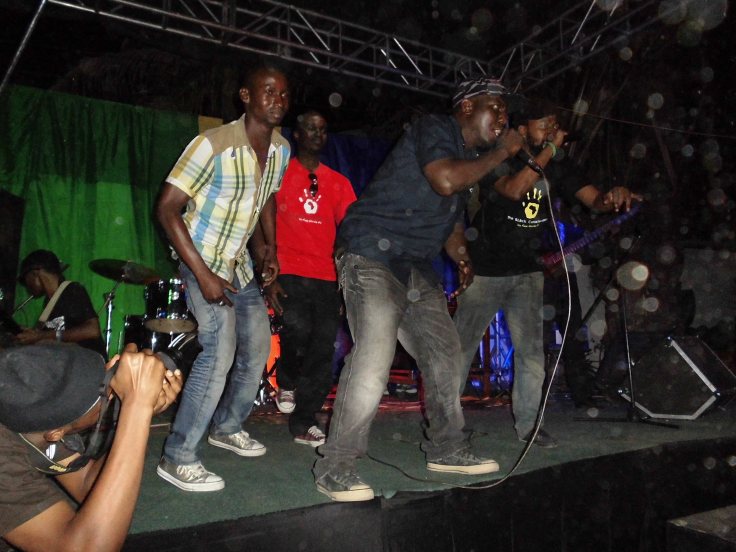
When I began working on these lyrics, I was an MFA student in literary translation at Queens College. Up to that point I had mostly translated classical Swahili poetry, which features a strict rhyme scheme and syllable count. Such rigidity is anathema to rap. Rhyme and rhythm remain crucial, but they must flow free, open to the unexpected. Because my translated lines are jagged, launching at different points of the page, they engender syncopation. Meanwhile, I let the rhymes fall where they may. I brought a few drafts to workshop, fancying that I had contrived a nifty solution. But a fellow translator made a prescient statement in his written comments: “I do think for it to merit being ‘put out there’ (given that songs often/always do plenty to speak for themselves) translations like these should be accompanied by other writing; the more I think about it, I keep coming back to essay and interview.” Clearly my translations, no matter how dynamic, were insufficient. Yet I found myself dismissing his suggestion; translating the lyrics was hard enough, now he wanted me to write a whole damn essay and bug some legendary artists for an interview? I went back to translating dead poets. But a couple years later, I received a grant from the National Endowment for the Arts (prior to its unceremonious disembowelment at the hands of the Trump administration) for a sci-fi novel I was translating. I managed to finagle a month in Dar es Salaam doing exactly what my colleague had suggested: interviewing the artists who built Swahili hip-hop.2
Interviews are not a traditional category of literary translation. Translating them should be more straightforward than translating lyrics. But these were the words of oral artists whose personalities were central to the story I was telling. I wanted their voices to be as distinct and indelible in my English text as they were in the Swahili recordings. I conducted interviews monolingually (Swahili peppered with occasional English phrases, though one rapper spoke English with a smattering of Swahili). The sole exception happened to be an especially indispensable source. Kibacha Singo, a.k.a. KSingo or KBC, was a member of Kwanza Unit, the most influential Tanzanian hip-hop crew of the early 1990s. (When Saleh J’s Swahili rendition of “Ice Ice Baby” won first prize at the Yo! Rap Bonanza contest in 1991, KBC, rapping in English, took second place.) He spoke to me in a fluid, code-switching fusion of Swahili and English often known as “Kiswanglish”. Here is a snippet of his interview on the left-hand side, with English phrases in italics, and my translation on the right:
Kwa Swahili speakers, you just have one language as an option. Haupati shida kwa sababu, that’s all you know. Lakini kwa sisi ambao tumeanza Kiingereza, sasa it’s like, you don’t want to do ile translation. Kusema labda I’m hot like six buffalo wings, how do you say that in Swahili, unajua? It’s like, you have to scrap that, halafu uje kwenye perspective ya Mswahili. Kama anataka kuexpress how hot he is, uje kama ‘nachemka kama maji ya moto’ ile the whole concept ya Mswahili anaongea. Lakini once you figure it out ikawa siyo ngumu tena. Actually, my first Swahili attempt, I didn’t even write it. That’s how, once you crack the code, I didn’t even write it down. That’s a song kwenye album ya Kwanzanians kuitwa “Nakuja”. It was me and D Rob, was the lineup. Ni kitu nakifeel na kitu nakiongea kama kawaida. Naimemorize the words, lugha naongea kutoka mtoto. Sina haja ya kujifunza jinsi ya kuongea hiyo lugha. Kiingereza inabidi, hii neno inatamkwaje vizuri. Lakini Kiswahili kipo tu. Kwa hiyo ilikuwa rahisi. Sasa mimi shida yangu ilikuwa okay, what cadence do I do kufanya watu wawe excited.
For Swahili speakers, you just have one language as an option. You don’t have any issues, because that’s all you know. But for those of us who started out with English, now it’s like, you don’t just want to do a translation. Saying, maybe, I’m hot like six buffalo wings, how do you say that in Swahili, you know? It’s like, you have to scrap that, then come with the perspective of a Swahili person. If he wants to express how hot he is, you come like “I’m hot like boiling water,” that’s the whole concept of a Swahili person speaking. But once you figure it out, it’s not so hard anymore. Actually, my first Swahili attempt, I didn’t even write it. That’s how, once you crack the code, I didn’t even write it down. That’s a song on the Kwanzanians album called “Nakuja”. It was me and D Rob on the lineup. It’s something I feel, and something I speak, like normal. I memorize the words, the language I’ve been speaking since I was a child. I don’t need to learn how to speak that language. With English, you have to figure out, how is this word pronounced correctly? But Swahili, it’s just there. So it was easy. Now my problem was, ok, what cadence do I do to get people excited?
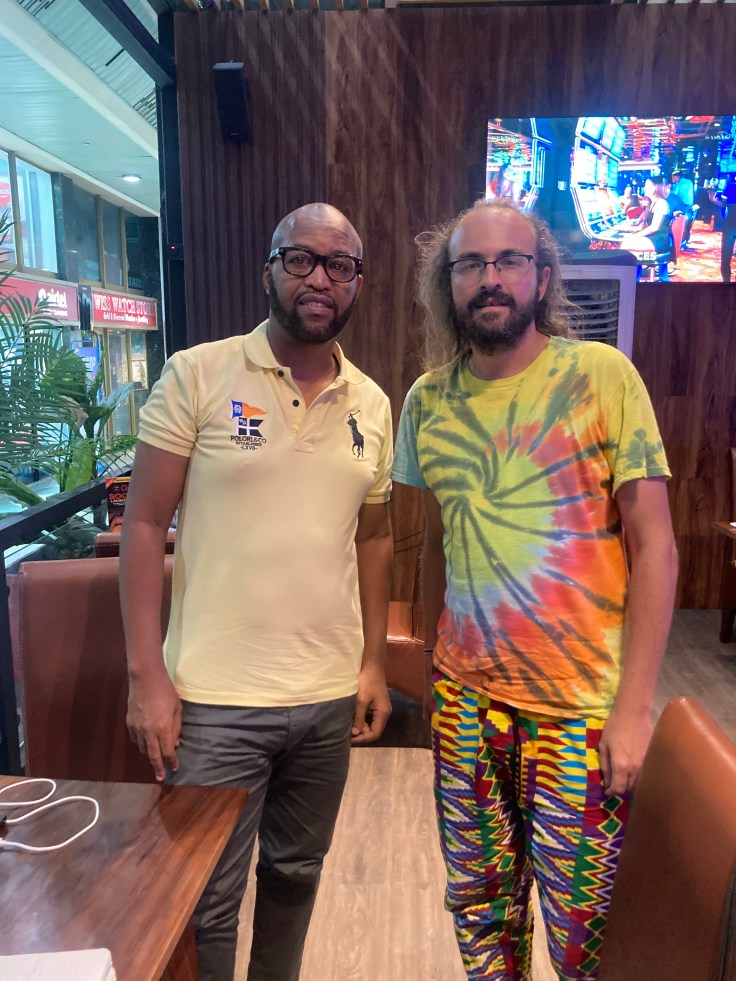
Translating Swahili rap lyrics is not easy. Concocting ersatz rhythms, decoding a plethora of arcane slang phrases and subcultural in-jokes. I surely failed as a translator many times in this book, but always with a spirit of creative risk. Translating KBC’s interview proved my most abysmal failure, as I found no creative solution that would transmit his unique style of speaking. At first I tried dotting my English translation with Swahili phrases to indicate his code-switching. But that only made him sound more Swahili (and less formally educated) than other artists I interviewed, when in fact the opposite was true, as he had pursued higher education in America. I ultimately admitted defeat in the form of a lengthy footnote.
KBC told me, “You don’t just want to do a translation.” He wasn’t talking about my translations, of course; he was explaining the creative liberties that allowed him to switch from rapping in English to Swahili. Yet his words remind me of my MFA colleague who read my translations and told me, “Translations like these should be accompanied by other writing.” When traversing the gulfs between Swahili and English, Tanzania and America, hip-hop music and literary object, maybe a translation can’t just be a translation. Perhaps translation is necessary, yet insufficient. In fact, that may be why I had to write a whole book to accompany my translations. Hundreds of pages of stories and arguments and footnotes, all responding to insufficiency, scrambling to recover all the music, culture and history I was hemorrhaging in translation.
- It sounds less absurd once you realize “Ice Ice Baby” sampled “Under Pressure,” co-written by Freddie Mercury, who was born in Zanzibar, just across the channel from Dar es Salaam. ↩︎
- Here I should also mention the “Bongo Flava” genre from which the book takes its name. Some argue Swahili hip-hop and Bongo Flava are interchangeable, others insist they are antithetical; the truth naturally lies somewhere in between, though not within the purview of a translator’s note. It will suffice to explain that “Bongo,” the Swahili word for “brains,” became a nickname for Dar es Salaam (and later Tanzania) in the post-socialist period, referring to the craftiness required to survive there. In the late 90s, local DJs began translating “Swahili hip-hop” as “Bongo Flava” and for some years the two were synonymous. But in the new millennium, the translation began to outgrow the term it was translating. Where scrappy Swahili rappers had survived the fallout of neoliberalism, flashy Bongo Flava singers began to capitalize on globalization. ↩︎
Support Swahili hip-hop: click here for a fundraiser to support the artists featured in Brain Flavour, forthcoming from Tenement Press.

Richard Prins is a New Yorker who has lived, worked, studied and recorded music in Dar es Salaam. His translations from Swahili include a collection of poetry by Muyaka bin Haji al-Ghassaniy We Are Still in the Fort (Vanderbilt University Press 2026) and a novel by Katama Mkangi They Are Us (University of Georgia Press 2027), which received a 2023 PEN/Heim Translation Fund Grant and 2024 National Endowment For the Arts Translation Fellowship. His work also appears in The Best American Essays 2024.
Originally published on Hopscotch Translation
Tuesday, June 9, 2026


