
As Grand As They Come: Reading and Translating Almudena Grandes
by Helen Cunningham
Grandes depicts people so well; she gives each of them a distinct personality and then surprises you with their actions and their depths.
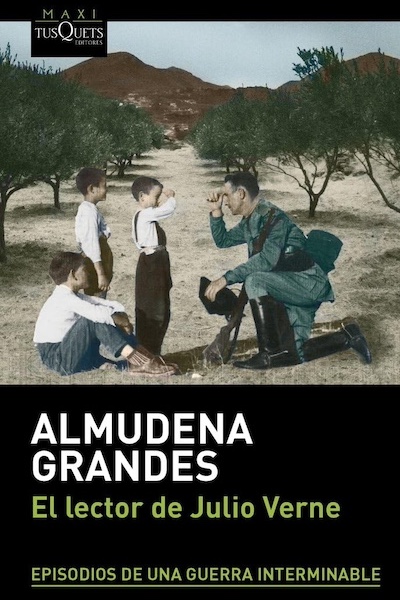
I’ve long been puzzled by the fact that Americans, North Americans to be precise, are largely unaware of Almudena Grandes, when her books have for decades enjoyed such popularity in Spain and Latin America. A quick survey of her career and accolades, and I think you’ll see what I mean. By the time of her death in 2021, Grandes had written fourteen novels and three short story collections, had a weekly slot on the popular “Hoy por Hoy” radio show in Spain, and had a regular column in the Sunday supplement of El País, the premier newspaper in Madrid. Six of her novels have been made into movies, one of which launched the career of Javier Bardem. And NETFLIX is currently running a ten-episode series, The Patients of Doctor García, which is based on the fourth book in Grandes’ series of novels called Episodios de una guerra interminable (Episodes in an Interminable War). It’s excellent—and yet most American readers still haven’t heard of her.
Grandes’ novel Aires difíciles topped the Spanish best-sellers list in 2002. Translations of it were published in France, Germany, Italy, Israel, and the Netherlands. She was awarded eighteen prizes for literature in Spain and Europe, including the Prix Méditerranée, the Premio Nacional de Literatura en la modalidad de Narrativa (National Prize for Narrative Literature) in Spain, and the prestigious Mexican Premio Iberoamericano de Novela Elena Poniatowska.
Posthumous recognitions abound equally. In the wake of her death, Grandes received the Gold Medal of Merit for Fine Arts and the title Chosen Daughter of Madrid. The street on which the extraordinary Feria del Libro, the annual Book Festival in Madrid, takes place was named for Grandes. Four libraries in Madrid have also been named for her, as have libraries in Huelva, La Rioja, and Toledo. The most recent portrait of a revered Spanish author to be hung in the Atheneum of Madrid is of Grandes. The main train station in Madrid was renamed Atocha Almudena Grandes, and Prime Minister Pedro Sánchez called her “one of the most important writers of our time.” Javier Cercas, himself a venerable author and one of the four writers (along with Grandes, Javier Marías, and Antonio Muñoz Molina) who are credited with “breaking the silence” after the Civil War and the ensuing Franco regime, said Grandes “made the Civil War past present” and called her “The Mirror of Spain.” So how is it that we in the US have hardly heard of an author so celebrated at home and abroad, and a veritable national treasure?
Grandes died of cancer in 2021 at the age of 61. She rose to fame with the1989 publication of Las edades de Lulú (The Ages of Lulu), a novel about an adolescent’s first love and her subsequent pursuit of sexual fantasies in a Madrid that was breathing freely for the first time in ages, following the death of Generalissimo Francisco Franco. After winning the three-year Civil War, the dictator ruled from 1939 to 1975, during which time the population’s activities were monitored, suppressed, and made to conform with Franco’s arch conservative Catholicism. Las edades de Lulú contains the seeds of Grandes’ interest in historical memory, and her subsequent books display a growing commitment to remembering the cultural aspects of the Civil War and its long aftermath. Grandes wrote about the Franco years with a rare balanced perspective, especially since her politics were progressive. Grandes often said that it was her daughter’s history books, which she found too partisan, that made her want to show other sides of history. Daniel Hahn, in a review of Frank Wynne’s translation of El corazòn helado, which was published in Great Britain as The Frozen Heart, wrote in The Spanish Riveter, “Many of the most acclaimed novels to come out of Spain in recent years are what you might call ‘aftermath fiction’ concerned with the legacies of the Civil War… Almudena Grandes certainly has more reach than most, finding the wide readership that literary fiction rarely attains.” Lorraine Ryan, a lecturer in Hispanic Studies at the University of Birmingham, writes in her book Gender and Memory in the Postmillennial Novels of Almudena Grandes that Grandes is “the one Spanish writer who has most engaged with perpetrator memory in her work, developing an original and complex perspective into the issues that transform cultural perpetrator memory in Spain into a nuanced cultural phenomenon” (p. xi). Ryan goes on to say that Grandes’ “fictionalization of the Republicans’ alienation [in other words, the alienation of those fighting against Franco] marks her as one of Spain’s most socially committed writers dedicated to reinscribing the lives of those who suffered marginalization due to their gendered or ideological nonconformity, into the contemporary Spanish psyche” (p. xiii).
Grandes writes about ordinary people on both sides of the Spanish Civil War during the four decades of Franco’s power. She examines the emotional choices people made when choosing sides about their whole- or half-hearted or completely reluctant commitment to their side’s ideologies.
After the tremendous success of Las edades de Lulú,which sold more than 1.1 million copies worldwide, Grandes moved away from writing erotic literature toward what her training as a student of geography and history and her experience as an activist had prepared her for. According to Lorraine Ryan, Grandes was always concerned with historical memory: she cites the male prison in Las edades de Lulú, the genealogy of maternal dissent from the beginning of the twentieth century in Malena es un nombre de tango, and how El corazón helado unravels a troubled family’s secrets from the time of the Civil War. El corazón helado was the book that set Grandes firmly as a leader in “el boom de la memoria,” the cultural movement that, as Hahn says, was concerned with the legacies of the Civil War. The next project, her magnum opus, was the series of six books entitled Episodios de una guerra interminable. I am still astonished at the boldness of publishing a list of the titles in this series that Grandes was GOING to write with the publication of the first book, Inés y la alegría. Each book in the “Plan de Obras,” the outline of the series, has a title, a topic, a location, and a timeline. The books move chronologically toward the present with a good deal of overlapping, covering the period from 1940 to 1956. The last of the books which would have covered the longest period, 1939 to 1964, was in progress when Grandes died and remains unfinished. The existing five books, each of which stands on its own and may be read totally independent of the others, are clarion examples of Grandes’ ability to depict bad guys, good guys, and regular people as complex humans. All five books are door stops, hundreds of pages long. The books cover real events and have some real people as characters. The complexity of the history and, as Ryan writes, Grandes’ “commitment to transforming the perception of perpetrators as reprobates to people with their own credible claims to humanity,” make the telling long. No simple evil Francoists and innocent victims for Grandes. By 2012, when she announced her series and published Inés y la alegría, the postwar writing had been going on for 37 years. Many people believed that there was enough literature on the subject and that Spaniards had lost interest in the topic, but Grandes was not satisfied; she felt “morally obligated” (Ryan p. xiii) to restore the memory of those who risked their lives for a return to democracy.

Of the five published novels from the series, my favorite is the second, El lector de Julio Verne, or The Reader of Jules Verne (my working title). The narrator is an adult looking back on his childhood in the years 1947, 1948, and 1949. As the story opens, Nino, the narrator, is nine years old. He is the son of a Guardia Civil. The Guardia Civil was once a highly regarded, highly selective constabulary that Franco turned into a paramilitary operation. Nino grapples with the duality of the loving father that he, his two sisters, and his mother live with at home and the dawning realization that his father and his father’s colleagues in the barracks where they all live are behind the torture, disappearances, and killing of the relatives of the kids at his school.
Nino befriends a newcomer to his village, Pepe el Portugués, a young man who tends an olive grove and lives in a mill on the edge of town. Pepe’s origins and affiliations are vague; Pepe befriends Nino’s father as well. The conversations between Pepe and Nino are often funny and when serious they are Grandes’ way of illuminating for her readers the profound moral dilemmas bedeviling the citizens in Fuensanta de Martos, their little town in Andalucía in the Southern Sierras. Grandes writes about “how ordinary people react to their historically determined circumstances,” says Lorraine Ryan, “people for whom memory is not a collective category but instead an eminently objective, cognitive, and emotional assimilation of key historical events” (p. xiii). This is exemplified in the relationship between Pepe and Nino.
Nino wants to be like Pepe. Nino’s father wants him to learn to type so he can have a dignified job in the town (read: not a Guardia Civil). The only person who can teach Nino to type is Doña Elena, a Red with a fine library, a generous heart, a physician husband who died in one of Franco’s prisons, a daughter married to a big deal minister in Franco’s administration, and a granddaughter rescued from an orphanage. Doña Elena lives near a farm run by women whose sons, husbands, brothers, or fathers are gone—dead, exiled, or guerillas in the mountains.
One day, Nino’s father and his colleague Romero, both Guardia, hide in their own apartments rather than follow orders to search and terrorize the people on the farms surrounding the town. “Enough,” they think. Two Guardias saving the locals from terror—really?! Grandes complicates the picture of a standard Guardia here.
If these characters were on a Venn diagram depicting political allegiance, you would have all the females on the farm on the left under “Reds” or “Republicans”; Nino, his mother, Pepe, and maybe also Doña Elena would be in the middle, representing where the sides overlap; and under “Nationalists” or “Francoists” on the right would be the Guardia Civil, including Nino’s father and some of the townspeople. By the end of the book there would be some shocking desertions to other categories. I love this book.
Recently I finished the first draft of a translation of El lector de Julio Vernes. Grandes depicts people so well; she gives each of them a distinct personality and then surprises you with their actions and their depths. She is a pleasure to translate, although the Spanish mania for giving everyone a nickname is a trial. For example: Comerelojes (literally: Watchgobbler) is a guy who is always losing his watch—I call him Wristwatch; Fingenegocios (lit. Pretendbusiness) is a guy who always carries a briefcase to look like he’s working—I go with Fakejob; and Putisanto (lit. Whoresaint) is a fellow who visits whores and leaves them holy cards—I name him Hookersaver. Then there are the arrogant daughters of the top Guardia Civil, one of whom has pretty face and a misshapen body, the other an unattractive face and a lovely shape; they are both called Mediamujer—Halfwoman.
Also challenging is the cursing. Take, for example, the following scene. Nino, as the adult narrator, says: “… todos nos portábamos mejor, porque sabíamos qué al empezar el invierno, mi madre dejaba a estar para bromas.” [“… we all behaved better because we knew that when winter began Mother was no longer in the mood for jokes.”] “Quien me mandaría a mi casarme con este, a ver, quien me lo mandaría, con lo bien que estaba yo en mi pueblo, joder.” [“Who, who thought it was a good idea for me to marry this man when I was so well off in my town, dammit” (says his mother, under her breath, in earshot of her children).]
“Joder” is a quite common curse word in Spanish that can be translated in a variety of ways, depending on the context. Would Nino’s mother, who grew up on the warm coast in Almería and who suffers from the cold in the mountains where the family lives, use “damn,” “darn,” “bloody hell,” “shit,” or “fuck” when she, a proper mother, says “joder” in her children’s presence when complaining about the weather? “Joder,” says the Oxford Spanish Dictionary, means “to screw (vulg), to fuck (vulg).” The Real Academica Española’s Diccionario de la Lengua Española agrees but allows that it can also be an “interj. de enfado, irritación, asombro, etc.”—“an interjection denoting anger, irritation, amazement, etc.” For the mother, I chose “dammit”; however, when Pepe el Portugués, a grown man, hears bad news from Nino, who is acting as a go-between for Pepe and his sweetheart, and says: “‘¡Joder!’ se levantó y empezó a sacudirse los pantalones a manotazos de rabia.” I translate that “joder” as “fuck”: “‘Fuck!’ he stood up and bashed angrily at the dust on his pants.” So nuanced the F-word, no?
It’s easy to leave money, food, clothing, and place names in Spanish, but how to handle a Spanish children’s song that is broken up in the text, interrupted by the singer’s intruding thoughts and by what he is hearing from the soldiers on the other side of his bedroom wall while he is singing? The Spanish song, “Vamos a contar mentiras” (Let’s tell tales), is a traditional song to which one can add verses endlessly. It speaks of plum trees full of apples, apples that turn into hazelnuts, sardines that scurry up into the mountains, and hares that run in the ocean. The English-language replacement must be recognizable as a children’s song; it must be appropriate to the situation and to the 1940s; and it must be universal enough to be seen in the text’s fragmented form. Nino is singing to his four-year-old sister Pepa, who was awakened by the sounds of a beating taking place on the other side of their bedroom wall. Pepa has climbed into Nino’s bed and is disconsolate. He is trying to cover the sounds first by nestling her little head into the crook of his arm to cover her ears, and then by trying to sing over the horrible noise. Meanwhile, he recognizes the voices of Fernanda, the pregnant woman who works in the butcher shop, who is being beaten, and the Guardia who are doing the beating. The Guardia want Fernanda to tell them where her husband and brother are hiding. Here is the Spanish:
… vamos a cantar, ¿quieres?, mi hermana lloraba y yo seguía escuchándolo todo, sabiéndolo todo, ahora que vamos despacio, y era imposible porque los calabozos no están lejos pero había paredes, puertas cerradas, ahora que vamos despacio, y ya no sabía lo que oía y lo que me imaginaba, vamos a contar mentiras, tralará, pero cuando empezaba a dudar de mis oídos, vamos a contar mentiras, tralará, todo volvía a empezar, vamos a contar mentiras, no me peguéis más, si yo no sé nada, por favor, por vuestra madre, no me pegueís más, por el mar corren las liebres, y por el mar corrieron, por el monte las sardinas, hasta que mi hermana se quedó dormida, pegada a mí, abrazada a mi cuerpo como un náufrago se abraza a una tabla, pero yo seguía cantando bajito la canción más larga que conocía, salí de mi campamento, para escuchar mi voz, salî de mi campamento, y no la de mi padre, con hambre de seis semanas, tralará, ¿y tú que te crees, que tu hermano no sabe lo que está pasando aquí?, con hambre de seis semanas, tralará, si a él le importara, no permitiría que te pasara esto, ¿o no?, con hambre de seis semanas, entonces, por qué le proteges?, me encontré con un ciruelo, ¿por qué no nos dices lo que sabes?, me encontré con un ciruelo, ¿por qué no nos dices lo que sabes?, me encontré con un ciruelo, ¿por qué no nos cuentas de una vez dónde está?, cargadito de manzanas, tralará, ¡tu puta madre te lo va a contar, cabrón!, cargadito de manzanas, tralará, y más ruido, más cuerpos cayendo, más voces ahogándose, cargadito de manzanas, y aquella vocal sola, larga, interminable, empecé a tirarle piedras, una vez y otra, y otra más, hasta que todo se acabó, empecé a tirarle piedras, las lágrimas y las canciones, y caían avellanas, tralará, las verdades y las mentiras, y caían avellanas, tralará, la resistencia de los que pegaban y la de los que recibían los golpes, y caían avellanas, y yo no me había dormido todavía.
And here is my English translation, with “Twinkle Twinkle Little Star,” which has been around since the 1800s, taking the place of “Vamos a contar mentiras”:
Let’s sing, Pepa, shall we? my sister cried while I heard everything, learned everything, how I wonder what you are, and it was impossible because the cells weren’t far but there were walls, closed doors, like a diamond in the sky, I no longer knew what I heard, but I imagined, up above the world so high, but then it would start again, twinkle twinkle, don’t hit me anymore, I don’t know anything, please, for your own mother’s sake don’t hit me again, twinkle, twinkle little star, until my sister fell asleep wrapped around me like a shipwrecked passenger clinging to a floating board, but I continued singing softly, up above the sky so high, twinkle, twinkle little star, how I wonder, does it even matter to him? if it did, would he let this happen? would he? when the blazing sun is set and the grass and dew are wet, how I wonder what you are, up above the sky so high, like a diamond, why don’t you tell us what you know, up above the sky so high, like a diamond in the sky, your damn mother will tell us, bitch, how I wonder what you are, more noise, more bodies crumpling, more drowning voices, little star, until everything ended, up above the world so high, the truths, the lies, little star, the stamina of the beaters, the stamina of the beaten, and I still hadn’t slept.
After this Nino hears someone vomiting outside his window. It is one of the Guardia.
The Reader of Jules Verne is a perfect, big read for our current moment. During the time depicted in this book, the ruler of Spain wrangled absolute power. His was a personality-driven regime. He whitewashed Spanish history—supposedly in the interest of uplifting the people. Franco passed laws making it legal to shoot an “escaping” prisoner, i.e., to shoot a prisoner in the back. He made it illegal to gather—without a permit—the esparto grass that grows in the wild and was used for centuries to make everything from sandals to saddles to rugs. And he passed a law making it illegal to sell eggs without a permit. Permits were only available to his supporters. During Franco’s tenure, the laws that permitted divorce were overturned; abortion became a crime against the state; contraception could not be used or sold, nor could information about it be disseminated. Motherhood was Franco’s only goal for Spanish women. Misogyny and homophobia were marching orders in his government. Franco’s ideology was a blend of fascism and a promise to restore Spain to its former glory.
Today, in the United States, we are seeing a similar conservative turn, with similar rollbacks of hard-won progressive rights, also in the name of restoring the country to some supposed former glory. If we want to oppose it, we need to learn lessons from the past, both ours and from similar moments in history around the world. And we need to look to writers who devoted their lives to combating governments like Franco’s and to repairing their countries after democracy was restored. Perhaps, then, it’s time we got to know Almudena Grandes.
Helen Cunningham is new to translation. She is a graduate of the University of Pennsylvania (MA), Trinity University (BA) in Washington, DC, and the Universidad Complutense de Madrid (Program for Foreigners). After a long career in philanthropy, she recently translated her first book, El lector de Julio Verne by Almudena Grandes, and plans to turn next to Grandes’ La madre de Frankenstein, also from her Episodios de una guerra interminable series.
Originally published on Hopscotch Translation
Tuesday, August 11, 2026


