
The Faithfulness of the Original
Evariste Pimplis interviewed by Peter Constantine
Being your own translator means you can act on what the dissection reveals.
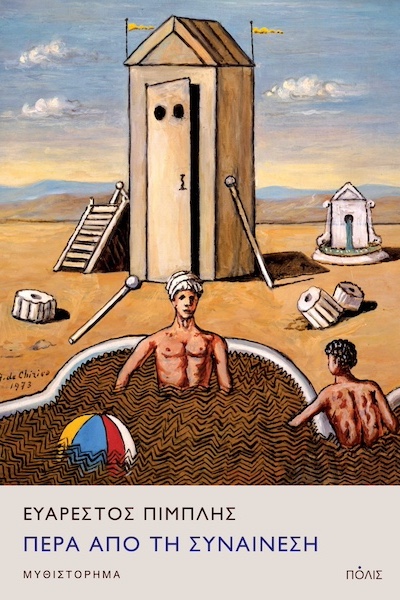
In Par-delà le consentement (Beyond Consent), Evariste Pimplis approaches consent without anesthesia. His protagonist, Enzo Pannequin, insists on his heterosexual identity, even as his actions complicate the claim. Aggressor and enigma, he humiliates what he desires and desires what he claims to reject. Raised on inherited virility and speaking from within a masculinist online ecosystem, he crosses boundaries: with women, with men, with the codes that once secured him. Witnesses speak. Lovers speak. Critics speak. Each voice unsettles the story he believes he controls.
Pimplis wrote the novel in French and then translated it himself into Greek: a second crossing, linguistic this time. It was published in Greece in November 2025 and in France in March 2026.
PC: For readers encountering Beyond Consent for the first time, how would you describe the terrain the novel enters?
EP: The novel is set in France in 2032, in a society where consent culture has fully triumphed. We know what “no” means—but what does “yes” mean? The story explores this question through the encounter between two men who seem to embody opposite worlds.
PC: And these two men, Enzo and Émile, come from radically different backgrounds.
EP: Very much so. Enzo was born in 1999 and raised to become a “real man.” As a young adult he finds himself disoriented by the cultural shifts that follow #MeToo. He feels his status eroding and so retreats into masculinist online communities that promise men a way to regain power. For him, sexuality has always been tied to domination. But as that script becomes harder to play out with women, he begins looking for the same dynamic elsewhere, while continuing to insist very strongly on his heterosexual identity.
Émile is the younger of the two. He was born in 2011 and grew up in a very different environment. As a teenager he discovers he is gay and later becomes active in LGBTQ+ politics. In principle, he rejects the kind of masculinity Enzo represents. Yet he also finds himself erotically drawn to it. Their relationship is brutal but consensual, forcing Émile to confront a difficult question: how can he desire, in private, forms of domination that he opposes politically in public life?
PC: But the real turning point is a very public incident.
EP: Yes. When a camera in a café captures Enzo hitting and humiliating Émile, the incident becomes a major scandal and sparks a new online movement, #BeyondConsent. At that point the novel opens outward: journalists, intellectuals, and social media voices enter the narrative, turning public opinion into a kind of third protagonist and reopening the debate about the meaning of sexual freedom.

PC: You wrote the novel in French and then translated it yourself into Greek. A second authorship?
EP: I grew up in Athens — my father Greek, my mother French. They sent me to the French school there, so French was always present, alongside Greek. At eighteen I moved to Paris to study history and political science, and ended up working at the Bibliothèque nationale de France. By that point French was my main everyday language, the language I was reading in most. Especially in the social sciences. Writing in French felt like the obvious choice. Between 2022 and 2023 I produced a first version, then spent another year editing. More than fifteen versions in the end. It was only after finding a Greek publisher in 2024 that the translation began.
PC: And did the Greek find something the French had missed?
EP: More than I expected. I found that translating forced me to take each sentence apart: word choice, meaning, syntax, hidden nuances, word order. And this with a precision and care I hadn’t always brought to the writing itself.
PC: Translation as a form of rereading?
EP: Dissection, I would say. And being your own translator means you can act on what the dissection reveals. I felt a constant urge to modify certain parts, not to correct the original but to deepen it. Gradually the Greek became an original in its own right, and parts of the French, in turn, became translations of it. Little by little, neither version was quite the original anymore. In the end I might say that both versions are originals, which was only possible because I have a full command of both languages. Even though I speak English and Spanish quite fluently, I could not have undertaken the same process in either of those.
PC: As it happens, I read your novel in reverse order of composition: the Greek first, then the French. What struck me, in both, was the distance between the two registers within the novel: the raw, feral energy of the slang, and then the cool analytic language of the essayistic passages. French slang and sociological terminology; Greek slang and sociological terminology.
EP: Yes, absolutely. The novel moves between a very colloquial language, sometimes slangy and sometimes quite raw, and a much more formal, analytical register, closer to the language of the social sciences. That was one of the main difficulties: making those shifts feel credible. I did not want the changes in register to interrupt the plausibility of the story or the realism of the characters.
PC: Reading the French and the Greek side by side, I was struck by how strongly the shift in register is carried by the characters themselves. Enzo and Émile bring markedly different textures of language with them, whether they are speaking French or Greek.
EP: Very much so. The crude, sometimes almost obscene language at the beginning belongs to Enzo, who dominates the first part of the novel. The more nuanced, perhaps more lyrical style of the third part belongs to Émile, the second protagonist. And the second part has another language again: the language of the media, social networks, experts, intellectuals. It is more discursive, more analytical, at times almost scientific.

PC: In your interview with Stavroula Papaspirou, you spoke about the hybrid form of the book: Enzo’s narration in the first part, Émile’s in the third, and between them a middle section made up of articles, social media posts, and public voices. When you moved the book into Greek, did you find yourself thinking differently about these different registers?
EP: The question was already there in French, but translation made it much sharper. I have lived in France for almost ten years, so I know French slang quite well. I also studied the social sciences in French, so that vocabulary is very familiar to me. In Greek, I had to work much harder. Sometimes I had to research terms that felt immediately available in French.
PC: Is part of the difficulty lexical? In Greece, there has long been a tradition of reading much of the sociological and theoretical literature in French and English. I sometimes think that a French term can feel more immediately accessible than its Greek equivalent.
EP: Yes, I think that was one of the difficulties. The vocabulary of political science and sociology around gender does not circulate in the same way in Greek as it does in French, and certainly not as it does in English, especially in the American context. A Greek equivalent may exist, but it may not have the same public presence or the same immediate recognizability. For example, according to Larousse, masculinisme was the most searched term on its online platform in France in 2025. In Greece, the term has not really entered ordinary public discourse. I had to choose a relatively uncommon equivalent, and the same was true of many other terms. When you write and translate around ultra-contemporary social questions, the process quickly reveals the disparities between national public debates, even within two countries of the European Union.
PC: Borges has that wonderful, startling line, “El original es infiel a la traducción” — “the original is unfaithful to the translation.” I thought of it when you described the Greek version changing your relation to the French. Did self-translation make the hierarchy between the French text and the Greek text feel less stable?
EP: What a wonderful line. I feel very close to it. Both versions now feel to me like originals, not in a hierarchical relationship but bound by a kind of horizontal parentage. Each is organically linked to the other, both belonging to the same creative process.
I was able to deliver the final French text to my publisher at the same time as the Greek to my publisher in Athens, and so I was able to revise certain passages of the French in light of what the translation had, by then, become; an original in its own right. It’s something I find myself thinking about as I work on the new novel that I am currently writing in French. I don’t yet know whether I’ll follow the same process, though I sometimes wish the Greek were already there alongside it. Translation or original? Perhaps by that point the question no longer applies.
PC: You open the novel with a line from Cavafy. It is a fascinating and poignant anchor for a French novel set in 2032, just short of a hundred years after his death. In the standard American edition translated by Edmund Keeley and Philip Sherrard, it reads: “Later, in a more perfect society, / someone else made just like me / is certain to appear and act freely.”
EP: This poem, “Hidden Things,” written in 1908, moved me profoundly when I first read it — I’d encourage anyone to seek it out; it’s very short, yet extraordinarily powerful. Cavafy seems to be telling those who will study him that they must dig beneath the surface to understand who he truly was: his origins as a Greek from Alexandria, never fully recognized in Athens, and of course his homosexuality. Placing these three lines at the beginning of the novel felt deeply symbolic. It meant that more than a century later, one can write freely, and no longer hide oneself in one’s work.
PC: The epigraph is a promise. Does the novel keep it?
EP: I feel it most strongly in Émile’s story. The third part of the novel, “The Promise of Freedom,” follows Émile as he grapples with not acting entirely freely in his intimate life. He searches for a path toward freedom through writing, while imagining his own vision of “a more perfect society.” In Greek, that phrase becomes the magnificent expression τελειωτέρα κοινωνία (teliotera kinonia). I wanted to end on a note of hope. A reminder of how important it is never to stop imagining one. That ambition, to imagine a more perfect society, seems to me the deepest thing literature can do. And it is there, I think, in Cavafy’s “Hidden Things”: a work on language inseparable from the society that produced it, and from the life that had to remain hidden within it.
PC: Does the epigraph belong to Émile entirely? It is Enzo who speaks first.
EP: Your remark is very pertinent. The epigraph doesn’t belong exclusively to Émile — it belongs to the whole book, to every character, and perhaps to every reader who recognizes something of themselves in it. There is a temptation to see Émile as the “good” character and Enzo as the “bad.” The novel doesn’t ignore responsibility: Enzo faces legal consequences for the homophobic aggression he commits. But I wanted to give both characters a path toward intimate freedom, one that might eventually open onto something collective. That meant giving Enzo the opportunity to write. He announces it on the very first page, declining a journalist’s call: “C’est à moi d’écrire mon histoire. Eux veulent la déformer” — “It is for me to write my story. They want to twist it.” And Enzo is not the kind of character one would immediately imagine in a first-person narrative. But writing obliges him to confront himself. It becomes a form of introspection — something men like him are rarely encouraged to undertake. To open oneself up, to express vulnerability, to question one’s own desires and contradictions: these are things traditional masculinity has often suppressed.
I also conceived the novel as a symbolic arc: from a dominant masculinity that until recently largely controlled the social narrative, toward another male voice — long marginalized, long unheard — that now claims the right to articulate its own vision of freedom, as Cavafy suggests in “Hidden Things.”



PC: Greece and France seem to be different landscapes when it comes to these questions. Did Greek and French readers find different novels?
EP: France is too recent to read clearly: the book has only been out a few months. But I can already sense differences, not just in the reception but in the composition of the readership itself. My assumption, perhaps a biased one, had been that the subject would find a more ready welcome in France. There is already a large, sensitized readership for these questions. This readership tends to act as a kind of first filter. A book addressing these questions reaches it before it reaches anyone else.
PC: What about Greece?
EP: Greece surprised me. The literary world there is less divided into distinct readerships, and the novel seems to have found a very diverse audience quite quickly. Readers across generations, genders, and social backgrounds. These are readers who don’t necessarily expect a work of fiction to engage with questions ranging from patriarchal models to queer experience, questions that have only recently become visible in public debate. A reviewer described it as something of an explosion in the Greek literary landscape. I didn’t anticipate that, and it moved me.
I hope the French readership broadens in the same way over time. And I find myself genuinely curious about what a third reading might look like. In the United States, say, within a cultural context different again from either of these.
PC: Enzo’s language in the opening pages of the novel is dense with slang — meufs, baiser, salopes, pédés, se branler — that specific argot of young French masculinist culture rooted in online spaces and pornography. How did that translate? Did Greek give you equivalents with the same texture? Did the voice have to shift?
EP: Such an interesting, and at the same time difficult, question. Being one of the few people to have read both versions, I would actually be very interested to know whether you noticed such shifts or different textures yourself.
PC: The very first books I wrote back in the 1990s were Japanese Street Slang and its sequels. I spent years trying to fathom the genesis of words and phrases. I realized it is all about translating temperature, class, rhythm, insolence, intimacy out of very different cultures. I felt that the French Enzo is completely French. And the Greek Enzo is completely Greek. It must have been quite a task to manage that.
EP: The first thing I fully realized, only when I started writing in Greek, was how much slang there was in the French version. In French I was much more familiar with this kind of argot, because of its presence in the media and in the artistic works I was drawn to. In Greek I had to work much harder to be certain of using the right words — words that could realistically be used, even if uncommon, but that would feel rooted in a Greek reality.
PC: Young men are quite different in Greece and in France.
EP: In Paris and Athens especially. Greek masculinity is often expressed in a more overt way. So I had to choose a language that reflected the French reality of the plot while at the same time feeling believable for a Greek readership. And behind every slang word, there was a need for deeper social and cultural analysis. Take pédé, which could roughly translate as “fag” in English. I remember discussing its regulation with Twitter’s then Chief of Public Affairs, while working on a French Council of State report on social media. This was some months before the company was bought by Elon Musk, became X, and largely abandoned word-based moderation. She explained the complexity.
PC: In France pédé is considered quite a strong homophobic insult.
EP: That’s right, and so Twitter initially decided to ban it. But they quickly realized they were not only deleting hateful comments, but also posts written by LGBT+ activists reclaiming the insult as part of their identity. So there were two different ways of using the word, which is reflected in the way Enzo and Émile use it. In Greece, poustis (πούστης) also remains a very violent insult, and is also reclaimed by some LGBT+ activists. So at first glance it could be used in exactly the same way as pédé. But you also hear it casually in everyday speech, mostly as an exclamation meaning something like “oh shit,” even among people who are very progressive or open-minded.
PC: And among straight men it can even be a term of endearment, a sign that they are comfortable enough with each other to say it.
EP: Exactly. Insults connected to sexuality or gender are still less socially banned from ordinary language in Greece than they are in France. So the question became: would the word carry the same meaning for a Greek reader if it is not necessarily perceived, every time, as either a direct expression of hatred or a reclaimed identity term? That is also why Enzo’s sections are where the French and Greek versions diverge most. The slang is there in both. But the context around certain words had to shift to carry the same charge for a Greek reader.
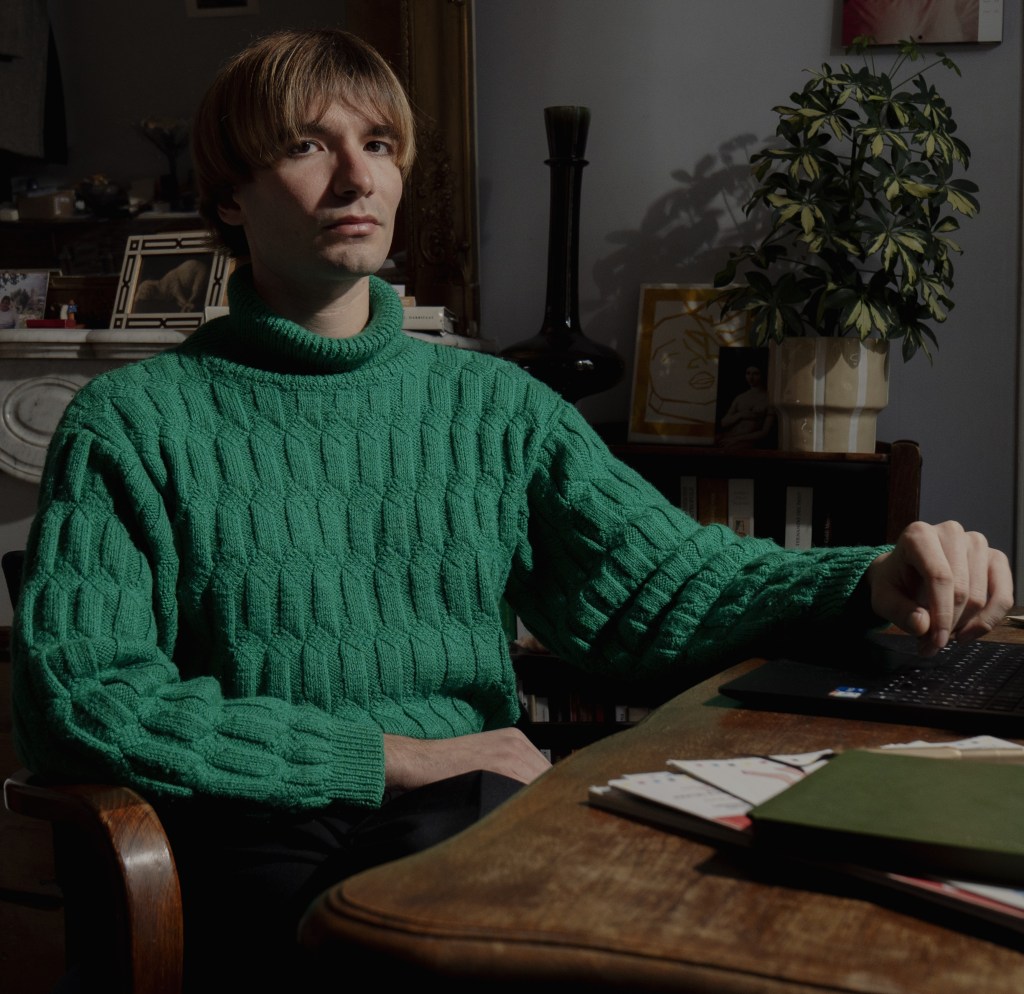
Evariste Pimplis (b. 1999, Athens) wrote his first novel in French and subsequently translated it into Greek. He studied history and political science at the Sorbonne and specialized in cultural policy at Sciences Po Paris, with a particular focus on how governments respond to the transformations brought about by new technologies and artificial intelligence in the cultural sector. He lives in Paris and works at the Bibliothèque nationale de France.
Peter Constantine’s recent translations include works by Augustine, Rousseau, Machiavelli, and Tolstoy; he is a Guggenheim Fellow and was awarded the PEN Translation Prize for Six Early Stories by Thomas Mann, and the National Translation Award for The Undiscovered Chekhov. He is Professor of Translation Studies at the University of Connecticut and publisher of World Poetry Books. His novel The Purchased Bride was published by Deep Vellum in April 2023.

Originally published on Hopscotch Translation
Tuesday, September 22, 2026


