
Bearing Down on the Numbers: Review of Venice Requiem by Khalid Lyamlahy, translated from the French by Ros Schwartz
by Houssine Dehbi
Venice Requiem is a stark refusal of the obliteration and the amnesia that surrounds the stories and memories of people like Pateh.
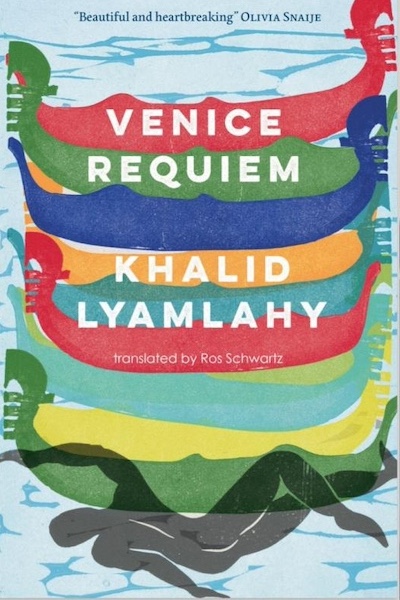
Lyamlahy, Khalid. Venice Requiem, translated from the French by Ros Schwartz. Hope Road, 2026. ISBN 9781913109387. £12.99.
In Venice Requiem, Khalid Lyamlahy has understood what Toni Morrison announced in her 1975 lecture at Portland University entitled “A Humanist View”: “The responsibility of artists and scholars is to bear down hard on those generalities: the statistics and the charts, and to make them give up the life they are hiding” (Morrison 2019, 7). That imperative, it turns out, does not belong to the writer alone. It falls equally on the translator—and in Ros Schwartz’s English rendering of Lyamlahy’s French, it is honoured with the same gravity and care with which Lyamlahy himself honours the memory of Pateh Sabally, the twenty-two-year-old Gambian refugee who, on the 22nd of January 2017, plunged into the cold waters of the Grand Canal of Venice to his inevitable death, becoming another statistic of another African refugee who perished in what Lyamlahy calls “a world-city enclosing a silent death” (Lyamlahy 2026, 11).
Venice Requiem is not only a text honouring the death of Pateh Sabally. It honours the stories, the feelings and thoughts, the complex lives of people who flee their homes to seek a better place to live, who are often reduced to numbers, statistics, and charts that conceal and congeal the multiplicities of their lives in locked-down unilateralisms—or what Lyamlahy calls “a plural of suffering and affliction” (Lyamlahy 2026, 96). Lyamlahy takes it upon himself to bear down on those numbers, addressing Pateh directly using “You”—a grammatical refusal of the idea that Pateh’s death means a closure of his story. The book addresses him in a way that charts the valleys and plains of his heart and soul, the topography of his thoughts, to reveal and release the human face behind the figures and the tokens.
How a Book Finds Its Translator
To bring this book into English is itself an act of witness. Ros Schwartz—an award-winning translator of over one hundred works from the French, and a Chevalier de l’Ordre des Arts et des Lettres—describes her encounter with the book in terms that mirror Lyamlahy’s own sense of vocation. The manuscript reached her through an ecosystem of like-minded literary critics, authors, and translators: the journalist and critic Olivia Snaïje read it and was “blown away” by it, and encouraged Lyamlahy to send it to Schwartz. It has only happened to Schwartz three times in her entire career, she recounts, that she has read a book and thought: “I have to translate this. This was written for me to translate” (Schwartz 2026).
What drew her to it was, in her own words, “the humanity of it, particularly at this time where we’re living in this hostile environment towards refugees; it felt like the antidote we all need. The way it humanises somebody who was just a nameless, faceless refugee feels very important” (Schwartz 2026). This is not a dispassionate professional assessment. It is the language of someone who understood, from the first reading, that translating this book was an ethical act as much as a literary one. Schwartz pitched the book to Pete Ayrton at Hope Road, a publisher whose Small Axes imprint—named, like the press itself, after a Bob Marley song—felt, she says, like “the perfect home” for it.
The Challenge of the Title: From Évocation d’un mémorial to Venice Requiem
Even before a single sentence of the book reaches an English reader, the work of translation announces itself in the title. The original French—Évocation d’un mémorial à Venise—could not be carried across literally. As Schwartz explains, “‘The evocation of a memorial in Venice’ doesn’t trip off the tongue” (Schwartz 2026). English titles need to be short and punchy, to somehow sum up the essence of the book. The word “Venice” had to remain—partly for commercial reasons, as Schwartz notes with wry humour: she found the book shelved under “Tourism, Italy” in a bookshop. “Death in Venice” was obviously not an option. The solution she arrived at, after weeks of discussion with Lyamlahy and with the publisher, was “requiem”: a word that preserves the sense of memorial while opening it outward, making the book not a monument but a hymn. “In a way,” Schwartz says, “the book is a sort of requiem for the dead. It’s a hymn to Pateh” (Schwartz 2026).
The decision resonates throughout the text. Wherever Lyamlahy uses the word ‘mémorial’ in the original, Schwartz translates it as ‘requiem’ to echo the title she has chosen—a quiet but profound act of coherence that knits the English version into itself, giving it its own internal logic. This is not translation as mere transference. It is translation as co-authorship, as architecture.
Ventriloquism and Voice: Translating the Impressionistic into the Concrete
One of the most striking things about Lyamlahy’s prose is its quality of what Schwartz calls “impressionistic painting.” Coming from a Moroccan author rooted in Francophone African literary tradition, Lyamlahy’s French—with its Latinate depth and its poetic syntactic liberties—can be, she says, like trying to “pin down” something atmospheric and elusive. “English tends to be a bit more concrete,” she explains. “So sometimes you read the words in French—they’re exquisite, they’re beautiful—but you can’t quite pin things down” (Schwartz 2026). Schwartz uses the phrase “translating an Impressionist painting” to describe the challenge of rendering certain Francophone African prose styles into English (Schwartz 2026).
One structural example she discusses is Lyamlahy’s French habit of beginning a sentence with an infinitive—“to write,” “to dream”—without a grammatical subject, a technique that is perfectly at home in French but strands the English reader without an anchor. “In English you have to say who’s writing, who’s dreaming,” she notes. “I had to take some liberties there.” Lyamlahy gave her carte blanche: he understood that to get this book into English was quite challenging, and the two worked through countless drafts together, Lyamlahy reading them all and responding immediately, his finger unerringly placed on anything that wasn’t working. It was, Schwartz says, “a very close and very fruitful relationship” (Schwartz 2026).
The “Lagoonal” and the Ethics of the Obscure
One small but telling detail illuminates the depth of ethical attention that went into this translation. Lyamlahy uses the French word ‘lagunaire’—“lagoonal”—a term borrowed from the poetry of Aimé Césaire and freighted with the whole weight of Francophone postcolonial literature. In English, “lagoonal” is obscure, rarely used. The temptation to domesticate it, to swap it for something more familiar, must have been considerable. Schwartz resisted. The word “lagoonal” (lagunaire in the original French) is the term used in existing English translations of Aimé Césaire’s poetry, and Schwartz’s decision to retain it preserves an intertextual connection central to Lyamlahy’s literary project (Schwartz 2026). After discussion with Lyamlahy and the publisher, the word was kept, precisely because it carries a literary genealogy that matters. This decision exemplifies what Schwartz calls “stealth glossing”—the translator’s art of making unfamiliar things legible without stripping them of their foreignness, without smoothing them into the assumed normality of the target language. In this, Schwartz’s practice aligns with what translation scholars have called a foreignizing ethics: the belief that a translated text should bring the reader toward the cultural other, not the other way around. This distinction between domesticating and foreignizing translation strategies derives from Friedrich Schleiermacher’s 1813 lecture “On the Different Methods of Translating,” as discussed by Venuti (2008, 15–16); for Schwartz’s own account of navigating these strategies in Venice Requiem, see Schwartz (2026). The English-language reader of Venice Requiem is not let off the hook. They are brought to the text; the text is not brought down to them.
A Writing of Oscillation and Vertigo: Translating Form
The fragmented writing in which Lyamlahy renders Pateh’s story holds up a mirror to the fragmented chronologies, memories, and stories that mark the life of a refugee whose temporality is far from linear, whose past, present, and future are entangled like the fibres of a ball of wool, whose life depends on shrapnel of fuzzy, sometimes surprisingly eidetic memories. Schwartz must translate not only the words but the form itself. As she describes it: “One of the interesting things about this book is that Khalid is questioning himself as a writer throughout… interwoven with the facts, there’s his introspective voice all the way through: What am I doing? How can I do this? How do you write about something like this?” (Schwartz 2026). The structure is composed of separate paragraphs, each with its own register—sometimes addressing Pateh directly, sometimes questioning the writer himself, sometimes weaving in historical connections. “The structure was there for me,” Schwartz says. “I just followed Khalid’s paragraphing and language register” (Schwartz 2026).
This is a generous description of what is in fact an enormously demanding task. The book’s introspective passages confront the translator with the same limits that confront the author. Lyamlahy writes: “That sweet illusion when writing believes itself capable of connecting fragments separated by miles of borders or years of silence. To write about your story, I have to take account of the limitations of writing, recognize the part that is lacking, incomplete, the gaps in each fragment” (Lyamlahy 2026, 25). Schwartz, reflecting on this, speaks of translation as a confrontation on two fronts: the limitations of writing itself, and the limitations of carrying that writing across a language divide. The double impossibility is, perhaps, precisely the point. “I’ve left some blank pages in my notebook,” Lyamlahy writes. “There’s no point telling all, explaining everything. Allow silence or others the opportunity to say the rest” (Lyamlahy 2026, 114). A translator must know when to honour that silence rather than fill it.
Translation as Hospitality, Translation as Witness
Schwartz has spoken of translation—drawing on Mireille Gansel’s Translation as Transhumance, a book she herself translated—in terms of hospitality. “Hospitality is being open to the other,” she says. “Translation is being open to the other and also being open to being challenged” (Schwartz 2026; see also Gansel 2017). In the case of Venice Requiem, that hospitality extends to the difficult ethical terrain the book inhabits. Lyamlahy is a North African writer reaching across to sub-Saharan Africa, determined, as Schwartz notes, “to make a connection with sub-Saharan Africa and draw on common shared histories” (Schwartz 2026). To translate this book is to be part of that reaching across—to extend the gesture into English, into a global readership.
Venice Requiem is also a stark refusal of the obliteration and the amnesia that surrounds the stories and memories of people like Pateh. Lyamlahy recognises that “Your [Pateh’s] memory is an easy prey and the Grand Canal looks like a long, scaly, green reptile” (Lyamlahy 2026, 87); he therefore attempts wholeheartedly to keep this memory alive through a writing of “oscillation and vertigo” (Lyamlahy 2026, 29). By translating this book, Ros Schwartz extends that act of resistance into the Anglophone world. She ensures that Pateh Sabally’s name, and the names of all those the book summons, are not merely preserved in French but become available to a wider readership. Translation, here, is not an afterthought; it is part of the book’s ethical project. To translate Venice Requiem is to keep lifting the surface of the water, and to keep spelling out the names of all the drowned—in another tongue, across another border, for another shore.
Drawing from the true story of Pateh Sabally, Lyamlahy bears witness. Like many other men and women, Pateh “headed to the night and vanished” (Lyamlahy 2026, 18). His story was immediately latched onto by European media, shrinking it and the stories of others into “numbers wrapped in foil survival blankets.” “No surname. No first name. Identity suppressed” (Lyamlahy 2026, 15). Lyamlahy asks the inevitable question: “How many transparent, flimsy lives are thus abbreviated on scraps of paper?” (Lyamlahy 2026, 15). Venice Requiem poses itself, heart-rendingly and poetically, as the undoing of this deafening abbreviation, the antidotal grammar for the stifling truncation of the stories of refugees, displaced people, those who constantly seek a place to call home. In Ros Schwartz’s translation—born of passion, shaped by weeks of collaborative labour, and carried across the language divide with what she herself calls the rhythm and music of a second writing—that grammar becomes available in English. Venice Requiem insists that Pateh’s life and death are not a closed circuit of tragedy but an open wound that demands continued witness. Schwartz ensures that wound remains open.
References
Gansel, Mireille. 2017. Translation as Transhumance. Translated by Ros Schwartz. London: Les Fugitives.
Lyamlahy, Khalid. 2026. Venice Requiem. Translated by Ros Schwartz. London: HopeRoad.
Morrison, Toni. 2019. “A Humanist View.” Address delivered at Portland State University, May 30, 1975. Reprinted in The Source of Self-Regard: Selected Essays, Speeches, and Meditations. New York: Knopf.
Schwartz, Ros. 2026. “Talking with Ros Schwartz.” Interview by Georgia Katakou and Kate McNamara. In Other Words, March 25, 2026. https://www.inotherwordsbooks.co.uk/talking-with-translators/8l8z94kzzx8o9shtzdghgwnfo7e915.
Venuti, Lawrence. 2008. The Translator’s Invisibility: A History of Translation. 2nd ed. London: Routledge.
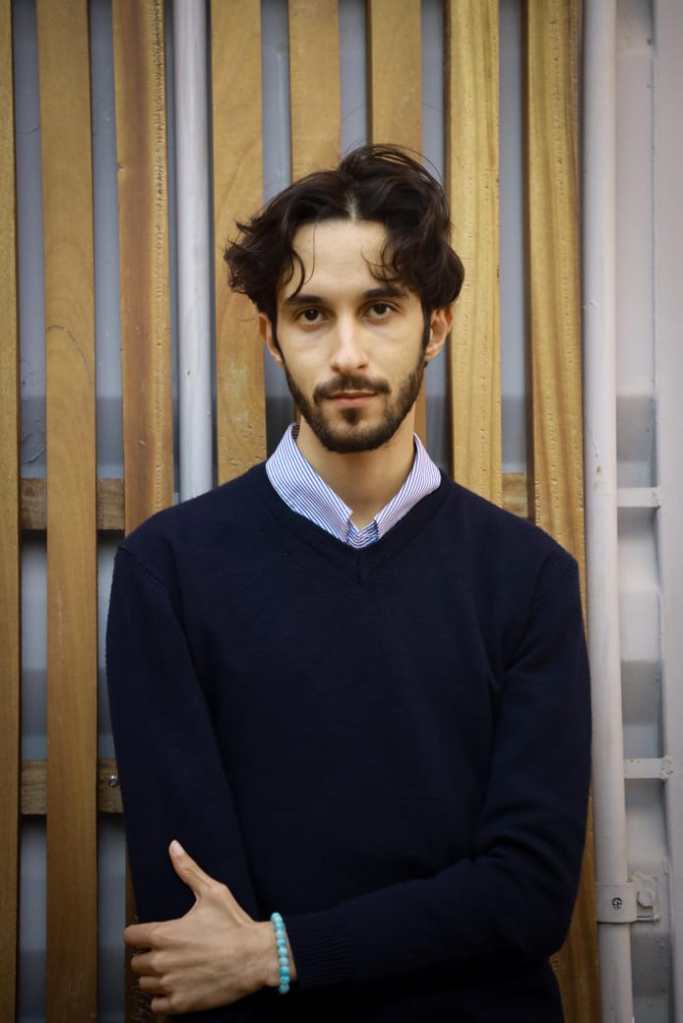
Houssine Dehbi is a PhD student at the Center for African Studies at Mohammed VI Polytechnic University. His research focuses on Anglophone African literatures, with a particular interest in African literary and cultural studies. He is also a published storyteller, with short stories appearing in literary magazines. He recently published a short novel, Lost Diaries of a Young Man, with the Moroccan independent publishing house La Croisée des Chemins. He is also the co-editor of a book titled Reading African Societies: Texts, Gestures, Techniques.
Originally published on Hopscotch Translation
Tuesday, October 13, 2026


