
The Hour Between Languages: On Daniel Hahn’s If This Be Magic
by Elton Uliana
Translation, Hahn suggests, is not the movement of isolated words but of the larger constellations of meaning, memory, and form.
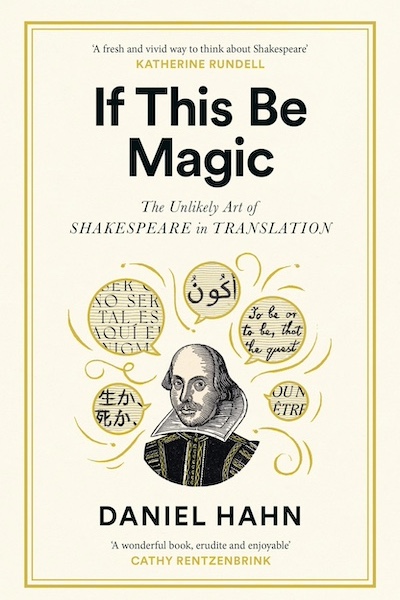
Daniel Hahn, If This Be Magic: The Unlikely Art of Shakespeare in Translation. Canongate, 2026. 406 pp. ISBN 978-1-80530-162-2. £25.
“Words, English words, are full of echoes, of memories, of associations — naturally.”
Virginia Woolf, “Craftsmanship” (1937)
I am not entirely persuaded by the idea that words belong neatly to specific languages. Or rather, I am not persuaded by it until I ask Google Translate what to do with the Portuguese word madrugada, at which point my confidence begins to falter. Depending on the day, the machine seems unable to decide whether it is dealing with night, dawn, early morning, or some strange compromise between all three; the word itself seems to have wandered into a border dispute, awaiting a ruling from whatever linguistic authority is charged with deciding where such things are properly allowed to reside. One almost sympathises. Madrugada, after all, occupies an awkward territory for translators. It is neither fully the end of one thing nor entirely the beginning of another; it belongs to bakers and birds, insomniacs and nurses changing shifts, airport terminals, long-distance coaches, and those rare conversations that continue long after they should have ended. The fact that English lacks a single word for it is perhaps less interesting than the fact that we continue to search for one.
Daniel Hahn’s delightfully provocative If This Be Magic: The Unlikely Art of Shakespeare in Translation (Canongate: Edinburgh, 2026) begins from much the same scepticism towards settled explanations. Hahn has little patience for the much-rehearsed tale of untranslatable words, those linguistic curiosities that periodically circulate online as evidence that other languages have somehow cornered emotional territories inaccessible to the rest of us. Nor does he have much time for the opposite belief, according to which all linguistic difficulties eventually yield to sufficient ingenuity, technology, or theoretical confidence. Instead, Hahn seems drawn to the places where languages overlap without quite coinciding, where meanings approach one another, brush against one another, occasionally illuminate one another, or briefly stand in for one another, yet refuse the stable equivalence that translators, dictionaries, and machines are sometimes tempted to promise.
At one point, he recounts the story of a transatlantic cruise ship whose canine exercise area contained both a lamp post and a fire hydrant, allowing British and American dogs alike to feel comfortably at home. This, Hahn tells us, is what he calls equivalence. The example is funny precisely because it appears rather obvious. A dog, after all, is not especially interested in the object itself; what matters is the function. Yet one of the pleasures of the book is that almost every apparently simple example eventually unfolds into something much more complicated. The lamp post and the fire hydrant may serve roughly the same purpose, but Shakespeare’s language is not quite so accommodating. Words carry stories, rhythms, jokes, social register, dramatic tensions, and unexpected associations. A lamp post can become a fire hydrant with relatively little fuss; a line in Shakespeare is a different ball game altogether.
Portuguese occupies a curious position in Hahn’s book. It appears first through the familiar suspects, words such as saudade and madrugada, which have become minor celebrities in contemporary translation debates, periodically summoned whenever somebody wishes to demonstrate either the irreducible uniqueness of a language or, depending on one’s temperament, the heroic, if invisible, ingenuity of translators. Neither position has much appeal for Hahn. The first risks turning languages into museums of emotional rarities, as though Portuguese speakers spent their afternoons cultivating saudade while the Welsh devoted themselves exclusively to hiraeth; and the second occasionally resembles a particularly optimistic branch of civil engineering. If one side insists that certain words can never cross linguistic borders and the other that they always can, Hahn is generally more interested in what happens while they are trying, which is to say, in consequences rather than correspondences, even if these effects are notoriously difficult to measure.
This is perhaps why the questions Hahn pursues throughout the book prove so illuminating. What they bring into view, with considerable acuity, is that the problem is rarely technological alone. Long before machine translation arrived, languages had already developed their own ways of organising experience. Google did not invent ambiguity, nor did it create the asymmetries that trouble translators; it merely placed them on public display with unusual efficiency, before generative AI came along to confront much the same difficulties with rather more confidence. For Hahn, such difficulties ultimately return us to the very act of reading. If there is a recurring protagonist in the book, it is not Shakespeare himself but the attentive reader, the translator as somebody whose job begins by noticing things that most of us, moving at the ordinary speed of reading, are liable to miss.
What makes the examples that animate Hahn’s discussion so effective is that they do not remain at the level of lexical curiosity. The discussion of saudade, for instance, is not finally about whether English possesses an exact equivalent, a question that can quickly become as sterile as it is recurrent. It is about what happens when words accumulate literary histories. Longing is not unique to Portuguese speakers, any more than grief, desire, nostalgia, or regret belong exclusively to particular nations. Yet words travel through novels, poems, songs, migrations, empires, and centuries of usages, gathering associations that cannot be easily packed into a suitcase and transported elsewhere. Translation, Hahn suggests, is not the movement of isolated words but of the larger constellations of meaning, memory, and form. Words, of course, rarely travel alone. They arrive accompanied by historical accidents, political arguments, literary ghosts, forgotten jokes, and the occasional misunderstanding, which is perhaps why translators often find themselves carrying far more luggage than they had originally packed. Much of their time involves negotiating borders that literature itself crossed long ago, the irony being that writing has always smuggled itself through frontiers more easily than the institutions built to police them.
For me, Hahn’s discussion acquires a particular resonance when he turns to Shakespeare in Portuguese, where the linguistic territory is rather closer to home. We are no longer asking what a word means, but what a play actually does. These are not always the same question, despite the best efforts of generations of literary critics to persuade us otherwise. In the book, Barbara Heliodora, Lawrence Flores Pereira and José Francisco Botelho arrive as readers making different wagers about what matters most, and not so much as rival claimants to Shakespearean absolute truth. Rhythm, meter, theatricality, syntactical and grammatical friction, typography, musicality, performance: each translator distributes these kinds of textual tensions differently.
At this point the language of equivalence begins to feel oddly inadequate. One can see why the concept enjoyed such a long career, rather in the way one can understand why medieval maps insisted on placing sea monsters at the edge of the known world. It provides reassurance. It suggests that somewhere a stable correspondence lies waiting patiently to be discovered. The concept has proved remarkably difficult to retire, however, and there is some irony in its enjoying a new lease of life just as translation technologies become ever more accomplished at persuading us that one thing can be made to line up with another. Yet the examples collected by Hahn point in another direction. In his view, what survives translation is rarely identity. More often it is relation: formal echoes, stylistic affinities, rhythmic correspondences, and all those intriguing and necessarily imperfect symmetries through which one language manages to recognise itself in another without ever becoming it. If Shakespeare continues to exist in Portuguese it is not because meanings are capable of remaining untouched, but more powerfully, because translators continually reinvent the formal conditions under which those meanings become legible, audible, and dramatically alive.
We come away from the book with the suspicion that the real difficulty is not impossibility at all, but perhaps surplus of meaning. Translators do not fail to translate: if anything, they translate too much, carrying across not only meanings but literary and social histories accumulated around those meanings over centuries. What gets lost in translation, if anything does, is hardly the thing itself but the illusion that the thing was ever singular to begin with.
Which is perhaps why it becomes increasingly difficult, after Hahn, to speak of Shakespeare in the singular. Heliodora’s Shakespeare is not Botelho’s, and both differ from the Shakespeare that English audiences encounter today, itself hardly the Shakespeare they encountered in 1603. Translation, in this reading, is not something that happens to literature after the fact, a secondary procedure performed on a finished object. It is one of the places where literature remains unfinished, where the work continues to make and remake its claims on new readers, new stages, new languages that were never part of the original contract. The lamp post and the fire hydrant, it turns out, are not equivalent after all. They merely persuade different dogs that they are.

Elton Uliana is a writer, literary critic and translator. He is a Guest Lecturer in Translation Theory at University College London (UCL) and co-editor of UCL’s Brazilian Translation Club. His work has appeared in World Literature Today, The Massachusetts Review, Asymptote, West Branch, Routledge’s Art in Translation and the José Saramago Foundation’s Blimunda, as well as in the anthologies Daughters of Latin America (HarperCollins, 2023) and Contemporary Afro-Brazilian Short Fiction (UCL Press, 2024). In 2026, he and Amanda Sarasien were awarded The Massachusetts Review’s Jules Chametzky Translation Prize for their translation of José Luís Peixoto’s “The Woman Who Dreamed.”
Originally published on Hopscotch Translation
Tuesday, November 10, 2026


