
The Translator’s Visibility: On Lydia Davis
by Noah Rawlings
Something like a loose theory of translation congeals in her recent collections of non-fiction.
Lydia Davis is one of America’s most prominent translators—an ancillary reward for being among the most famous writers of fiction today. Her creative work, which spans a dozen short-story collections and a novel, is trumpeted by Jonathan Franzen, Ali Smith, George Saunders, Miranda July, and Tobi Haslett. It’s won her a Guggenheim (1997). It’s won her a MacArthur Fellowship (2003). It’s won her a Man Booker (2013).
She is the first translator whose name I noticed. Raised a monolingual American, I grew up reading foreign books heedless of the fact that an invisible intermediary hovered between the text at hand and the original. I knew Dostoevsky was from Russia, but it never really struck me that The Brothers Karamazov was originally written in … Russian. Ditto for Dazai, Kafka, García Márquez, and a French writer whose last name I pronounced “Came-Us.”
If on some murky level I registered the existence of a species called “translators,” who took unwieldy foreign tongues and twisted them into nice American English, I disregarded these creatures as I disregarded publishers, editors, and other such superfluities. The important thing was the Author. All else was accessory.
I have Lydia Davis to thank for puncturing my provinciality and misplaced purism. The jolt came not from her much-hailed translations but from Break It Down, her 1986 collection of short fiction in which translation plays no small role. Characters are translators. Characters translate. Translation is dramatized, and Davis makes it all look intriguing:
That spring she was translating a book because it was the only thing she could do …. She did a lot of hard work on the translation just to keep the pain away. [TL 51]
Many years ago, my husband and I were living in Paris and translating art books. [TB 88]
Well, revisiting some of these stories now, translation doesn’t come across as all that glorious. These sentences are sparse, bare, simple. Yet pathos and purpose hum beneath—drawing in, say, a dreamy would-be writer.
As I awaited the apparition of my subject matter, my voice, my process, I thought perhaps I might translate. Perhaps one day I could live with a lover in a grand European city, giving my countrymen the gift of foreign writing. Perhaps I might translate so as to stave off the bitter pangs of memory. Davis made the translator heroic, artistic, something toward which to aspire.
Translation seemed simple. There are words and phrases in one language, and you hunt for their equivalents in another. No problem.
Still, I’d had intimations that things weren’t so easy. I’d seen a professor shake his head in pity at befuddled undergrads, who would never understand the unbridgeable abyss that lay between their grubby paperbacks of Goethe’s Faust and his own, between the mangled English translation and the original German. I’d heard whispers, too, of an occult concept: untranslatability. The word bespoke cloudy regions beyond mortal reckoning.
I didn’t quite buy the untranslatability bit. And I still don’t completely, for reasons I’ll not inflict on you. But these misty matters did awaken practical reflections. One thought led to another, and I soon realized—bear with me—that translators might have differing approaches or varying styles. Translations of literature might be like interpretations of music. (Bach played by Glenn Gould vs. Bach played by Tatiana Nikolayeva.) One translator might strive to capture the spirit of the original. Another might make the original her own, imbuing it with non-native idioms and images. By now I’d also studied enough Latin and French to realize that the syntax and vocabulary of the source language might map less than neatly onto the target tongue, creating all kinds of compelling problems and potentials. Translation was a heady domain.
Snared, I studied Davis’s renditions of great French writers like Proust and Flaubert. I wrote a B.A. thesis on her fiction. When I graduated college, I started translations of my own, waking up at godless hours before work to shove obscure French poems into English. I began asking myself the questions every translator does. This word or that one? To rhyme or not to rhyme? Keep the meter or bastardize it? The questions have not stopped.
The questions never will. That doesn’t keep translators from leaving them unanswered and plunging ahead, putting practice before theory. Nor, for that matter, from endeavoring to answer them.
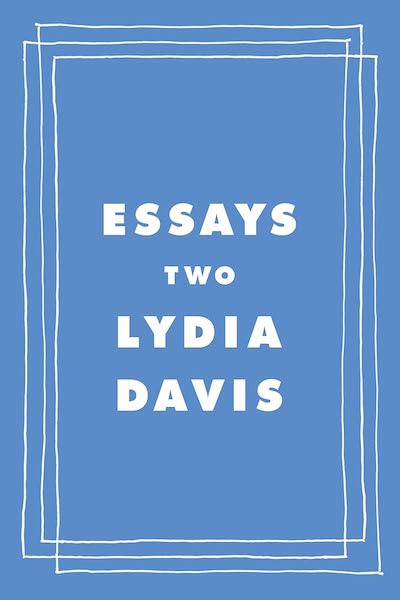
Some translators have felt compelled to address their methods at treatise length. Vladimir Nabokov devoted two volumes of commentary to his single-volume translation of Eugene Onegin. A more reader-friendly essay accompanied Paul Valéry’s version of Virgil’s Eclogues. Lydia Davis has never ventured such a systematic account of her approach, discussing it only briefly in interviews and introductions to her work. But something like a loose theory of translation congeals in her recent collections of non-fiction, Essays One (2019) and Essays Two (2021).
Nabokov presented the translator as fastidious scholar; Davis presents her as epicurean. Essays Two opens with a piece titled “Twenty-One Pleasures of Translating,” and in soothingly succinct terms Davis conveys these pleasures. They might be summarized as follows.
The pleasures of
-
-
- working with language
- solving a puzzle
- being able to work when tired
- company
- disappearing from oneself
- entering into another person
- entering into another culture or time
- importing another culture or time to your own
- acquiring greater perspective on your native culture and history
- becoming more knowledgeable about your own language
- adopting the style of other writers
- “doing it yourself”
- sharing your problems with others
- research
- studying a work more closely
- revision
- hearing from grateful readers
- detecting through the target language what the original might have been
- hearing the original language echoing in the background of the target language
- being comforted by the task
- reading a foreign text that you are not responsible for translating
-
Theories of translation tend to be explanations or justifications of how and why translators translate (or ought to). Davis at first seems to offer something different: an account of the experience of translating. She provides, in other words, not an Art of Translation analogous to Henry James’s or Milan Kundera’s The Art of the Novel but an explanation of what it feels like to translate. She is descriptive rather than prescriptive:
… in this activity you are entering another person—you are speaking in his or her words, you are writing what he or she wrote. You become a shadow person, for a time, insubstantial. In this, you are like an actor. It is restful. [TPT 10]
But if pleasure is predicated on approval—or at least on some consonance between the source of pleasure and the self—then even this inventory of joys implies theoretical views about what constitutes a good or bad translation.
Take pleasures #18 and #19, both of which bring us to contentious terrain. Here, as elsewhere, Davis makes known her fondness for translations that are “not quite natural” or that convey “an occasional strangeness”—the source of which is the grammar or phraseology of the original tongue. As an example, she cites a Georges Simenon novel whose English translator, Howard Curtis, offers clunkily literal English equivalents for French expressions. Avait souligné d’un coup d’œil is “had underlined with a glance.” À l’aide d’un couteau de bois is “with the help of a wooden knife” [JH / MJ]. (A more organic translation would simply be, “With a wooden knife.”) Davis doesn’t scoff at these Gallicisms; instead, she finds them appealing, finds that they convey some of the text’s original Frenchness to English readers.
But many a translator and theoretician would scoff at such phrases. The idea that the source should somehow inflect the target is frequently dismissed, for instance, by David Bellos, a translator of Georges Perec, Fred Vargas, and Romain Gary. Bellos sees such “foreignizing” as failure, the failure of the translator to bear in mind their reader’s likely inexperience with the source language. As he writes in Is That a Fish in Your Ear?, his 2011 book on translation,
Foreignizing translation styles bend English into shapes that mirror some limited aspect of the source language, such as word order or sentence structure. But they rely for their foreignizing effect on the reader’s prior knowledge of the approximate shape and sound of the foreign language. [FE 55]
In order for readers of translations to perceive foreignizing as such, Bellos argues, they need some basic familiarity with the syntax of Mandarin, Polish, Farsi, etc.—whatever the original is. If they lack such a base, foreignizing might seem like a “representation of the funny ways foreigners speak” [FE 59]. Or it may simply come across as bad, awkward, wrong: foreignizing is often, and accurately, seen as evidence of a translator’s insufficient knowledge of the source language.
Davis’s own translations have faced criticism for their foreignizing bent, which she sometimes equates with “stay[ing] close to the original” [TPT 21]. (“I just don’t think her French is very good,” an eminent translator once privately remarked of Davis to me.) The philosopher Alexander Nehamas, for instance, objected to the handling of certain French idioms in Davis’s translation of Proust. Take one example. Proust’s Du côté de chez Swann features a domestic servant from the provinces, Françoise, who expresses her employers’ enthusiasm for asparagus with the colloquial expression ils ne les mangeront pas avec le dos de la cuiller [RTP 59]. In French, not to do something with the back of the spoon (avec le dos de la cuiller) is to go about a task directly, uninhibitedly (in this case, eating). Davis translates the idiom quite literally, as “they won’t push it about with the backs of their spoons” [SW 60]. This particular rendition suits her general stance on foreignizing: instead of searching for a semantically similar colloquialism in English, such as “they won’t mess around” or “they’ll make no bones about it,” Davis sticks, almost word-for-word, to the French.
And here a legion of other translators recoil with Nehamas in indignation.
“The problem,” they would say, “is that the expression ‘with the back of the spoon’ doesn’t do much work in English. It’s not a colloquial phrase in the US. It lacks precedent. It lacks semantic weight.”
And here I come to Davis’s defense.
Idioms emerge from somewhere. Sometimes from the technical vocabulary of a profession or activity, like raccoon hunting (“barking up the wrong tree”) or aviation (“balls to the wall”—which is not in fact derived from bro culture). Sometimes from single works, like the New Testament (“wolf in sheep’s clothing”). Other times, the origin is common, or hazy, or only seems to be pinpointable. (Did Antonio Hardy coin the expression “played yourself” in the 1988 song “The Symphony,” or did he just lift it from colloquial speech?) Crucially, idioms can work regardless of whether one is aware of their origins. You need not know the nautical derivation of “by and large” to say that, by and large, you dislike this essay. If the idiom alone isn’t effective, context is.
I put this to the test. With science. I asked a dozen people—some friends, some family, some literary, some not—what they thought the expression “they won’t push it about with the backs of their spoons” might mean. Without any additional context, 5 were spot-on. 4 were close. 3 were wrong. (My dad was wrong on the first guess, closer on the second.)
If foreign idioms can in fact work despite their novelty to readers—as my experiment demonstrates—why propagate a de facto rule against them? Why can’t idioms come from—or be passed on by—a “foreignizing” translation? Foreign idioms might even enrich a language as much as those created by native speakers.
Of course, certain colloquialisms won’t come across as readily as the ones I’ve been talking about. But if a literal translation of a foreign phrase confuses a reader, she might look it up. She might then get excited by the parallel universe of sounds, words, and expressions that exist in another language. That excitement may flash and fade—or, it may persist. It’s precisely such moments that ignite the urge to learn a new language.
And yet: there’s a distinction between foreignizing turns of phrase and foreignizing syntax. The former is what Davis enacts in her translation of the spoon idiom. The latter more easily falls prey to a silly representation of foreignness itself, such as a translation of the Italian ho sonno as “I have sleep” instead of “I’m sleepy,” or of the Latin malum edo as “Apple I eat” instead of “I eat the apple.” The most radical case of such foreignizing I can think of is a hypothetical one: Michael Emmerich’s idea to maintain the vertical writing structure (tategaki) of Japanese in English translation, the merits of which I leave you to judge [WN].
What “foreignizing syntax” amounts to is an extremely literal approach to translation, one in which the translator does not fully inhabit either the source or the target language but, to quote Guy Davenport, “invent[s] a third that lies between, a treacherous nonexistent language suggested by the original and not recognized by the language into which the original is being transposed” [GI 34]. The translator begets a monstrosity, a warped stumbling tongue.
For Davis, this monstrosity has its merits. She is fond of translations that stick “very close to the original” and therefore generate “occasional strangeness,” a strangeness that “can become part of the style of the work in English and create quite a charming effect” [TPT 22, 459, 461].
Those who are not charmed by this effect have a derogatory name for it: translationese. Davis herself wields the term in Essays One to describe a recent translation of the Gospels known as “The Scholars Version”:
The Scholars Version has the ring of “translationese” to it, an effect partly of colliding dictions … and partly of “wooden-ear” choices …. There are, further, rhythmical deficiencies that make it far less generally euphonious than the King James Version, though it is undoubtedly more accurate ….
“Consider the lilies how they grow” sings to us more than “Think about how the lilies grow” …. [I]n the Scholars Version the balanced structures so precisely maintained in the King James Version are often either slightly lopsided—“they toil not, they spin not” becomes “they don’t slave and they never spin”—or abandoned altogether—“The life is more than meat, and the body is more than raiment” becomes “there is more to living than food and clothing.” [PA]
This all sounds like criticism. But it’s really the prelude to praise:
Oddly, the unlyrical style of the Scholars Version—the constant jolts, the rockiness—has a tonic effect: it keeps me awake, or keeps the text awake, it refreshes it, allows me to hear it. [PA]
In other words, this translation makes the most familiar of Western texts new, odd, alive—through its emphatic literalism, through its translationese. If time has domesticated the Bible, made its phraseology over-familiar and dulled its euphony, then retranslating it into bland contemporary speech has, paradoxically, reintroduced foreignness.
We must travel to approach it.
This, then, is the task of the translator for Davis: to impart, or at least to maintain, cultural and linguistic and historical distance. To alienate.
In this regard, Davis’s ideal translation is much like Davis’s ideal piece of literature, which she has characterized as writing that “throw[s] our attention onto the work as artifact, or the work as process, rather than the work as conveyor of meaning” [FU 222]. Hers is not an aesthetics of perfection or purity. What Davis finds faulty in seamless translations she also finds faulty in impeccably crafted works of literature, such as Anna Karenina or Madame Bovary: “I lose sight of the text as artifact, the text becomes invisible, and I lose sight of myself” [FU 222-223].
For Davis, this is lamentable. She craves the opposite experience. If familiarity and perfection can deaden what was once vibrant, can disarm what was once forceful, then art’s aim should be to defamiliarize, to rejuvenate our senses by first shocking or confounding them. As Anaïs Nin enjoined in The Novel of the Future, “The writer shakes up the familiar. What we are familiar with we cease to see” [NF 25]. This is also Davis’s aim.
In her fiction, Davis has shaken us up through an aesthetics of fragmentation and interruption. She has confined herself, for most of her career, to bits of flash fiction that are no sooner begun than finished. You sit down. You read a paragraph or two,
She stands over a fish, thinking about certain irrevocable mistakes she has made today. Now the fish has been cooked, and she is alone with it. The fish is for her—there is no one else in the house. But she has had a troubling day. How can she eat this fish, cooling on a slab of marble? And yet the fish, too, motionless as it is, and dismantled from its bones, and fleeced of its silver skin, has never been so completely alone as it is now: violated in a final manner and regarded with a weary eye by this woman who has made the latest mistake of her day and done this to it. [TF 40]
and the story is over. You look up, ejected back into the material world—a room, a bus stop, a café—far earlier than other fiction has accustomed you to be. The literary illusion is never sustained; you are constantly torn from it.
Davis wants translation to accomplish a similar effect. She wants to leave exposed the non-native frame of the translated text—the beams of the original apparent in the strange idioms and stilted syntax of the English—the better to keep us alert to language and life, the better to keep our relationship to literature one of attention and inquiry. If this often leads, as she admits, to “rather awkward English,” it does something else, too: it makes the unheard audible, the invisible seen [HH 254].
Abbreviations Used & Works Cited
FE: David Bellos, Is That A Fish In Your Ear?, New York, FSG, 2011.
FU: Lydia Davis, “Fragmentary of Unfinished,” in Essays One, New York, FSG, 2019.
GI: Guy Davenport, The Geography of the Imagination, Boston, Nonpareil, 1997.
HH: Lydia Davis, “Hammers and Hoofbeats: Rhythms and Syntactical Patterns in Proust’s Swann’s Way (Proust Talk II),” Essays Two, New York, FSG, 2021.
JH: Georges Simenon, The Judge’s House, trans. Howard Curtis, New York, Penguin, 2016.
MJ: Georges Simenon, La Maison du juge, Versailles, Feryane, 2011.
NF: Anaïs Nin, The Novel of the Future, New York, MacMillan, 1968.
PA: Lydia Davis, “‘Paring Off the Amphibologisms’: Jesus Recovered by the Jesus Seminar,” Essays One.
RTP: Marcel Proust, A la recherche du temps perdu, 1, 3 vols., Paris, Gallimard, 1954.
SW: Marcel Proust, Swann’s Way, trans. Lydia Davis, New York, Viking, 2004.
TB: Lydia Davis, “The Bone,” in Break It Down, New York, FSG, 2008.
TF: Lydia Davis, “The Fish,” in Break It Down.
TL: Lydia Davis, “The Letter,” in Break It Down.
TPT: Lydia Davis, “Twenty-One Pleasures of Translating,” Essays Two.
WN: Kris Kosaka, “Wisely navigating the levels of translation,” in The Japan Times, Nov. 14, 2020.

Noah Rawlings is a writer and translator from North Carolina.
Originally published on Hopscotch Translation
Tuesday, August 27, 2024

 hopscotchtranslation.com