
Down the Rabbit Hole: Emily Hunsberger on her Debut Book-length Translation of Melanie Márquez Adams’s Wonderland
Emily Hunsberger interviewed by Michelle Mirabella
What does it mean that I’m translating it into English? And how can I do it in a way that doesn’t silence her act of resistance?
“Down, down, down. Would the fall never come to an end? ‘I wonder how many miles I’ve fallen by this time?’ she said aloud.”
– Alice’s Adventures in Wonderland (1865), Lewis Carroll, Chapter 1
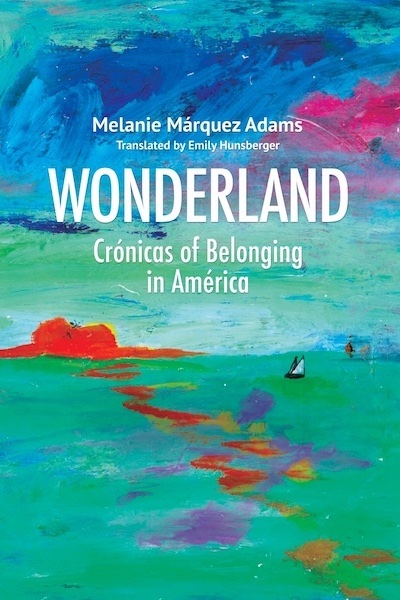
I wondered something of the same about my drive as I sped along the PA turnpike listening to Lewis Carroll’s Alice in Wonderland. En route to Philadelphia, I was using my drive to prepare for my conversation with translator and fellow Pennsylvanian Emily Hunsberger on her translation of Melanie Márquez Adams’s Wonderland: Crónicas of Belonging in América. Wonderland (Mouthfeel Press, 2025) is Hunsberger’s debut book-length translation, a collection of nonfiction works written and published in Spanish right here in the United States. For Hunsberger to make her book-length debut translating a US-based author writing in Spanish is no surprise, given her years of work championing the idea that the United States is a Spanish-speaking country. Below is an edited version of my oral interview with translator Emily Hunsberger.
Michelle Mirabella: It’s such a treat to find myself back in Philadelphia to discuss your debut book-length translation, Em, so let’s dive right in. Wonderland: Crónicas of Belonging in América by Melanie Márquez Adams is a book of crónicas. I wonder how you see the texts of this work embodying, or even breaking with, what we’ve come to understand as crónicas in the Latin American literary tradition.
Emily Hunsberger: It’s interesting because the definition of what a crónica is has morphed so much over the centuries and combines so many different influences, that it works especially well with this collection, because the texts don’t all fall into one single category. I think you could find specific crónicas in the book where you might say, this is creative nonfiction or a lyrical essay. I’m thinking of “The Ghost of the South,” where Melanie weaves together the history of Guayaquil and Nashville from her vantage point as an Ecuadorian immigrant living in the South. There are other texts that are more autobiographical, but it’s still a narrative Yo or a narrative I, not Melanie herself. Other texts are more experimental in terms of their form and the way they play with our concept of nonfiction. And I should point out that Melanie used “Crónicas de una latinoamericana en USA” as a subtitle for Querencia, which is one of the collections of crónicas that she published in the US in Spanish, with Katakana. For the subtitle of Wonderland, using the word “crónicas” in Spanish, instead of saying “chronicles” in English, was a way of claiming the freedom to defy genres and experiment. It also signals to the reader that this isn’t fiction, but it also keeps them guessing as to what kind of collection of texts this is.
MM: In your translator’s note you speak of how Melanie writing in Spanish while living in the United States is an act of resistance. Can you talk more about what that means, especially in today’s climate?
EH: For the Spanish-speaking community in the US, there’s so much pressure, indirectly and directly, explicit and implied, in many areas of life, to not speak Spanish. President Trump just signed an executive order declaring English as the official language in a country that’s never had an official language. So I could easily imagine folks pushing back and saying, no, I am going to do whatever I do in Spanish as an act of resistance. And it just so happens that because Melanie is a writer, this is her avenue for doing it.
As an individual, I know Melanie dislikes labels and being pigeonholed. But there is a broader current, or you could call it movement, of US-based writers that choose to write in Spanish, including authors who identify with the New Latino Boom. In a country with 40 million people who speak Spanish at home, it makes perfect sense that among them there would be writers who would want to create and publish in Spanish. There’s a whole ecosystem for literature written in Spanish in the United States, including literary magazines such as Spanglish Voces, El Beisman, and Suburbano, and presses such as Katakana and Mouthfeel. (Mouthfeel also published Melanie’s second book of short stories in Spanish called Anfibias.) I was introduced to that ecosystem when I met Melanie.
Also, when you go into a bookstore here, whether it’s an indie or a big bookstore chain, a lot of the titles you’re going to see in Spanish are in the self-help, spirituality, and children’s books sections, and a good chunk of the Spanish-language fiction often has been translated from English into Spanish. It’s rare to find books in Spanish by authors based in the United States who were either born here or have been making their life here for a number of decades, and they’re writing in Spanish and publishing their work here. This is homegrown literatura en español, and it’s literary work, not self-help. Not to disparage that genre, but it’s different.
I think this is something that the general publishing world has no box for. Their implied position is: we don’t know about that, we don’t care about it, and we’re not seeking it out. And I also think part of it is an attitude toward readers, too. Because, well, that’s what they think their market is, but do they truly know what Spanish-dominant or bilingual readers are interested in or could be interested in, if given the opportunity? It seems that the mainstream profile of the Spanish-speaking reader in the US is very narrow, given the range of books that are typically available. So I think all of that plays into this idea that writing in Spanish, when you are a bilingual author with the option to write in English, is an act of resistance, it’s a statement. It’s also a way for these writers to connect with Spanish-speaking readers in the US as well as the global Spanish-speaking audience.
At the same time, I’ve just translated one of Melanie’s works of resistance into English. But she’s very happy to have it translated into English, which is something I talk about in the translator’s note, too, wrestling with that apparent contradiction. What does it mean that I’m translating it into English? And how can I do it in a way that doesn’t silence her act of resistance?
MM: That’s what I want to talk about next. How did Melanie writing in Spanish as an act of resistance influence your translation process? And more specifically, how did you approach the decision of what to leave in Spanish in your English translation?
EH: When my translation was still in the early stages, I thought about this. I knew I wanted to keep some Spanish in the translation, especially because she has English in her original writing, which is a reflection of the multilingual and multicultural reality she is chronicling in these texts. But I didn’t do it automatically. I went about my normal route, where I’m translating entirely into English. So I actually had to go back to my draft and figure out some places where this idea I had in mind might work. And I didn’t have a systematic approach, per se, to keeping Spanish in the translated text. Later, I looked for the patterns in what I did, because it was pretty intuitive in the moment. I do think there was a sort of latent logic behind what I was doing. Some of it was to make the dialogue realistic; for example, I left some hesitation words in Spanish when someone bilingual was speaking English. In other places, I assumed the internal voice in the narrator’s head was likely in Spanish, even if they were describing an experience in an English-language context. So I felt like it would be emotionally impactful to leave an unsaid thought in Spanish. One particular crónica, “Interpreting the American Dream,” portrays interpreting in a healthcare setting. So I decided to leave the Spanish-speaking patient’s dialogue in Spanish. In plenty of other crónicas, the dialogue was happening in Spanish, but I’ve translated it all into English; in this particular case, the crónica is about the complexities of interpretation, so I wanted to reflect what the experience really is like. In some places, I did add a stealth gloss. For example, there is a phrase I translated as: “in the wee hours of the madrugada guayaquileña.” I added “wee hours” to gloss “madrugada.” I do want this book to be understandable for a reader that has zero knowledge of Spanish, but even if it isn’t, the reader is either going to look the Spanish words up or they’ll experience a moment where the language dynamics are flipped. And that has a decolonizing, destabilizing effect, which you could consider an act of resistance.
Beyond keeping some Spanish in my translation, I wondered if there was something else I could do that would be surprising or different for the reader. I started thinking about the space between brackets that’s normally reserved for a technical clarification or historical context. If you’re going to actually put an in-line note like that in the text, it feels very erudite or academic. But what if I use that space to show that I know exactly what she’s talking about on a personal level? Or even to just respond to the text itself? It ended up being a way to close the distance between author and translator, which I hoped would erode the assumption that this translation is based on a text imported from a faraway place. And I identified where to insert myself in this way into the text through a mix of intuition and intentionality. For example, there are a few places where a particular image or metaphor is very similar to one that appears in another text, and I used the space between brackets to acknowledge that connection. And that, in a way, closes the distance between the translator and the reader. I’m noticing things they might notice as well. We’re both readers of Melanie’s text.
MM: So in each crónica you made different decisions, because that’s how it was feeling to me. It was dependent on the voice or the style.
EH: Yes, that’s right. Some crónicas have more Spanish or text between brackets than others. I didn’t go back and try to evenly distribute these devices. Perhaps that felt too heavy-handed and less intuitive. And there were a couple texts that were previously published in literary magazines when, at that point in time, I hadn’t made these overt decisions about my approach to translating Melanie’s work. I decided to leave those crónicas mostly as they had been previously published.
MM: As I was moving through this text, I began to feel that you were pulling from concepts of transcreation, particularly with the brackets and the “Choose Your Own Crónica.” You’re not just translating the meaning. You’re inserting yourself. You’re recreating, reimagining the text with the translator explicitly present. You’ve already spoken about your use of brackets, can you share how and why you came to include the “Choose Your Own Crónica”?
EH: It’s like a monologue that I’ve turned into a dialogue. The “Choose Your Own Crónica” section, which includes two alternate translations, “Inventory of an isla en peso” and “Inventory of the Weight of an Island,” came about because I really liked what Melanie did in the original text, and it inspired me to experiment in my treatment of it. She took a very form-forward approach with the inventory concept, beginning each paragraph with numbers of things. Then she wove in fragments of “La isla en peso” by Cuban poet Virgilio Piñera. I also thought it was interesting because she’s Ecuadorian, but writing about Cuba, her connections to Cuba, desde cuando vivía en Ecuador to when she first came here and was living in Miami. I personally identified with this particular crónica because I grew up in South Florida, which is hugely influenced by Cuba and Cuban-Americans. She talks about news coverage of the Elián González case, and I have very vivid memories from when all that was happening. So it felt very close to me.
Where I decided to experiment with this text was with the fragments of Piñera’s poem. Do I look for an existing translation of the poem? Do I translate the fragments myself? Do I translate them based on their context in the poem, or do I slightly alter the translation based on how they’re fitting into Melanie’s text as I’ve translated it into English? Or do I just leave the slivers of the poem in Spanish and let the text breathe and code-switch naturally? This questioning is what ultimately led to me creating two alternate versions: one with Piñera’s words left untouched, and one with his words translated into English.
For the second version, I did look at Pablo Medina’s existing translation, and I used his translation of the poem’s final line, which appears in the last paragraph of Melanie’s crónica. But I tried to make sure that my own translations of the rest of the fragments worked in the context of the crónica and still made sense among the lines of the poem itself. Because that was part of what Melanie creatively accomplished, she was able to seamlessly graft bits of the poem into her original Spanish text. One challenge I remember was translating “el mar picando en sus espaldas.” I ended up going with: “the sea prodding them in their backs.” I didn’t know that one definition of picar is to prod, like you would a livestock animal. I really liked this because it was evocative of being pushed into migration, having to keep going without looking back. It worked in both contexts, and I was really happy to find that verb. So there was a lot of thought that went into what I was going to do with those little slivers of poetry.
After I had created both versions, I decided to take them to a virtual ALTA workshop. This was back in 2023. Annie Fisher was leading the workshop, and both she and the other participants encouraged me to include both versions in the manuscript. Annie had actually mocked up a paper model where you could lift the tabs containing the Spanish fragments of the poem to reveal the English translation underneath. So this group of my peers seemed really inspired by the coexistence of the alternate versions, which I wasn’t expecting. And even the people that didn’t speak Spanish said it still worked for them. This was one of my favorite texts in the book to translate, and I felt like I had been given a kind of permission to include both versions, based on the reaction of the folks in the ALTA workshop. So that’s what led to them both appearing in the manuscript, with an invitation to the reader to choose their own crónica, and thankfully Maria Maloney of Mouthfeel Press was on board with it.
MM: Let’s end in Wonderland. For your readers, can you speak to the intertextuality between this book and its namesake, Alice in Wonderland by Lewis Carroll?
EH: There is a lot I can say just based on the epigraph, which comes from Alice in Wonderland: “When I used to read fairy tales, I fancied that kind of thing never happened, and now here I am in the middle of one! There ought to be a book written about me, that there ought! And when I grow up, I’ll write one…” This epigraph first appeared (in Spanish translation) in another book of Melanie’s crónicas, whose title, El país de las maravillas: crónicas de mi sueño americano (published by the Instituto Digital César Chavez para el Español en Norteamérica), is derived from the Spanish title of Carroll’s book, Alicia en el país de las maravillas. When I consider these references to Alice in Wonderland, I see a metaphor for the immigrant experience: traveling through a rabbit hole and ending up in a whole new place that seems, at turns, familiar and foreign, exciting and disturbing, welcoming and treacherous. The place you find yourself is not as strange and inhospitable as another planet would be, but the rules of social interaction that you thought you understood are of little help when it comes to finding your way. You’re not sure who is your friend and who is out to get you. You’re not sure if everything around you is upside down, or if you’re the one standing on your hand. I think the epigraph is also Melanie’s way of saying that she’s channeling Alice’s urge to write about her adventures. From my own conversations with Melanie, I understand that writing helps her make sense of the journey she’s on; and for the rest of us, being able to read, whether in Spanish or English, about the exhilaration and alienation that are a part of Melanie’s immigrant narrative is a way of peering into the looking glass to view the United States from her perspective. This isn’t travel writing or an anthropological study; it’s the reflections of someone who has built a full, three-dimensional, multilingual life here. Someone who belongs here.
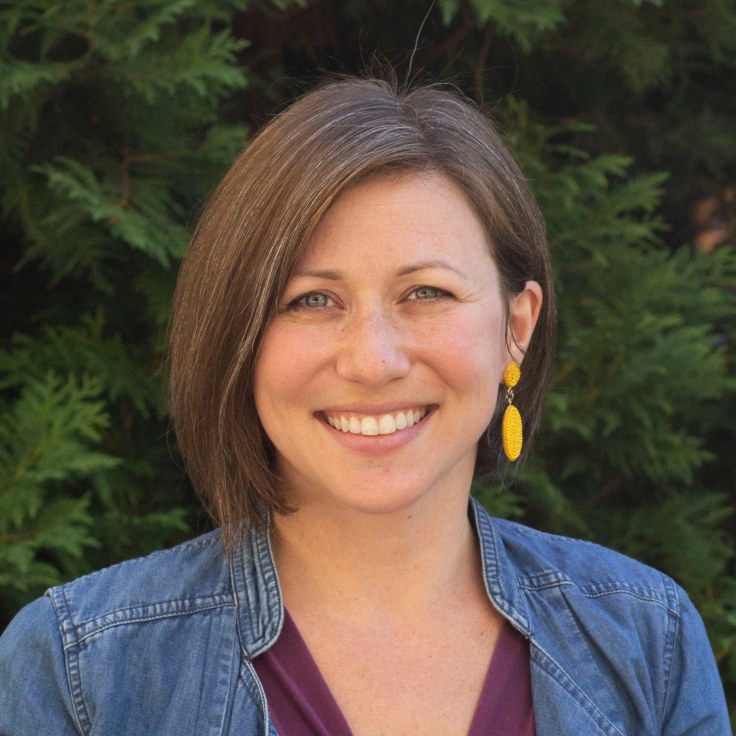
Emily Hunsberger translates literature written in Spanish by authors from all across the Americas, including the United States. Her translation of Wonderland: Crónicas of Belonging in América, a collection of essays by Melanie Márquez Adams, was recently published by Mouthfeel Press. Her translations of shorter works have appeared in Latin American Literature Today, The Southern Review, PRISM international, The Common, Southwest Review, and forthcoming in Grist. She lives with her family in Philadelphia. Find more of her work at emilyhunsberger.com.
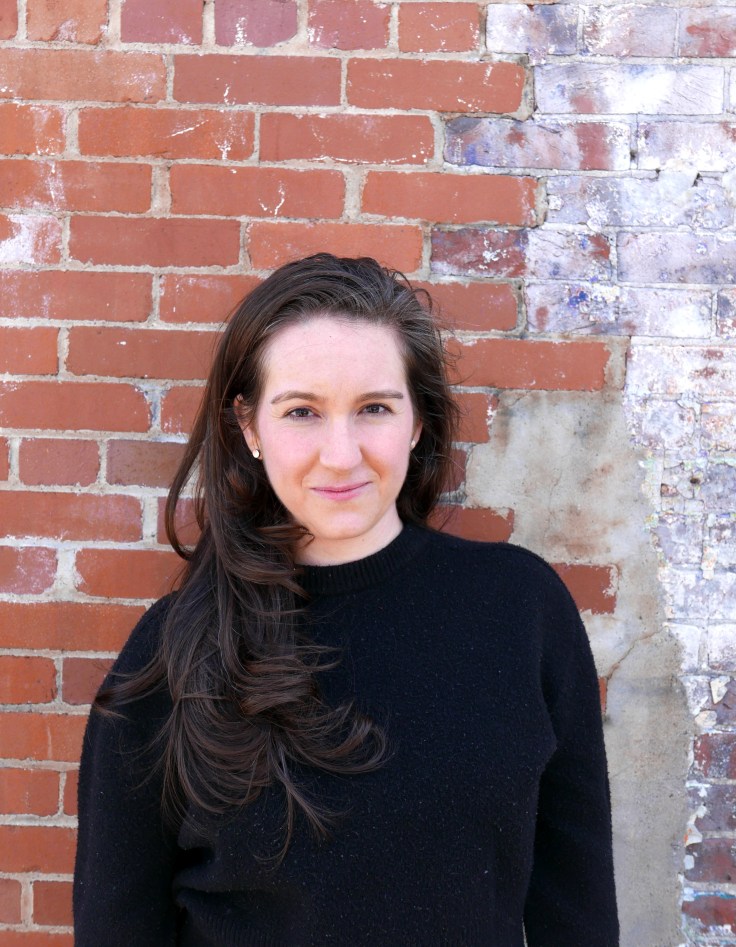
Michelle Mirabella is a Spanish-to-English literary translator. In addition to her translation of Catalina Infante’s debut novel, The Cracks We Bear (World Editions, 2025), her work appears in the anthologies Best Literary Translations (Deep Vellum, 2024) and Daughters of Latin America (HarperCollins, 2023), as well as in venues such as World Literature Today, Latin American Literature Today, and Southwest Review. Michelle holds an M.A. in Translation and Interpretation from the Middlebury Institute and is an alumna of the Banff International Literary Translation Centre and the Bread Loaf Translators’ Conference. Find more of her work at michellemirabella.com.
Originally published on Hopscotch Translation
Tuesday, June 24, 2025

 hopscotchtranslation.com